
Sarvam Epoch 2026
Sarvam’s first conference, in Bengaluru. Keynotes, launches, a demo hall and a technical session on continual learning. These are my notes from day one, the Builder Edition.
First of all, Sarvam’s design team rocked. It was simply India’s best AI conference. Period.
Then came the keynotes. They were a full display of everything Sarvam has been building, with demos that worked on stage. Sarvam also published a summary of everything announced, so the official numbers are included below.
Key highlights
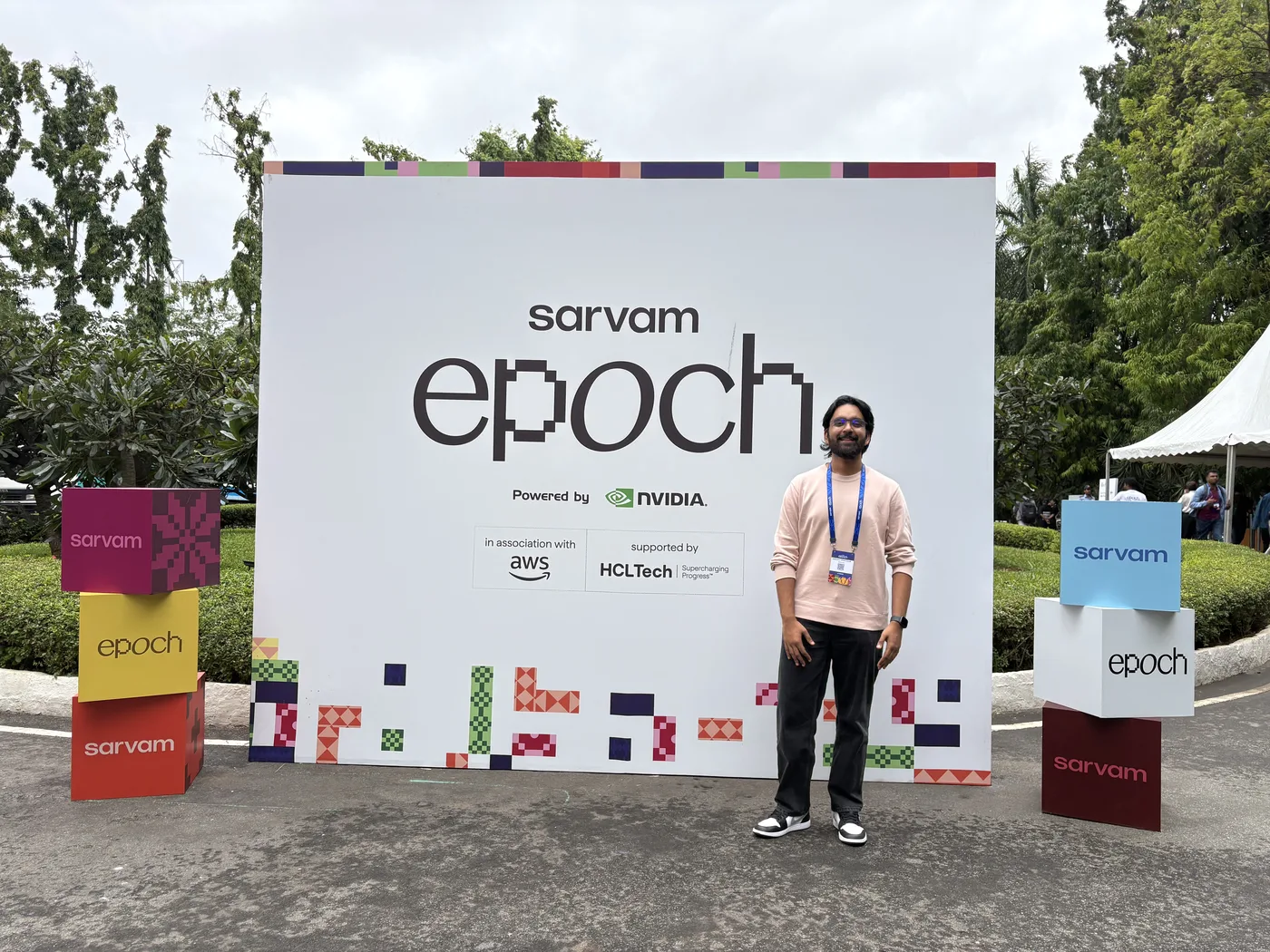 At the Sarvam Epoch banner, outside the venue
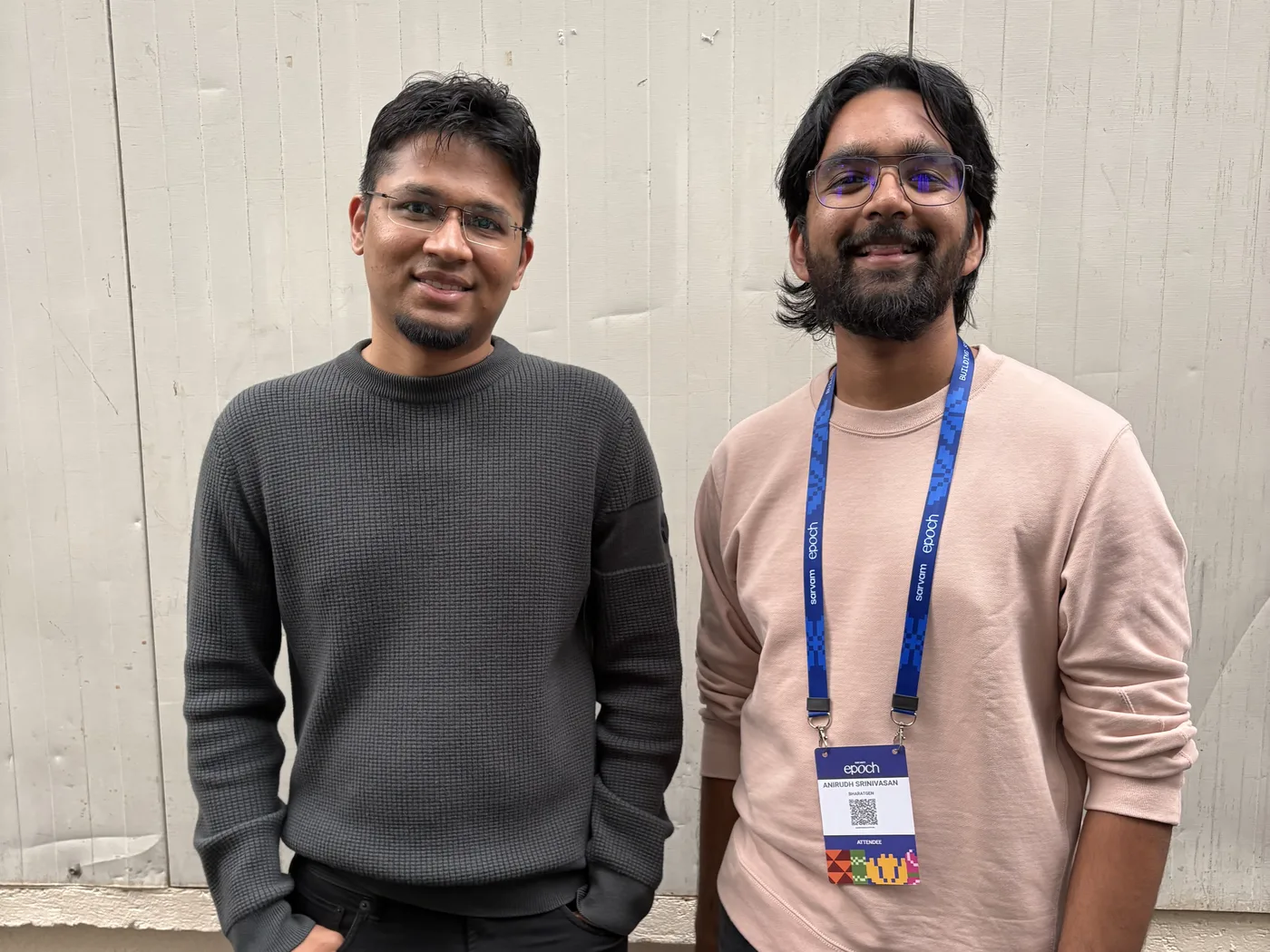
- The design. India’s best AI conference, from the stage and the opening animation to the website and the film.
- The launches. Sarvam 105B, Vision 2.0, Saaras V4, Bulbul V4, Sarvam Inference, Indus and Sarvam Code, each with the slides explained.
- The systems talks. Serving mixture-of-experts models on Blackwell with NVIDIA, and how AWS built the network under training.
- The panel on continual learning. Models and harnesses, evals, traces and weight updates, written up question by question.
- My conversation with Devendra Singh Chaplot. Scaling laws, how to choose which experiments to run, how VLMs scale, and whether to do a PhD. Thank you, Devendra, for giving me 15 minutes of one-on-one time!
- The non-trivial ideas, gathered in one place.
The day, hour by hour
Day one, 30 July, was the Builder Edition, for developers and researchers. The Enterprise Edition followed on 31 July, with leaders from banking, government and industry. This is the part of the Builder day agenda that I cover below.
Technical Session
Vivek Raghavan, Devendra Singh Chaplot, Manish Gupta, Aaditya Sood
On continual learning.
First, the design
Sarvam's design team rocked. It was simply India's best AI conference. Period. The effort that went into the design and the planning was amazing.
The website, and the film
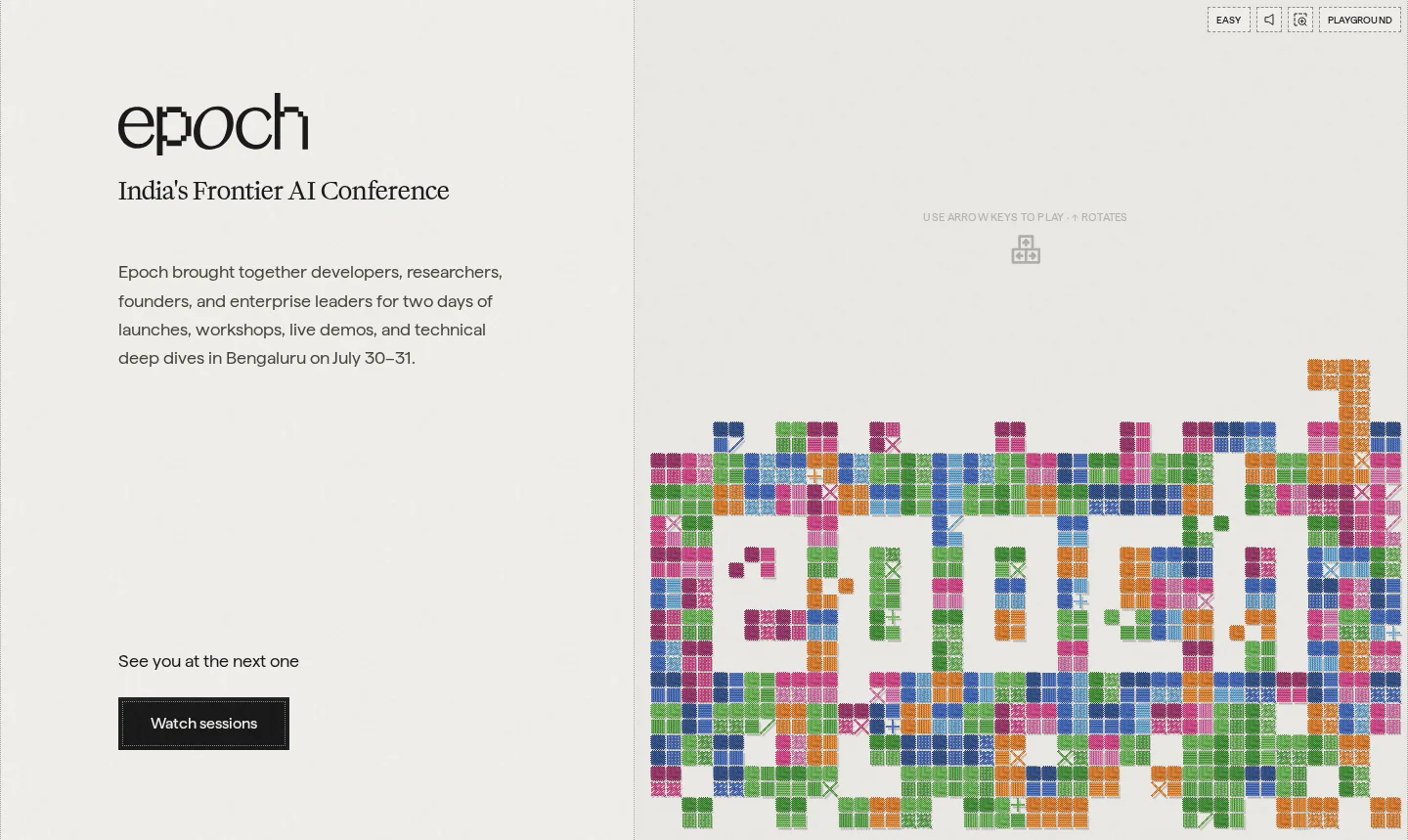
The design did not stop at the venue. Brilliant job by the design and marketing team on epoch.sarvam.dev too. The first thing you see is the same pixel-block “epoch” wordmark, built out of cross-stitched squares in blue, green, pink and orange. It is also a game. A note says to use the arrow keys, and up rotates. When I pressed them, pieces came down and stacked over the wordmark, and a counter in the corner began to count. There are switches for an easy mode, sound and a playground.
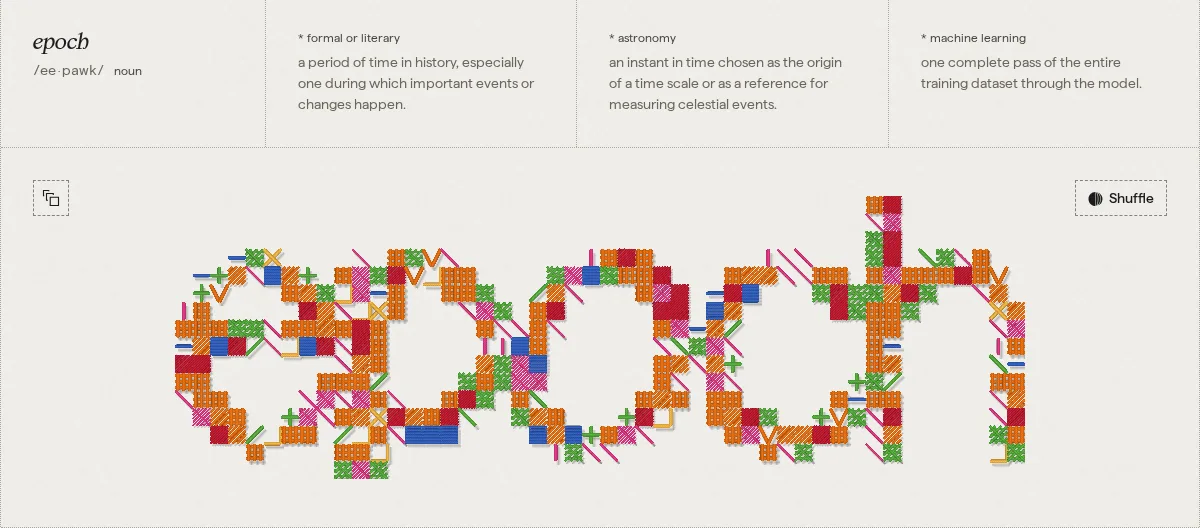
At the bottom of the page is my favourite touch. It is a dictionary entry for the word epoch, with three senses. One is formal and literary, a period of time in history. One is astronomy, an instant in time chosen as the origin of a time scale. The third is machine learning: one complete pass of the entire training dataset through the model. The name of the event is the three meanings at once. Under it sits the wordmark again, stitched in thread and flowers, with a button to shuffle it. The footer says it was “stitched with love by Sarvam”.
The video was also cool, and it had Indic design in it too. This is Sarvam’s own film of the event, Chapter 1.
The opening animation
Before the keynote began, the three screens played an animation. A stack of pixel blocks twisted into a ribbon of blue, red, orange and green, then spread into a rolling wave of coloured block rows. The wordmark stayed put on the white panels the whole time. It was simple, and it set the mood: everything on this stage was made of the same small square.
The song and dance
Then came the performance. A live song, with dancers in red and saffron in front of the screens. What made it work was what the screens did behind them.
- Circuits. Orange traces run together into one bright point, and from it blue filaments fan out like a neural network.
- Embroidery. The screen turns into cross-stitch flowers, wired together with circuit-board lines. A sunburst pulses in the middle of the pattern.
- Weave. A woven border of yellow triangles on red lines. Later, an arched doorway in carpet colours, and then diagonal bands of colour like a loom at full speed, with the truss pillars lit on either side.
Circuit board into embroidery, and neural network into weave. The message was clear without a single word: this technology is being built here, out of this culture, and it does not need to hide either one.
This is how I would want a sovereign AI company to be. Serious about the technology, proud of where it comes from, and careful enough about both to design every pixel. Hats off to the team.
The keynotes
The keynotes were a full display of what Sarvam has been building. This section goes through them one talk at a time and covers the technical content of each, with the slides that carried the numbers. Tap a section to open it. For the full list of announcements, Sarvam published a summary post, and the sessions are online at epoch.sarvam.dev. All numbers are Sarvam's own.
Everything on this page, in order. Tap one to jump to it
MissionThe opening keynote: build at the frontier
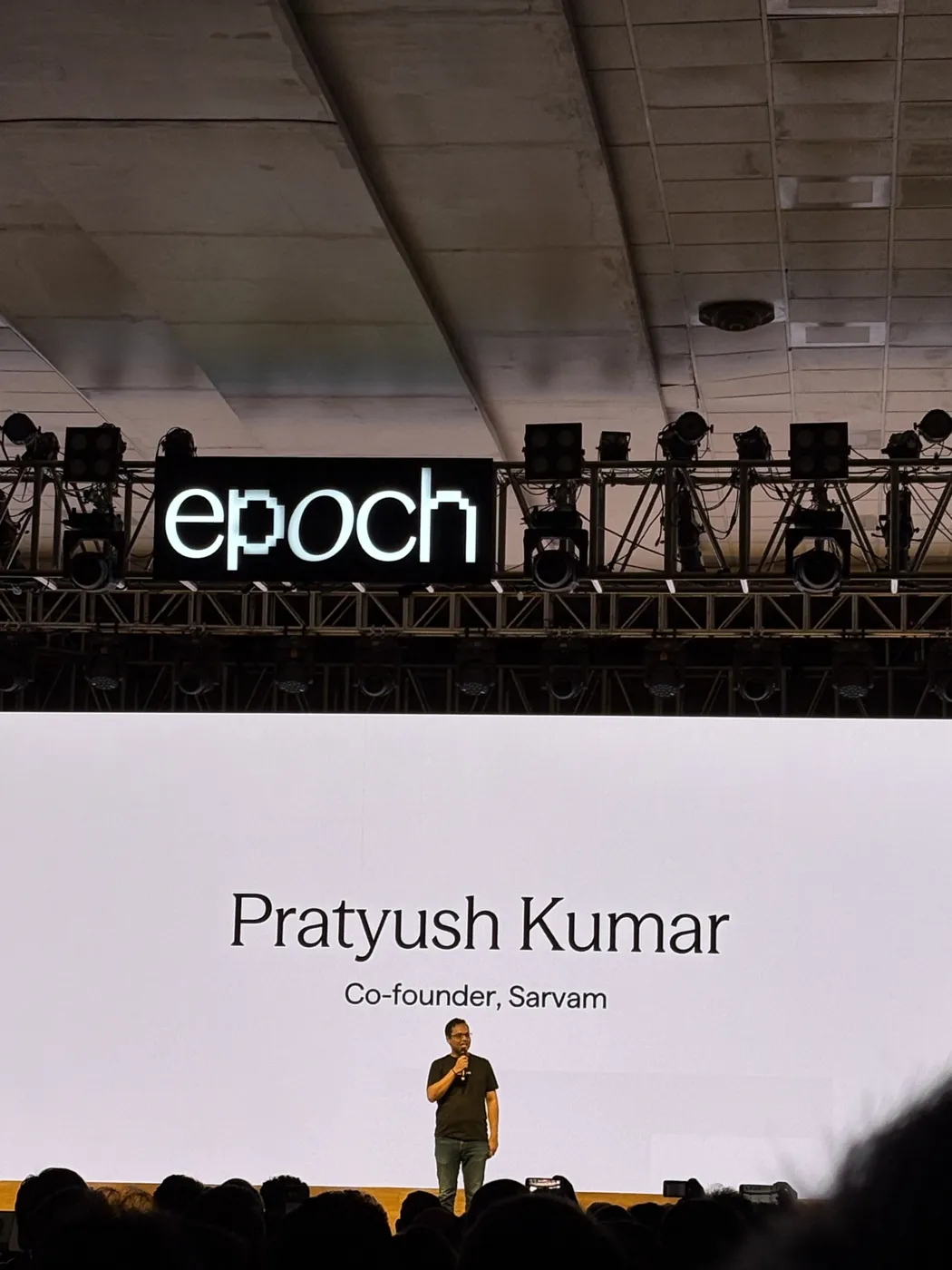
Pratyush Kumar, Co-founder, Sarvam
The opening keynote: build at the frontier
Pratyush Kumar, Co-founder, Sarvam
The opening keynote was by Pratyush Kumar, one of Sarvam's co-founders. He began with the name. An epoch, he said, is the moment in training when a model has seen the data once, and learning takes hold. This was the first ever Epoch, the first of a series where Sarvam’s ideas, products and partnerships come out into the open. Day one was for builders. The next day was for enterprise, government and policy leaders. He promised research, new models and a few products nobody expected, with booths and buildathons in the afternoon and the whole team in the room to talk. Then he got to the mission, and the mission was a nice one.
He called AI both financially lucrative and the pinnacle of human engineering and insight. That pinnacle moves faster than in earlier technology waves, which is why being at the very edge matters so much. For Sarvam, he said, it means building the frontier, defining it, sometimes keeping pace with it and sometimes pushing it further.
The first big slide said it in one line: build at the frontier, to create value for all, on the decade's clock, not quarters. Sarvam's own summary of the session calls these three commitments. Build at the frontier. Create value at population scale. Keep a decade-long horizon.
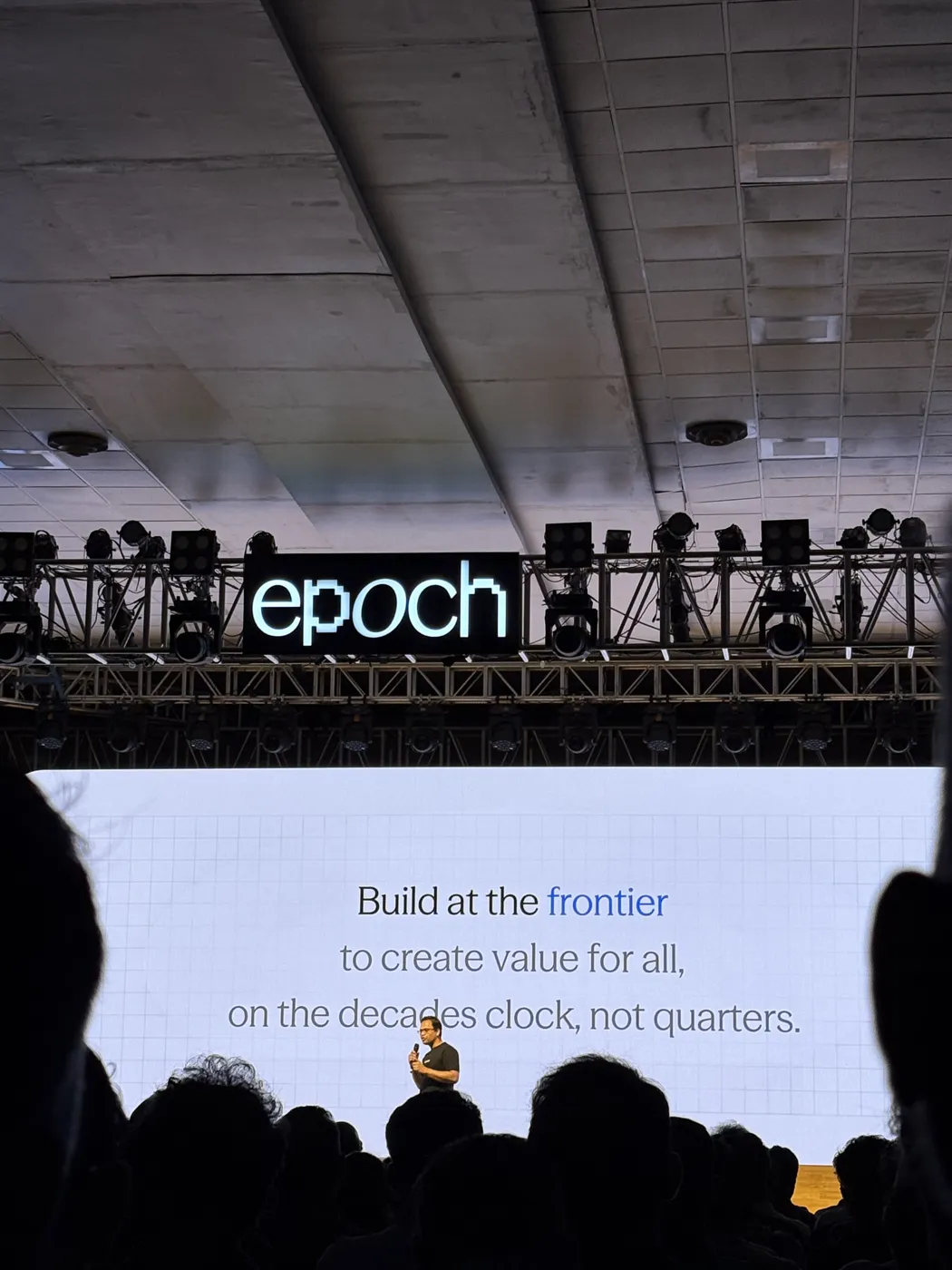 Build at the frontier, on the decade’s clock, not quarters
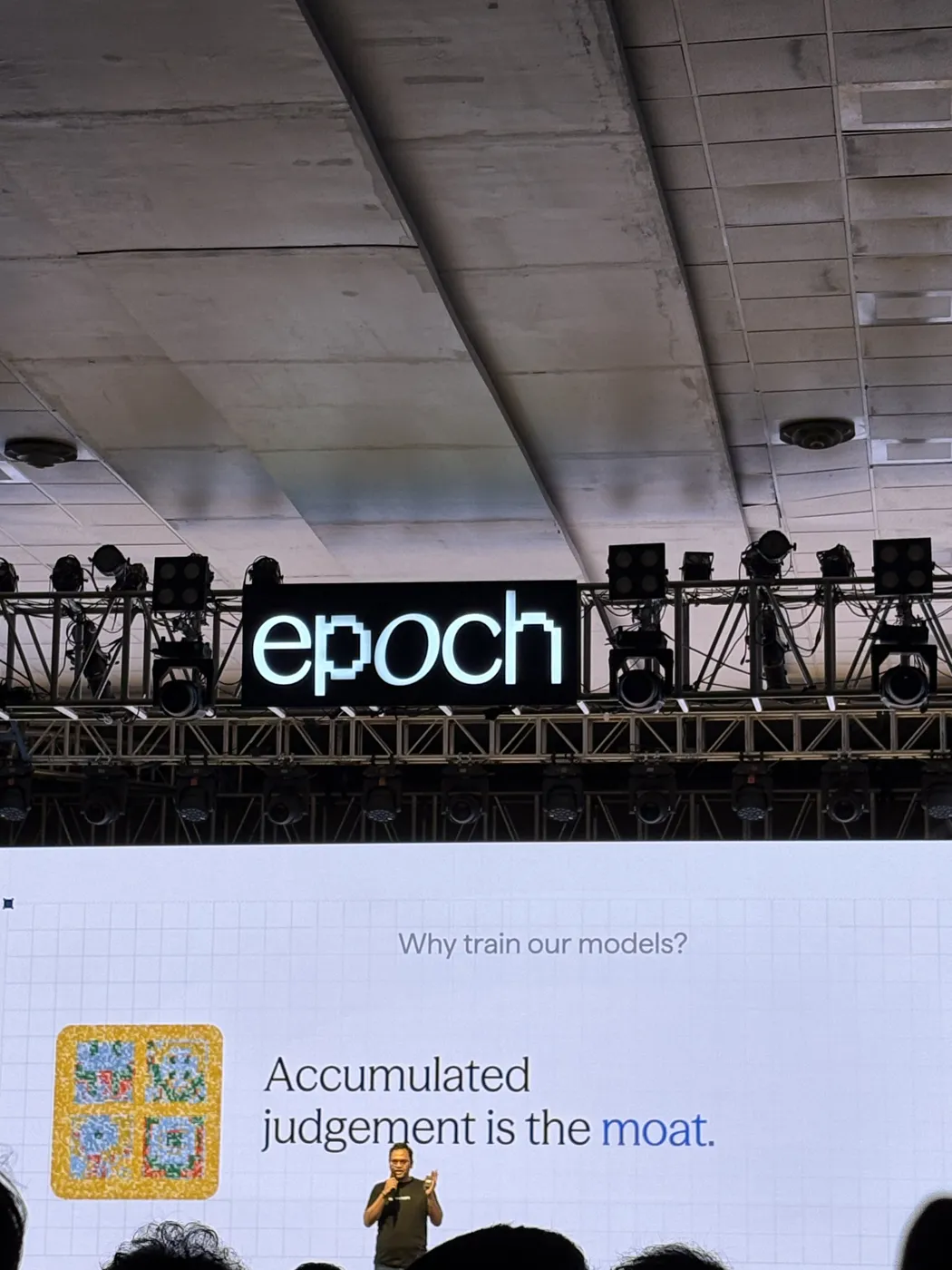 Why train our models? Accumulated judgement is the moat
The second commitment, creating value, he separated from “token maxing”. He pointed to the studies asking where AI’s return on investment is. India has seen digital public infrastructure work at population scale, and he wants the same for AI. Value means solving real problems with real outcomes for enterprises, governments and citizens, and the word all is in the name Sarvam. On the third, he said we are in year four of the post-ChatGPT world, “the second over of a Test match”, so the horizon has to be decades, not quarters. The field is noisy, with a new thread or point of view every day, so the engineering has to stay at the frontier while the mission runs much longer. We are never going back to a world before LLMs, he said, and India’s opportunity in AI is now.
Then came the question every Indian AI company gets: why train your own models at all? Some voices in the country say a strong open model, like Kimi K3 from Moonshot, is all we need. Pratyush called that absolutely the wrong conclusion. Use the best models out there, closed and open, but also make your own bets. The slide gave the reason in four words. Accumulated judgement is the moat. Many call it taste. A team that trains models learns what good data is, how to work with GPUs at scale, and how to make a model useful in a product.
Non-trivial. The moat he named is not the application and not the user base. It is the judgement a team builds by training models over several years. The proof was Sarvam’s own path: contributing to Llama 3 and learning to add language skills; pre-training a tiny 2B model on the first thousand Hopper GPUs in India with Infosys; building Sarvam M, a thinking model on top of Mistral’s small model, with RL, which he called the first thinking Mistral model; then pre-training a 100B+ model from scratch on 4,000 Hopper GPUs. Each step took on one more capability, so the judgement was built in layers.
There was a second argument, about access. Today there are excellent open models, and Sarvam uses them all the time. But a country cannot make its progress depend on fair access to a technology that many see as a huge differentiator. He joked that each quarter has its theme: token maxing, then complaints about expensive closed models, and maybe next a quarter of closed Chinese models.
Non-trivial. His case for training at home is not that open models are bad. It is that the grievance changes every quarter, so the only stable hedge is the ability to build your own.
The next slide showed how Sarvam sees the stack. Everything we build is built from the vantage of model research. The layers are infra, models, harness, data, and users and applications. Many companies build at one or two of these. A model builder sees all of them differently. Infra looks different after training on thousands of GPUs than it does to an inference provider. Data is something you understand deeply. He added that users will move toward custom models for specific applications, and a model builder can customise models for them.
Non-trivial. A harness looks different when you have trained the model. He said Sarvam understands where models need load-bearing components in the harness. My reading is that a company that only wraps someone else’s model has to guess.
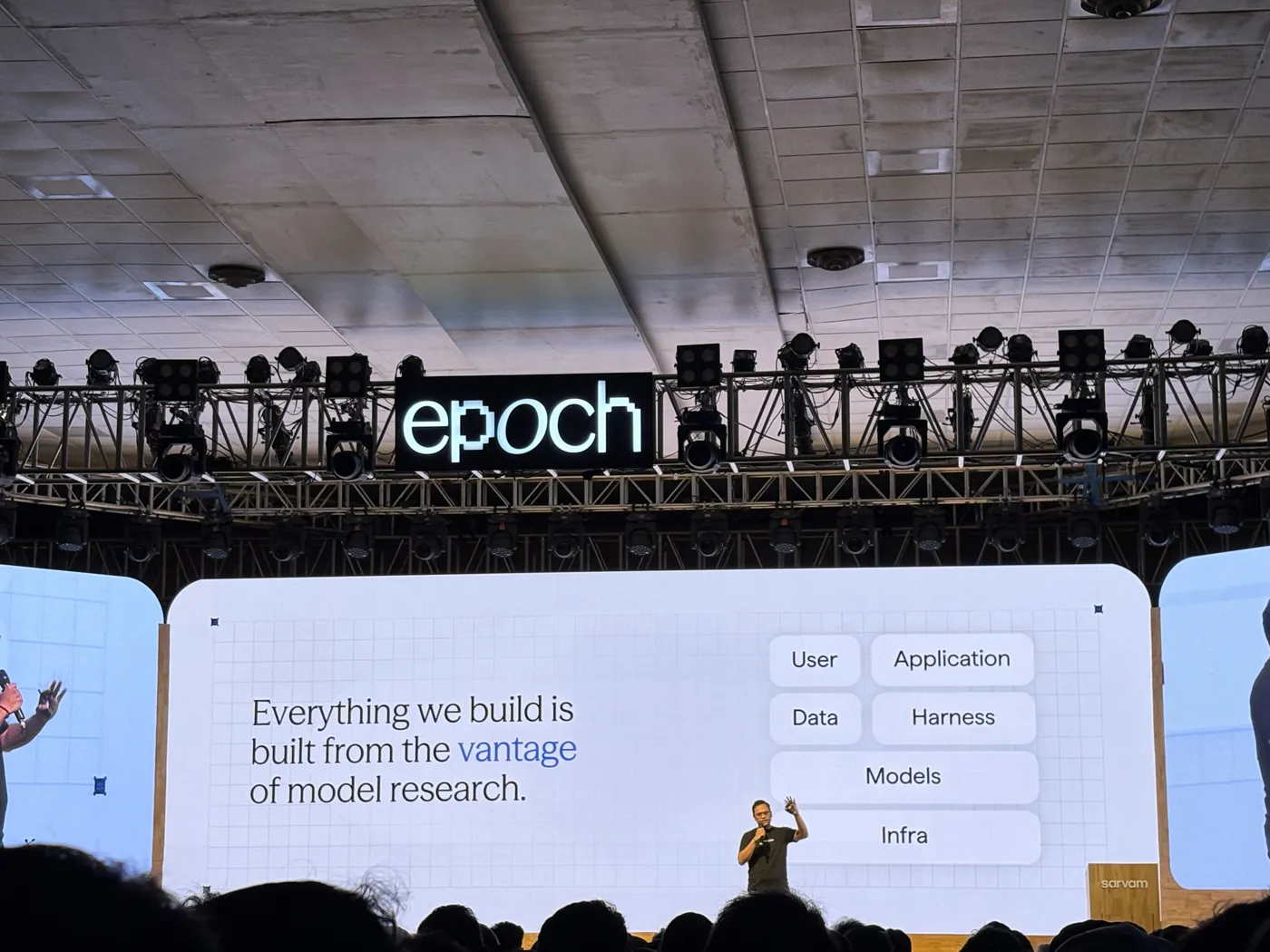 Everything is built from the vantage of model research: user, application, data, harness, models, infra
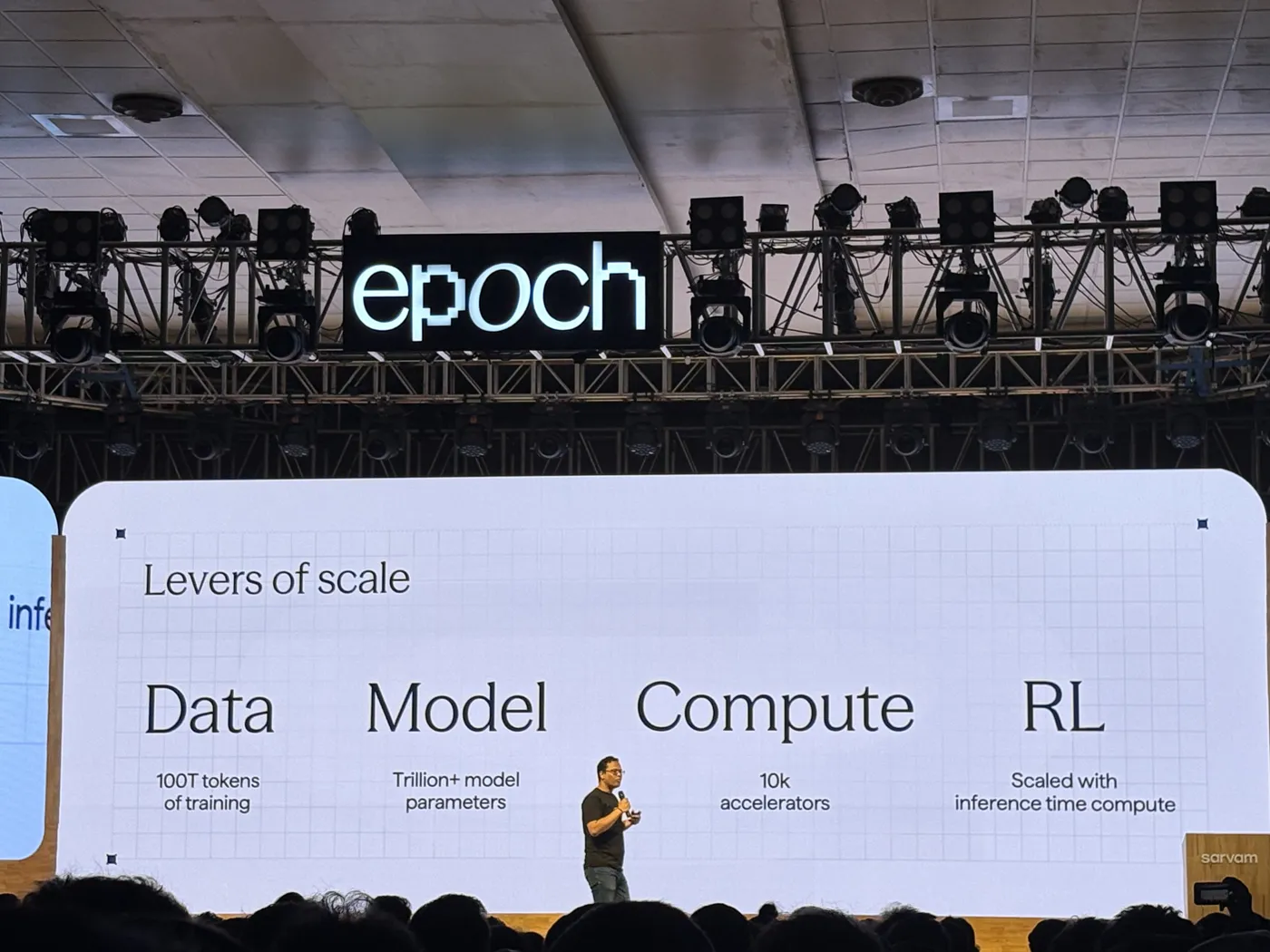 Levers of scale: 100T tokens, trillion-plus parameters, 10k accelerators, RL
Before the levers, he previewed what would be released. On text, Sarvam would release its best conversational models and very effective agentic models, post-trained on its own sovereign models, with what he called the most competitive conversational AI in India on price and benchmarks. On vision, the document models would get new benchmark results and global competitiveness across languages. On speech recognition, the models would be pushed further against international competition. On speech synthesis, Sarvam would release very human-like, expressive audio, which he said is better heard than described. Everything would be available to build on right away.
The levers-of-scale slide named four things to push on, and Pratyush gave the numbers for each.
- Data. From tens of trillions of tokens to almost hundreds of trillions. The numbers sound abstract, he said, but the scale is not: it takes an enormous amount of content and engineering effort.
- Models. An investment in trillion-plus parameter models, built from scratch in India, for coding, cybersecurity, simulation and science.
- Compute. Access today to the largest Blackwell cluster in India, run by Sarvam from bare metal, and scaling up to about 10,000 accelerators. Running compute reliably in India, he argued, is a condition for the first two levers.
- RL. The algorithm that keeps paying off as models train for longer, including continual learning on specific tasks.
He did not give the size of today’s cluster on stage. The 10,000 figure came back in the fireside that followed.
One slide turned the research story into a service. Making infra and know-how available to enterprises to hill-climb on their specific tasks. The picture is the loop from the RL environments talk at the PyTorch meetup: an agent acts, an environment responds, reward pipelines score the result, and that data trains the agent again. Sarvam wants to run this loop for companies. There is more on that loop in Talk 3 of the meetup page.
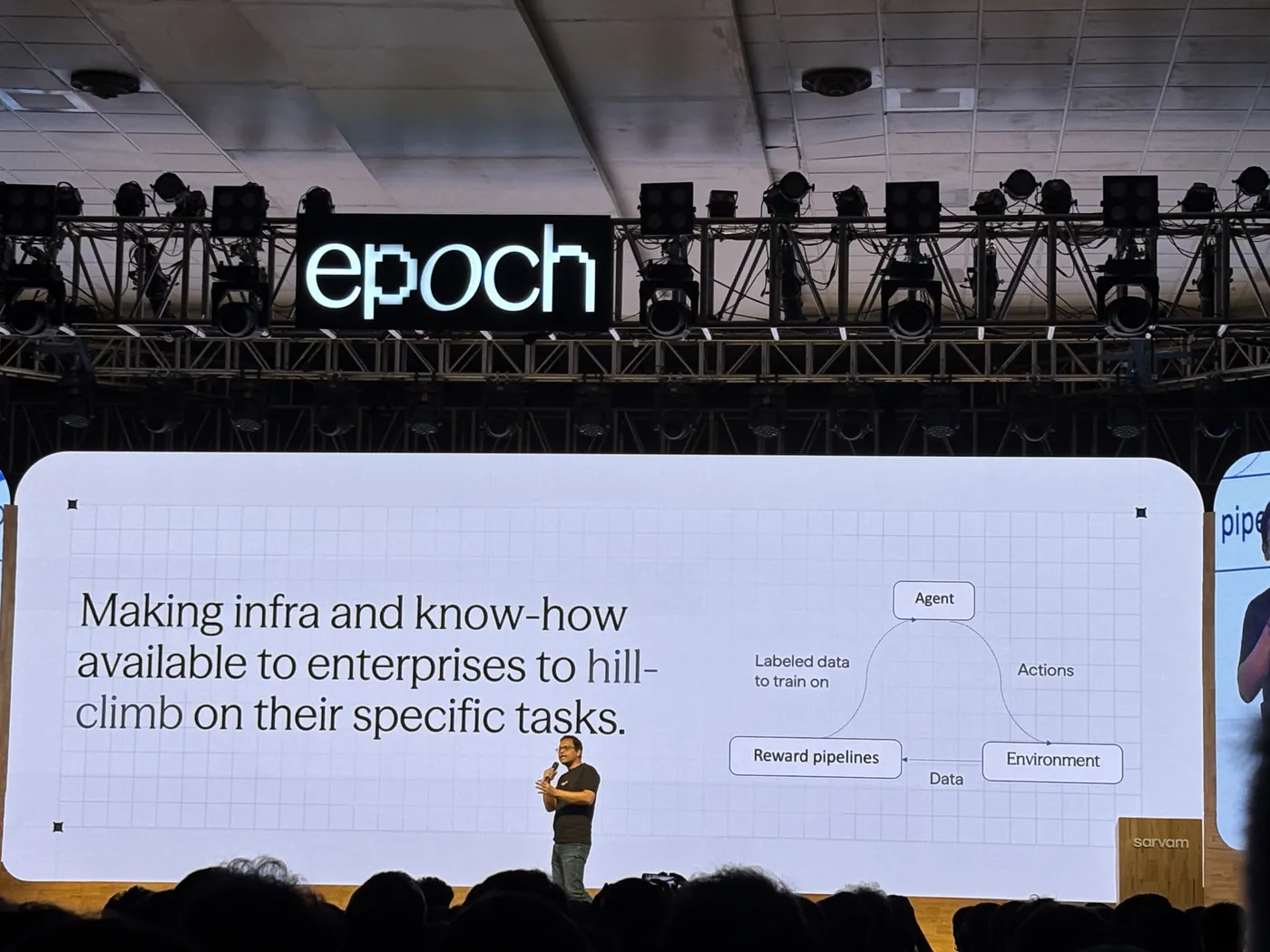 Infra and know-how for enterprises to hill-climb: agent, environment, reward pipelines
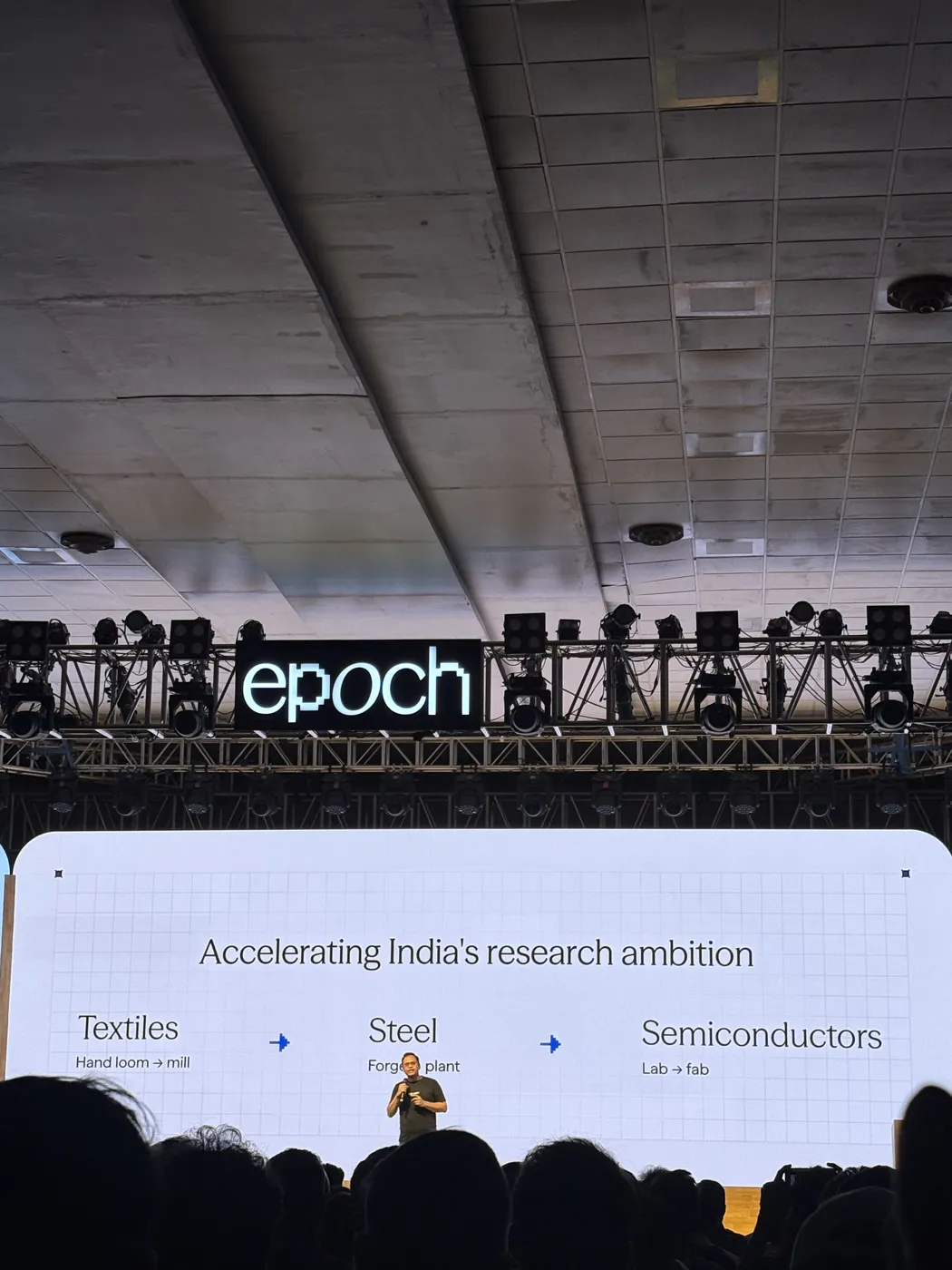 Textiles, steel, semiconductors, and now tokens
One slide I liked for the framing. Accelerating India's research ambition. Technology waves, Pratyush said, are won by building the systems that manufacture what people need: textiles, steel, and in the late 1980s semiconductors. In this era the core component is the token. Today most of the tokens Indians use are produced outside the country, some by international vendors and some by Indian ones.
Non-trivial. The framing is manufacturing, not software. Sovereignty over how you manufacture intelligence is the point, and the measurable goal is the largest share of the tokens India consumes, produced in India.
Where the research is going
He also listed five research problems Sarvam is committing to.
- Dense models for the edge. Memory is getting expensive, and mixture-of-experts models are great in the cloud but hard to fit on a local machine.
- Live interactive systems. Low-latency, high-fidelity, multimodal experiences, built on what running the country’s largest voice platform has taught the team. It is not only a harness problem. It is the model and the systems engineering too.
- Cyber systems. Few companies in the room have not worried about cybersecurity in the last month, he said, and Sarvam is no exception. The team built tools because of it, with results shown later in the day.
- Systems for real operations. Work with the strategic sector, including digital twins that simulate large systems and then operate them.
- Foundation models for customer data. India has enormous digital public goods and finance data. He said the market keeps asking for models built on this data, and that it needs real innovation.
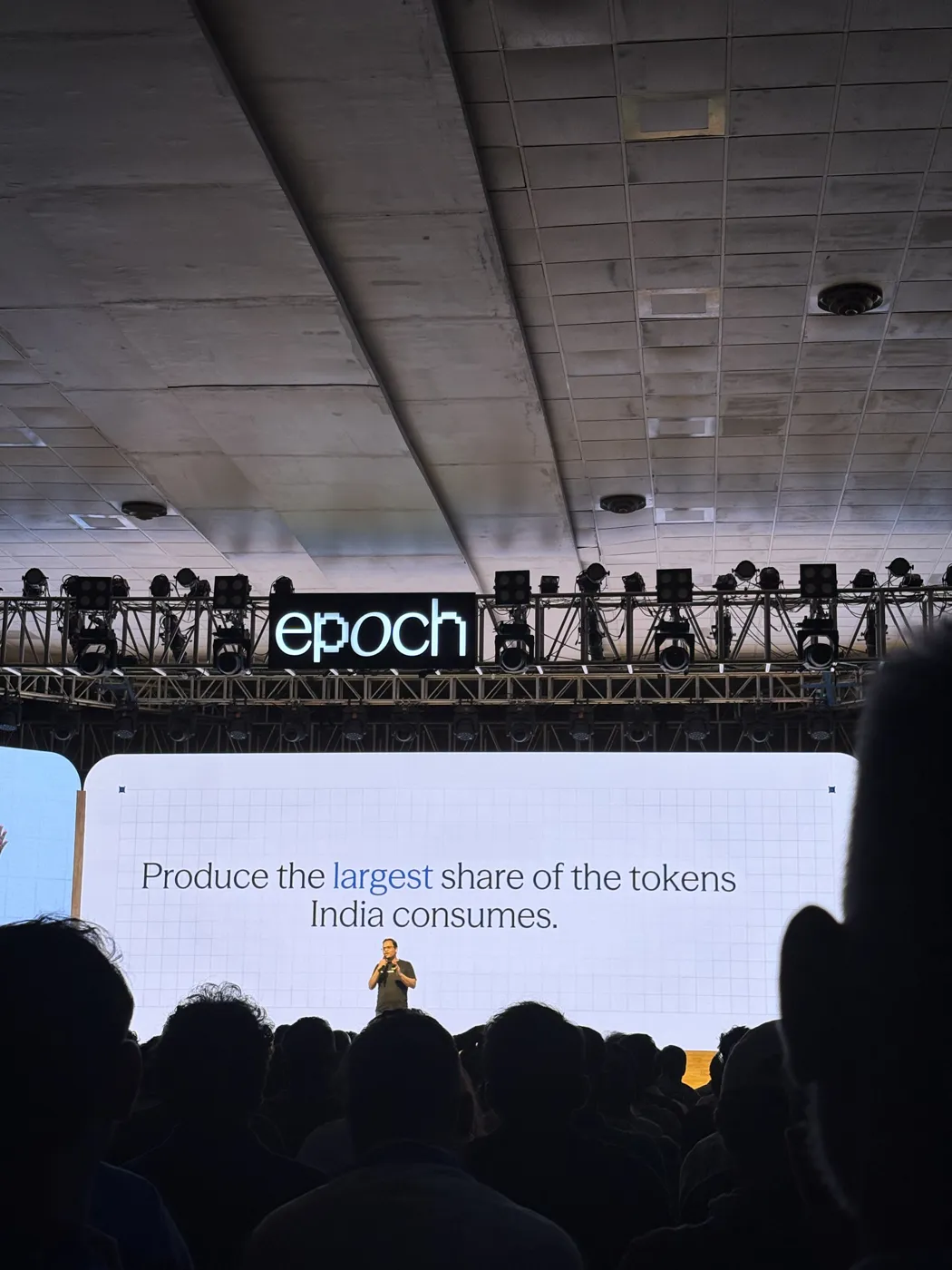
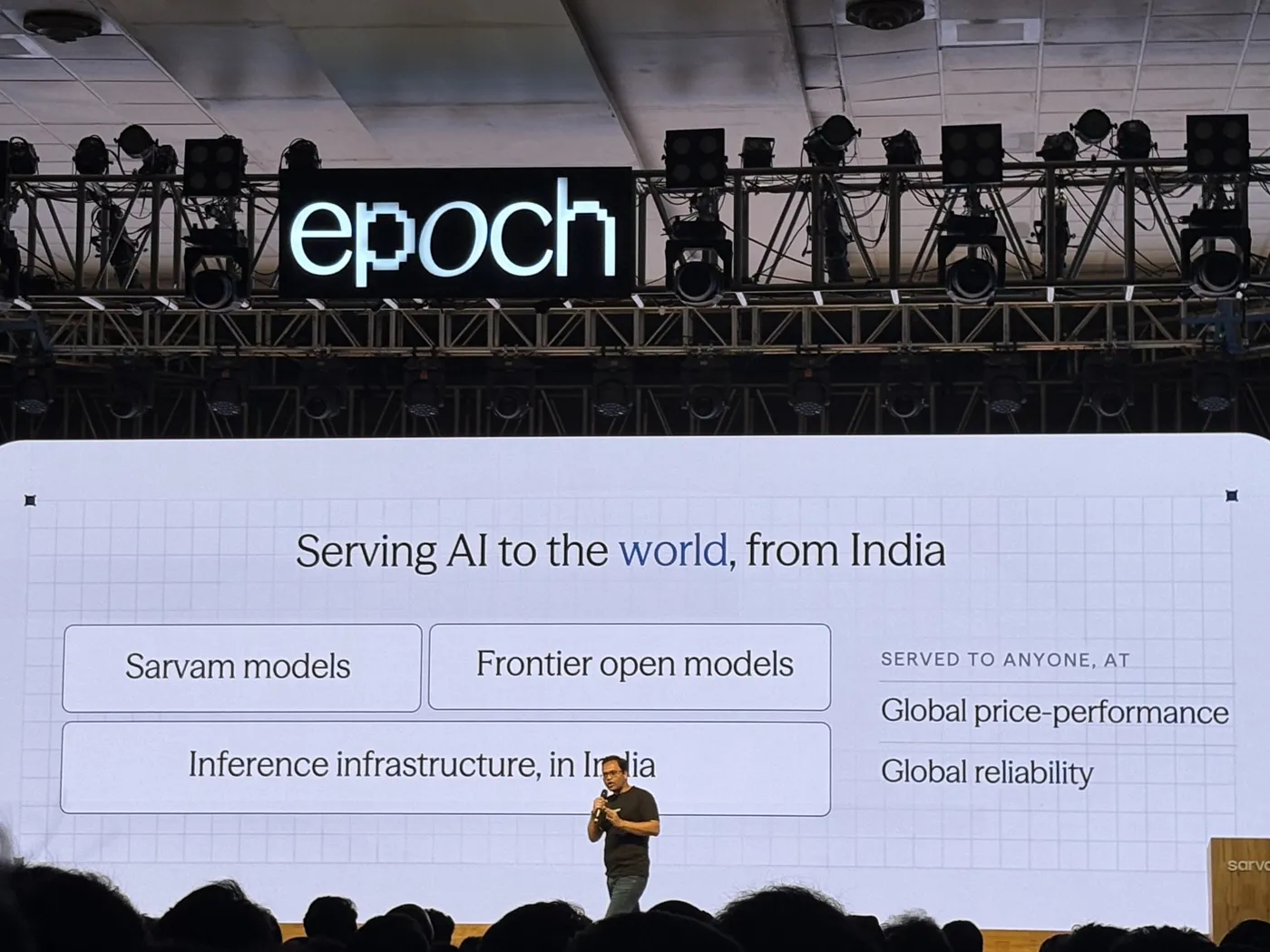
The last part of the keynote was the “token factory”. The goal is on the slide: produce the largest share of the tokens India consumes. Sarvam wants to serve AI to the world from India, with its own models, frontier open models and inference infrastructure in India, at global price-performance and global reliability. He announced an inference platform running in India, serving Sarvam’s models and a range of frontier open models. Indian developers and enterprises, he said, should not have to pay a tax to use models here, and he promised data security of the highest order.
The slide that tied back to my last event said that building a token factory is hard but worthwhile. In his words, the hard parts are taking thousands of GPUs and many workloads and routing them, splitting parts of the compute apart, handling the KV cache extremely well, and managing the memory hierarchy, from the on-chip memory on the GPU out to the disk and shared file system. Then there is kernel-level optimisation of the model on the GPU. Models, GPUs and methods all keep changing, so the frontier applies here as much as it does to models. These are the same topics as the inference and profiling talks at the PyTorch meetup. The map next to it shows who the factory serves, which is general users, knowledge workers and builders. In front of it sit the models for text, vision and speech, and on top of them a constantly evolving harness.
His framing of the harness stuck with me. Think of the model as the CPU and the harness as the operating system. A year from now, using a model directly may feel as odd as writing assembly. Over the last three months Sarvam has built harnesses that optimise skills, memory, tools, sub-agents and RLMs (recursive language models, as I read it), and hill-climb on the prompts. He said Sarvam has harness results that are globally competitive, across work agents, coding agents and cybersecurity agents.
Non-trivial. His words: “You might have the best token factory, you might have the best models. You need to ensure that for that combination of models, you have the right harness that gets the right performance.” The three pieces have to be tuned together.
Non-trivial. “No tax” is the product promise for inference. Being in India should carry no premium on price, security or reliability.
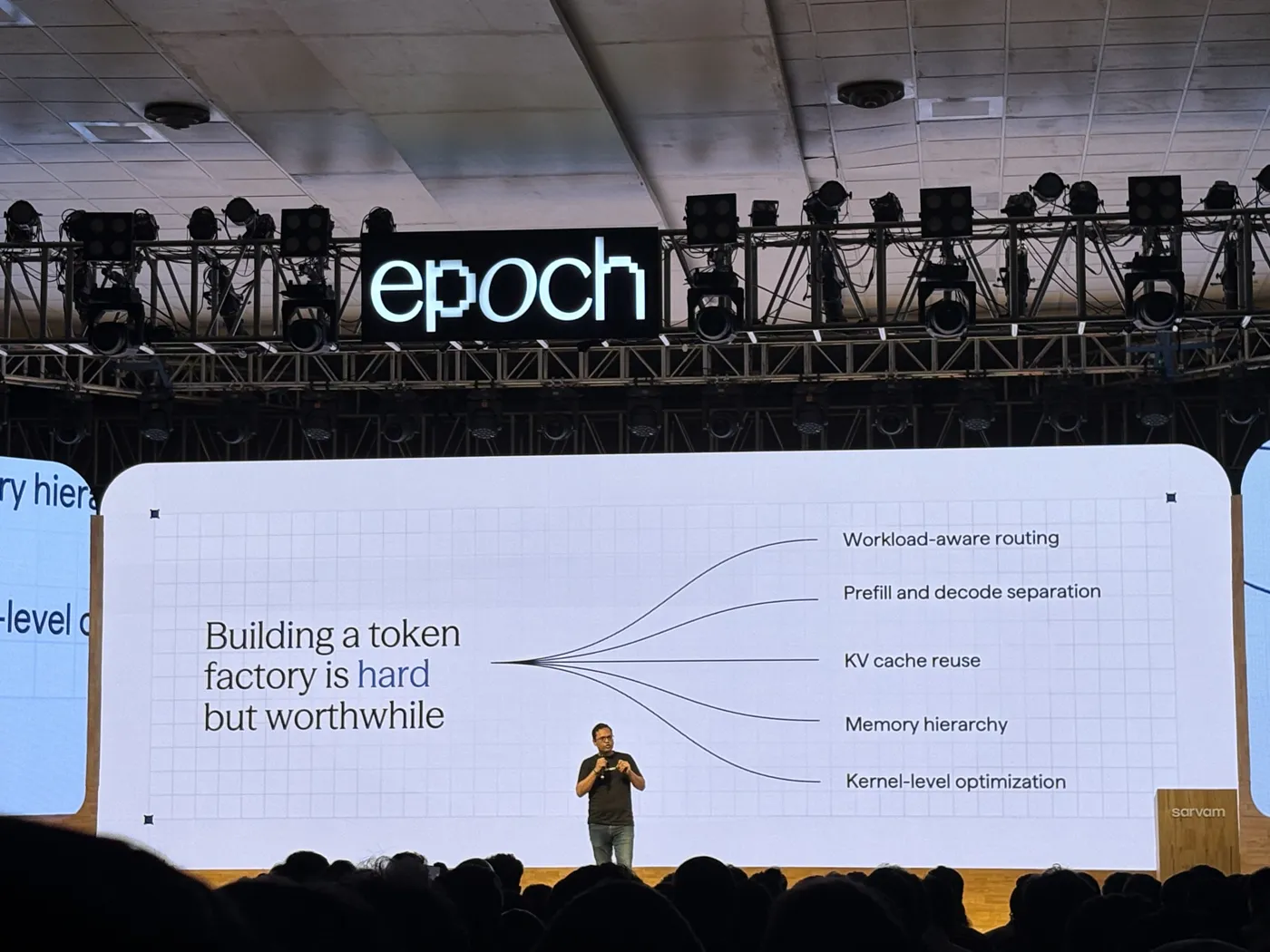 Building a token factory is hard but worthwhile
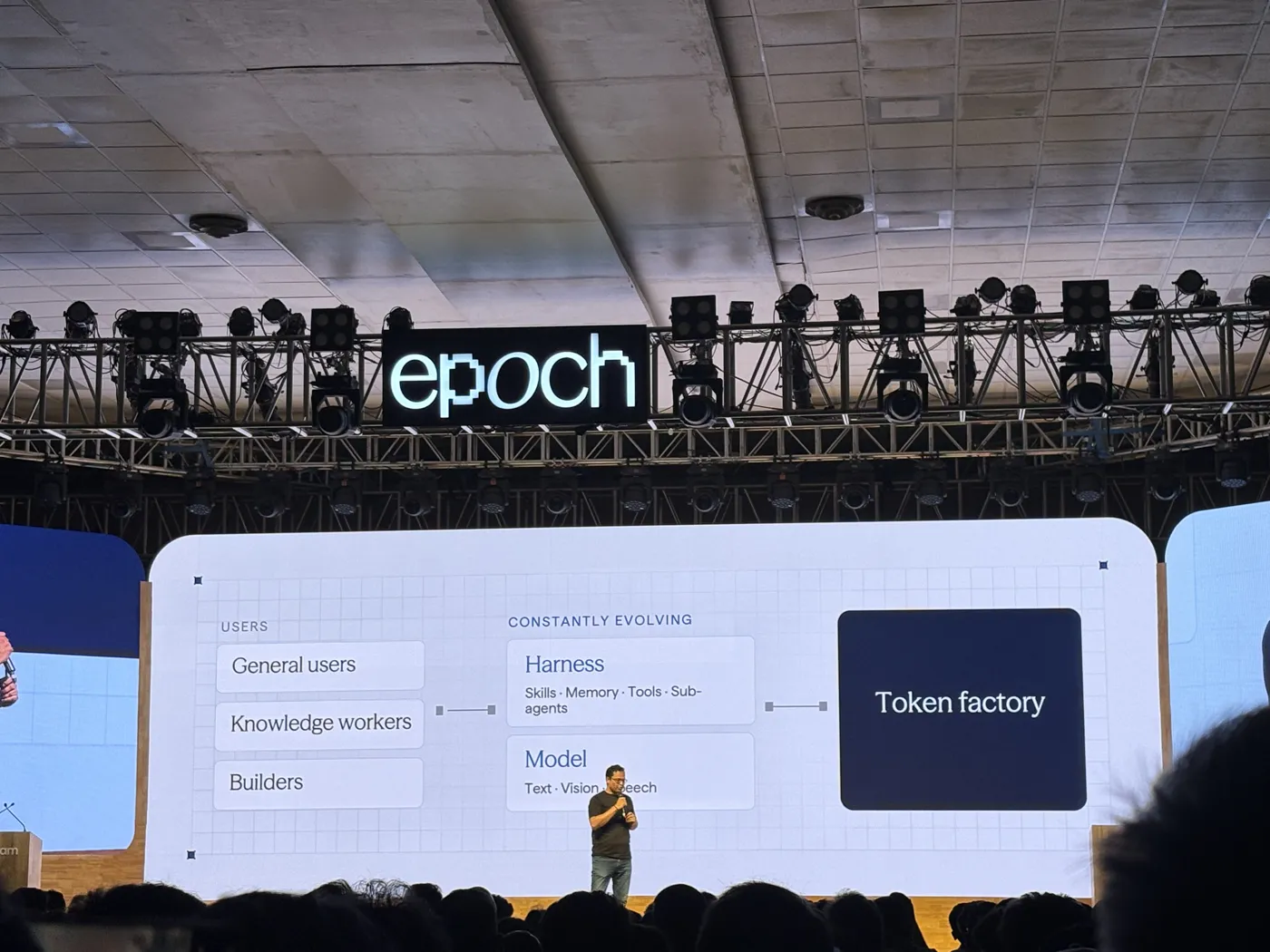 Users, a constantly evolving harness and model, and the token factory
Weaving
He ended on the theme of the event. China did not move fast on AI because a couple of labs built it, he said. It was a whole-industry effort of universities, startups and organisations exchanging ideas. He quoted the Chinese premier: no single string can weave a cloth by itself. Then he added that Epoch’s theme is also weaving. It is the same idea as the screens in the design section: many small threads, one cloth. He asked everyone to build the frontier together.
What stayed with me. The mission was not “build a model”. It was to own the whole path from research to tokens served, and to be patient about it.
MoonshotsAiming for moonshots: from strategic to cognitive independence
Dr. S. Somanath, former Chairman, ISRO
Aiming for moonshots: from strategic to cognitive independence
Dr. S. Somanath, former Chairman, ISRO
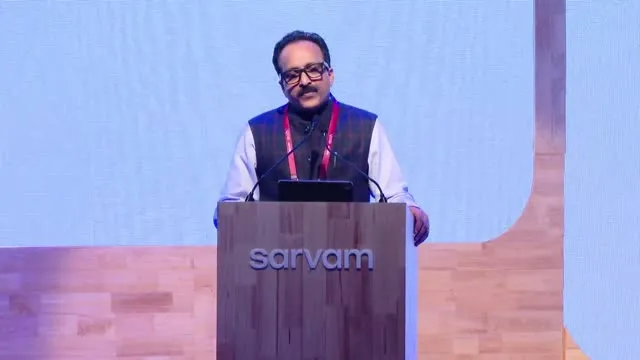
Dr. S. Somanath, the former chairman of ISRO, spoke on sovereign AI as the next moonshot. He said up front that he comes from a different domain, space technology, and that India has done something fantastic in space, so it should now do the same for AI. The talk had a clear structure: an analogy from space, a case for language and education, and then a long, technical section on where AI meets physics.
From strategic independence to cognitive independence
Space gave India strategic independence: the ability to design, develop, build and launch from its own soil. When people abroad ask how India reached the Moon so cheaply, he said, cost is not the real point. The point is that everything was Indian: the rocket, navigation, propulsion, software, mission planning and manufacturing. Nothing came from outside. The new race is for intelligence, and the sovereign AI stack will decide cognitive independence. His lines: access is not ownership, and adoption is not the real advantage. If someone else owns the intelligence layer, you do not own it.
The space-to-AI map
He has built rockets and the systems around them, and he mapped the parts one for one.
| Space | AI stack |
|---|---|
| Launch vehicle | Foundation model |
| Launch pad (Sriharikota) | GPU and compute architecture and infrastructure |
| Spacecraft | AI applications built on Sarvam |
| Navigation technology | Data and data governance |
| Payload (communication, imaging) | Domain knowledge in the AI stack |
| Mission control | AI orchestration |
Without your own launch vehicle you lack the freedom to choose what to build and launch, and a mission like Chandrayaan-3 would never get to orbit if you depended on another nation's rocket. Space is also unforgiving. If one layer fails, one signal, one correction, one piece of software, the result is a rocket that explodes. The same holds for the AI stack: foundation models, compute, applications, an indigenous content and data pipeline, and domain development. Every layer has to succeed.
The ISRO case study: applications first
When ISRO built the PSLV, he said, it never looked at what NASA was doing, because there was nothing to replicate. And ISRO did not build the rocket first. It built the applications first: satellite communication and village resource mapping, and the capacity to analyse data and generate intelligence. Then it built sensors and launched them on Russian rockets. Only after that capacity existed did it build its own launcher. He called this an interesting case study for AI.
Non-trivial. India's space programme did not start with the rocket. It started with the applications and the ability to turn data into intelligence, bought launches, and built the launcher once the demand and the skills existed. The AI analogy is that the order of building matters: capacity to use intelligence at scale came before capacity to produce it.
He added a point aimed at the room: “We don't want more engineers to become prompt engineers. We want them to become the foundation model scientists.”
Language, education and health
India speaks many languages, with dialects numbering 1,500 and more. Language has historically divided the country, though he said it is not a serious problem now. He noted that Sarvam handles more than 22 Indian languages, speech recognition, multilingual speech synthesis, code-mixed speech and voice preservation across languages. He described how he calculates in his own mother tongue in his head and then translates to another language, and said AI can reduce that pain.
- Education. Good teachers are scarce. AI should not replace teachers. It should take over the routine, such as attendance, question setting, evaluation and report cards, so teachers become enablers and motivators. NEP 2020 gives fertile ground for personalised, competency-oriented, lifelong learning at national scale, since students learn at different paces. His moonshot: every child, regardless of geography, language, income or background, should have access to the world's best teacher, laboratory and library through AI.
- Healthcare. In his village the doctor will look at you, not touch you, and write a prescription. AI can do more by listening and by drawing on wearables, previous records and disease-spread data. He listed imaging for cancer, tuberculosis and stroke, precision medicine from genetics, environment and lifestyle, drug discovery with less sample evaluation, and public health in rural India. His one-line summary: a doctor with AI will outperform a doctor without it.
Physics-informed AI: the technical heart of the talk
His argument was that the real world is not driven only by data. It is constrained by Newton's laws and by relativity. Embedding physics, equations and energy balances into data-driven models could do wonders, and he hopes AI with physics-informed systems will one day design a real rocket, though today it cannot. In his words, AI should be about understanding reality, not only predicting it.
He gave a test. He took a small physics problem, a sketch of a funnel emptying water, and the reverse case, and asked which empties faster. One AI tool answered wrongly. A second tool gave the same wrong answer. When he gave the correct answer, the tool agreed with him.
Non-trivial. The funnel test shows the failure mode of purely data-driven systems. They are fluent, they agree with you when corrected, and in high-end computation an error that nobody can detect is not tolerable. That is the case for putting physics in the loop.
Where he sees the pressure points, in order of the talk:
- Simulation cost. Aerodynamics and computational fluid dynamics simulations run for hours on large computing networks. Discretising the governing equations, the Navier–Stokes equations, gives a very large matrix. For each rocket flight ISRO runs thousands of simulations, if not millions, and engineers go through the data personally. AI surrogate models could speed up decisions on small design changes. He named physics-informed neural networks.
- Propulsion. Combustion instabilities, thermal runaway, transients and the energy release of chemicals in flow fields are all computationally hard.
- Digital twins. He wants real digital twins that run from the model through operating systems and sensors to reality, with test feedback going back into one model. For the LVM-3 he has never had a full digital twin, only bits and pieces, so before each launch he runs mission, propulsion, guidance, control and wind simulations separately. He described a new engineering loop: design, build, test, relearn, redesign, rebuild.
- Guidance, navigation and control. ISRO has started using AI with sensors and navigation algorithms for path planning and collision avoidance.
- Space situational awareness. With a very large number of satellites in orbit, operators have to nudge a satellite when a collision is possible, and must predict at least a day ahead. This is done today with closed-form numerical techniques, which he called not the efficient way.
- Manufacturing, materials and structures. Materials, design and quality checks are all candidates, as are biotechnology and chemistry.
The close
He ended with history. People said India could not build launch services, so it launched satellites on Russian and other rockets. Then it built the PSLV. He was on that team, and he still remembers walking in, in 1985, and ordering a drawing board for an A4 sketch. He saw it grow from that sketch to reality. His advice: never let the thought that something is not possible for us take hold. India's moonshot was never about reaching the Moon, but about proving that the limits imposed by the constraints of the mind can be overcome. AI is the next moonshot, and the goal is not another software industry but a sovereign stack. The measure of AI in education, he said, will be not the machine's intelligence but the confidence, creativity and capacity of young minds. He also pointed to the startup Skyroot and its Vikram-1 launch as a sign that space has become affordable.
FiresideBuilding a frontier model in India
In conversation with Devendra Singh Chaplot
Building a frontier model in India
In conversation with Devendra Singh Chaplot
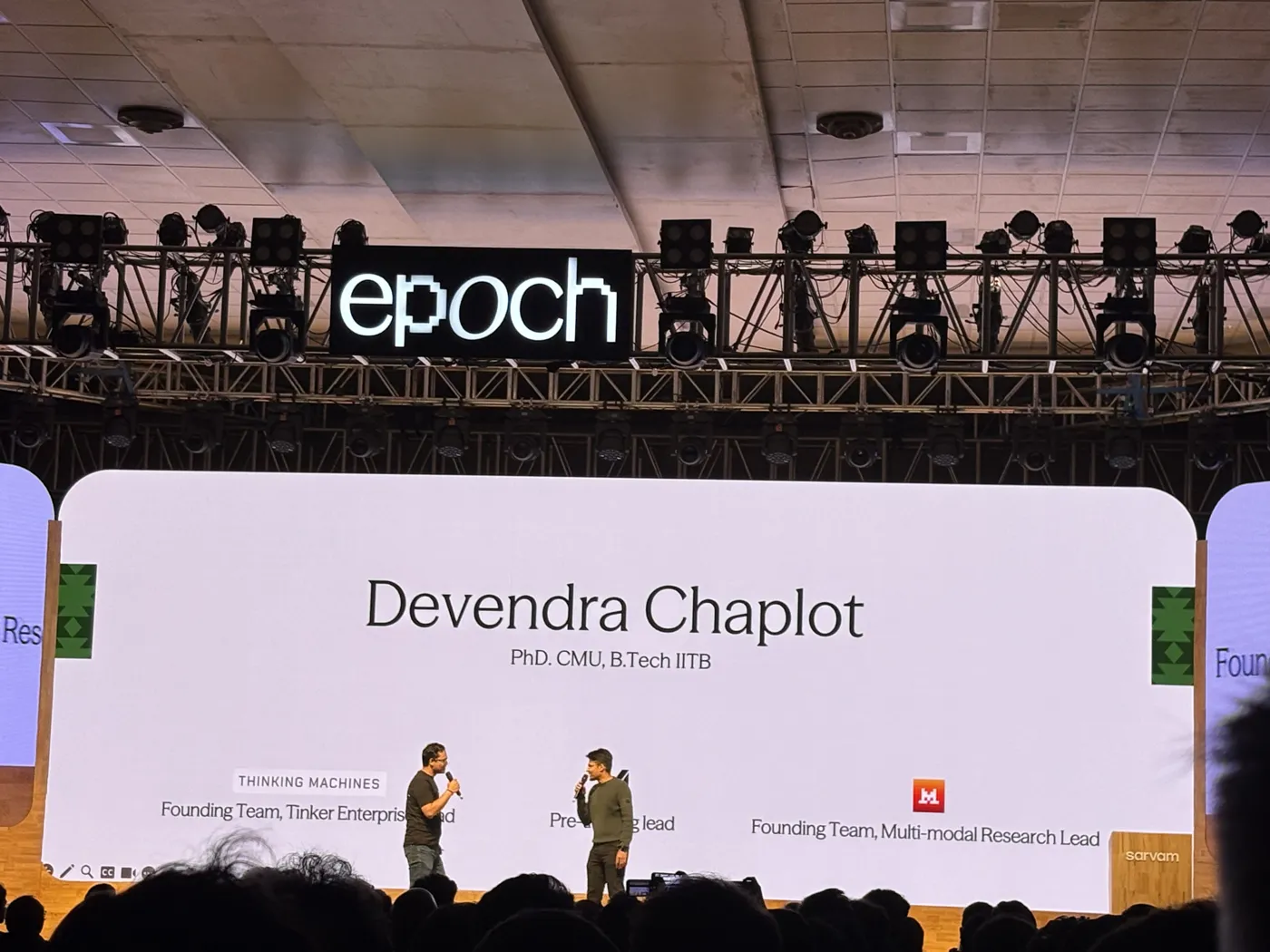
This closed the models part of the keynote. Pratyush Kumar invited Devendra Singh Chaplot on stage and made two announcements. Sarvam is opening a San Francisco office, to hire people who can contribute to the mission. And Devendra is joining as an advisor. He had flown in from San Francisco the day before. Pratyush said Sarvam wants globally competitive, best-in-class models, and wants the people who build for companies across the world to also build for India. Then they talked about what it takes to build at the frontier, from India.
His introduction slide shows a PhD from CMU and a B.Tech from IIT Bombay. It lists the founding team at Thinking Machines, where he led Tinker for enterprises, and the founding team at Mistral. A third line is hidden behind the speakers and ends in “lead”. In his own words, he was most recently the pre-training lead at xAI. Before that he was on the founding teams at Mistral, where he worked on Mistral 7B, 8x7B and Large, and at Thinking Machines Lab. On the technical-session slide he is listed under Sarvam.
What does it take, in numbers?
Devendra said that many people think building at the frontier takes huge resources, and some think it is impossible in India. That is not true, he said. Take a model about the size of Kimi K3, with 3 trillion total parameters, with about 100B active in a mixture-of-experts design, and even if you train it for as many as 100 trillion tokens. That is about 6 × 1025 FLOPs of pre-training. On the 10,000 Blackwell chips that had just been announced, with good utilisation, you could pre-train it in about two months.
I checked the arithmetic, because it is a good one to know. The rule of thumb for training compute is 6 × active parameters × tokens. Here that is 6 × 1011 × 1014, which is 6 × 1025. Spread over two months (about 5.2 million seconds) and 10,000 chips, it comes to about 1.2 PFLOP/s sustained per chip. NVIDIA's published dense peaks for a B200 are roughly 2.25 PFLOPS in BF16 and 4.5 PFLOPS in FP8. So the claim needs about half of BF16 peak, or about a quarter of FP8 peak. That is demanding, but believable. Note what the sum leaves out: getting 100 trillion good tokens, and the RL stage after pre-training. His conclusion was that compute is not the barrier. Pratyush’s own summary at the end was “10,000 Blackwells for six months”, a few experienced people and lots of motivated ones. Two months is the pre-training-only figure at good utilisation. My reading is that the gap leaves room for the work the estimate leaves out.
What about the people?
Having been on the founding teams of two frontier labs, he said there is a misconception that you need a huge team of very experienced people. You need a handful of experienced people, and mostly you need a lot of motivated and talented ones, and India has plenty of them. Even people with experience, himself included, have only a few years on this work, so experience is not the bottleneck. With the right guidance from a few experienced people, a lot of people can catch up quickly. Pratyush added that mission-oriented teams go at the problem with a lot of energy.
Ten years out: the foothills of AGI?
Pratyush asked whether we are in the foothills of AGI, climbing, or already past that, and then what the world looks like in ten years. Devendra flipped the question and asked what the audience wants that world to be. Do you want a world with only three models, or with thousands? Most people, he said, would choose thousands, and it is good for the world.
My link, not his. “Thousands of models” fits the Custom Model Training launch. If the future is many small specialised models, then training them has to become something you can do with an SDK.
ModelsSarvam 105B, tuned for conversations and for work
Sarvam 105B, tuned for conversations and for work
Sarvam 105B first came out as a checkpoint in February. At Epoch, Sarvam released updated variants for the two jobs where it sees the most traction in India: conversational agents and work agents.
Conversations
Public benchmarks miss too much for conversation. They do not cover ambiguous messages, noisy speech recognition, code-mixed speech, answers that must be drawn from retrieved documents, or an instruction that must still be followed many turns later. So Sarvam built its own benchmark from production data, to show where frontier models break when they run as voice agents.
One instruction-following test puts a fixed line in the system prompt. The model must say it word for word on the tenth turn, for example ending the call with “Arre sir, we are done for today”. A model that loses the instruction over ten turns fails. Sarvam compared 105B against GPT 5.4 Mini and Gemini 3.5 Flash on it.
| Capability | Sarvam 105B | GPT 5.4 Mini | Gemini 3.5 Flash |
|---|---|---|---|
| Voice-call capability | 82.1 | 74.7 | 78.9 |
| Instruction following | 63.4 | 37.4 | 52.4 |
| Tool calling | 78.8 | 57.6 | 71.8 |
| Linguistic quality, win rate | 61.3 | 6.0 | 32.7 |
These numbers come from Sarvam's summary post. The widest gaps are in instruction following and linguistic quality, the two things that decide whether a voice agent survives a real call. The post puts the price at $0.80 per million blended tokens, against $4.50 for GPT 5.4 Mini and $9.00 for Gemini 3.5 Flash. On stage the speaker said about five times cheaper than GPT 5.4 Mini and eleven times cheaper than Gemini 3.5 Flash, and described it as intelligence per dollar. His headline claim was careful: the best conversational model available hosted in India, at a far lower price.
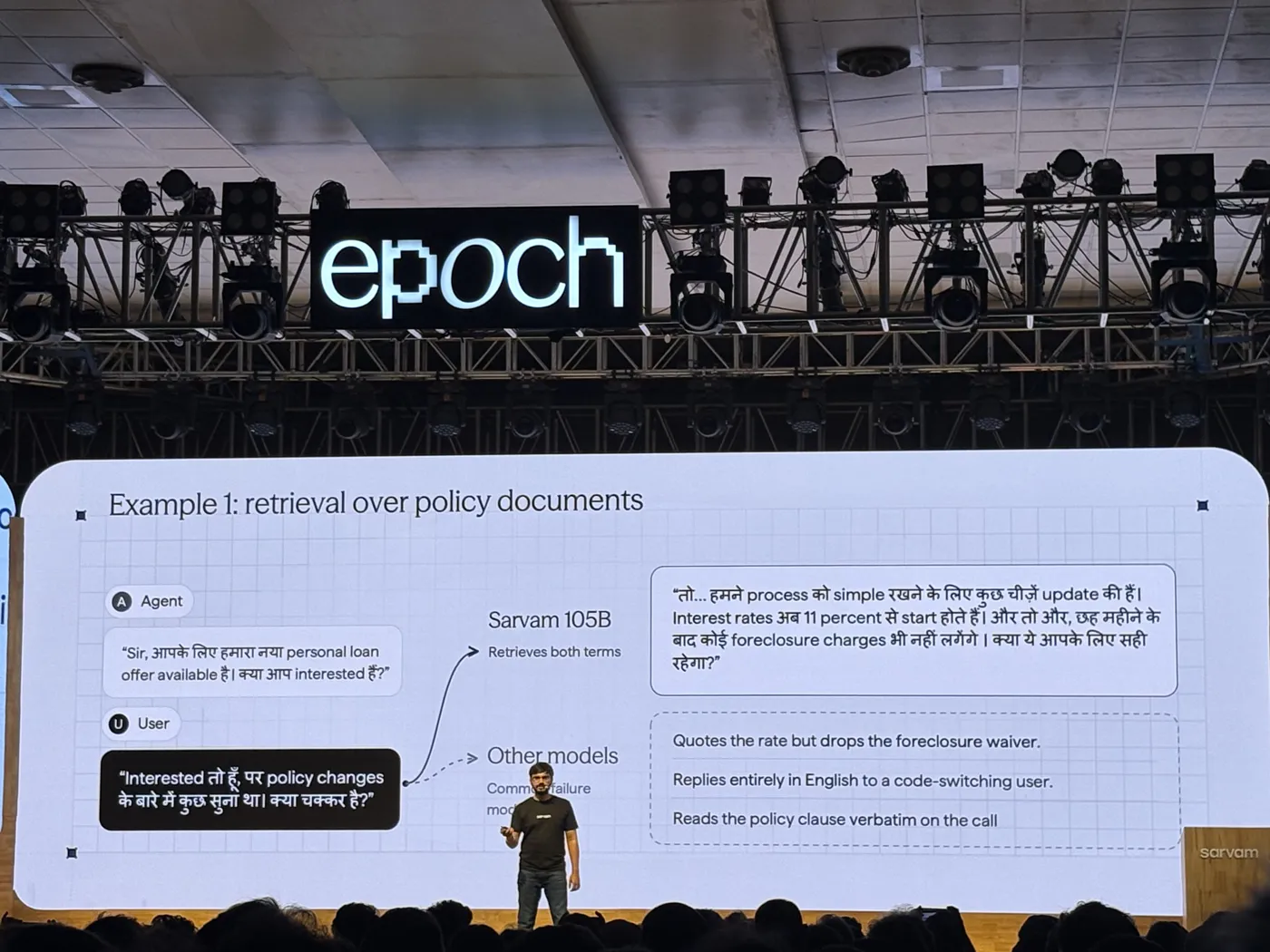
This slide shows what “linguistic quality” means in practice. The speaker described an assistant asking about a policy, with a customer who wants to know what changed in the policy documents. On the slide it is an agent offering a new personal loan in Hinglish, and the customer replies in the same mix: interested, but I heard something about policy changes, what is that? Sarvam 105B retrieves about fifteen policy documents with a tool call, then answers briefly in the same mixed language. The process is simpler, interest rates now start at 11 percent, and there are no foreclosure charges after six months. The slide lists how other models fail. One quotes the rate but drops the foreclosure waiver. One replies entirely in English to a customer who is code-switching. One reads the policy clause out word for word on the call. The speaker said Gemini, in this case, went through all fifteen points it had retrieved instead of answering directly.
Non-trivial. A good voice answer is not a complete answer. The model has to select from what it retrieved, say it briefly, and stay in the caller’s language mix. The failure modes on the slide are about selecting, and about language.
The second example was instruction following. The system prompt says the agent must not assume anything, and may only call the tool that clears a balance when the user is very clear. In production logs, frontier models often ignored that rule and called the balance tool on an ambiguous request, and money was involved. Given the same request, Sarvam 105B stopped and asked a clarifying question first. Sarvam says it already serves crores of minutes on this model on its own platforms.
Non-trivial. The test that matters in agents is whether the model refuses to act when the request is ambiguous. That case came from production logs, which is why Sarvam built its own benchmark instead of using public ones.
Work agents
For work agents, Sarvam tuned the model for its own harness, the one it unveiled later in the day, and tested it on HarnessBench. It has 106 sandboxed tasks across software engineering, data and finance, knowledge retrieval, office work, tool use, SRE and long-running autonomy.
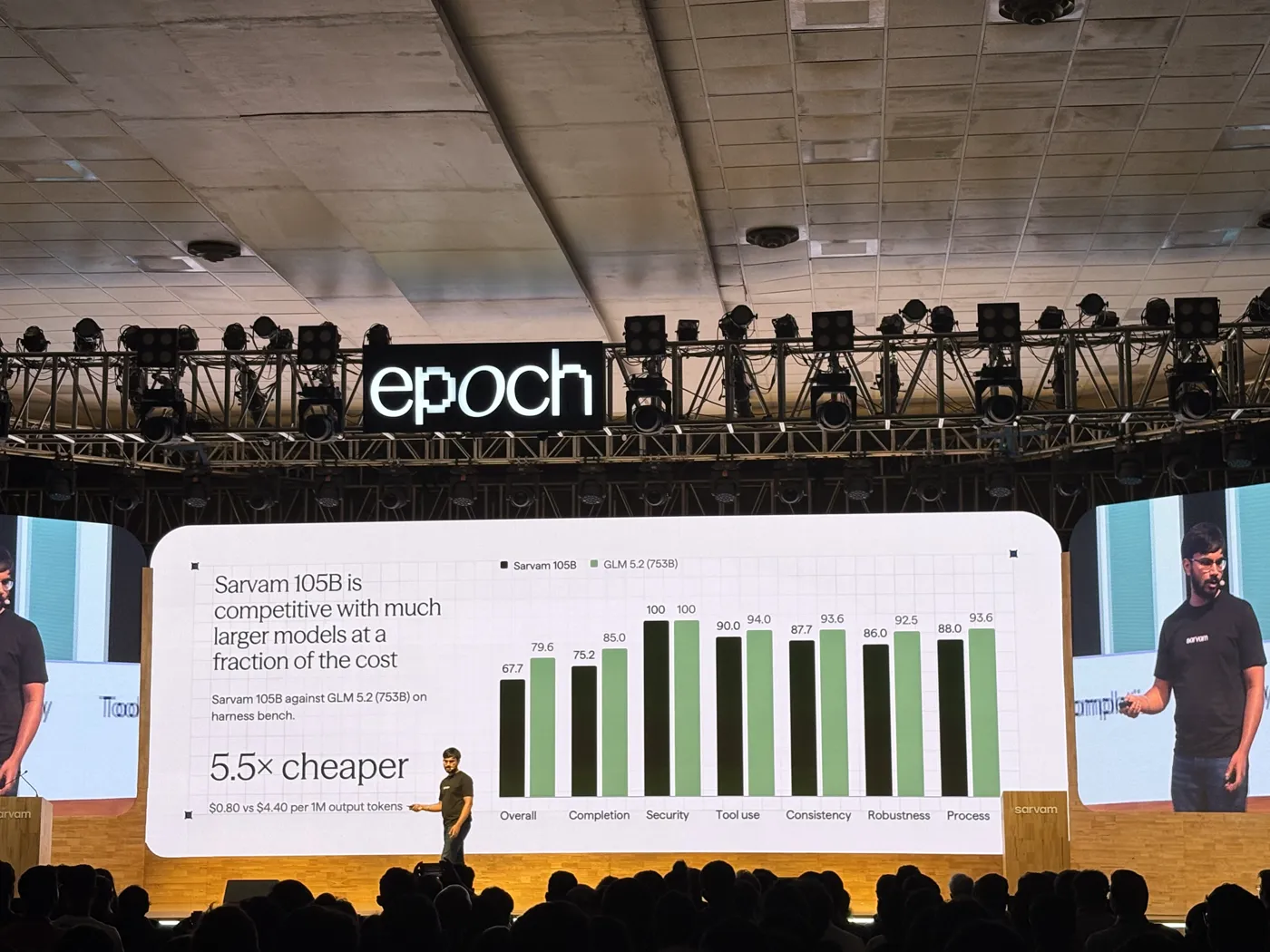
The chart compares Sarvam 105B (black bars) with GLM 5.2, a model of about 750B parameters (green bars; Vivek Raghavan later called it 768B). GLM 5.2 is ahead overall, 79.6 against 67.7. It also leads on completion, tool use, consistency, robustness and process. Both score 100 on security. Both models ran in the same harness. The speaker said security and tool use are already near the frontier for Sarvam 105B. The right half of the slide is about price. Sarvam 105B is 5.5x cheaper, at $0.80 against $4.40 per million output tokens.
The useful idea is routing. Sarvam tuned a router that decides, for each request, whether 105B or GLM 5.2 should answer. In Sarvam’s internal testing, 36% of day-to-day queries were already solvable by 105B, and the cost of the harness fell by about 40%. A model does not have to win every task. It has to win enough of the cheap ones. The speaker also pointed out that GLM 5.2 is almost seven times larger and has far more active parameters, so being near the frontier inside a good harness is the result.
Two short demos showed the model inside the harness. Given just a Google Sheets link to an e-commerce spreadsheet, and asked for the return rate, the returns by category and why the top category is returned so often, it produced an HTML report with graphs. Asked for an interactive projectile simulator, it built a single HTML page covering the different kinds of projectile motion, where a student changes the controls and watches the physics. He closed on one measure: intelligence per dollar, inside a harness.
The speaker said the conversational model will be served in India at scale and made available through the Sarvam API, for people to use right away.
VisionVision 2.0 and Vision Edge
Vision 2.0 and Vision Edge
Sarvam Vision 1.0 launched in February and has since digitised more than 35 million pages. At Epoch came Vision 2.0, and with it Vision Edge.
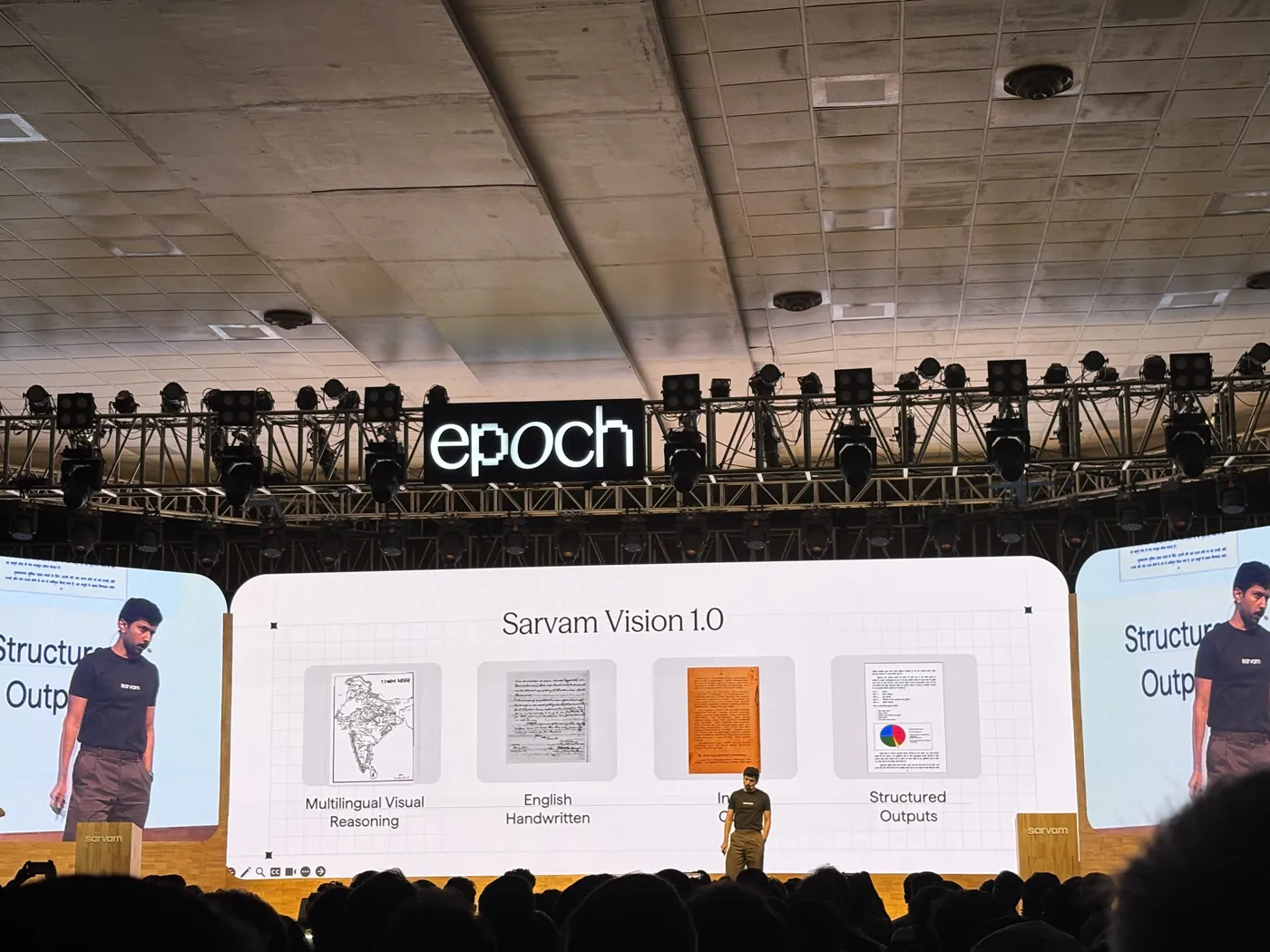
The first slide recapped version 1.0 with four examples. Multilingual visual reasoning, on a map of India. English handwriting. Indic documents. And structured outputs from a page with a chart.
What is new in 2.0
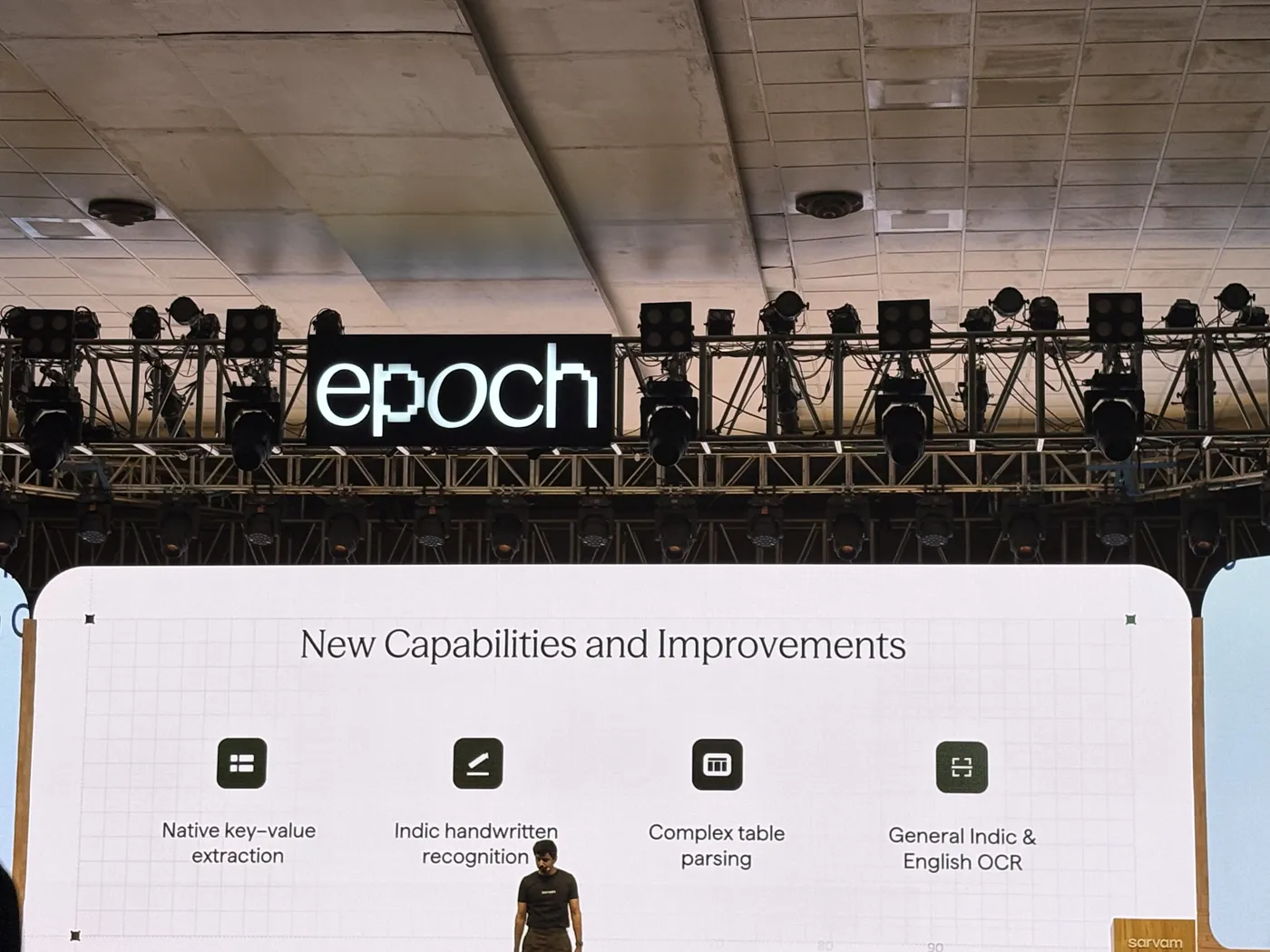 New capabilities: key-value extraction, Indic handwriting, complex tables, general OCR
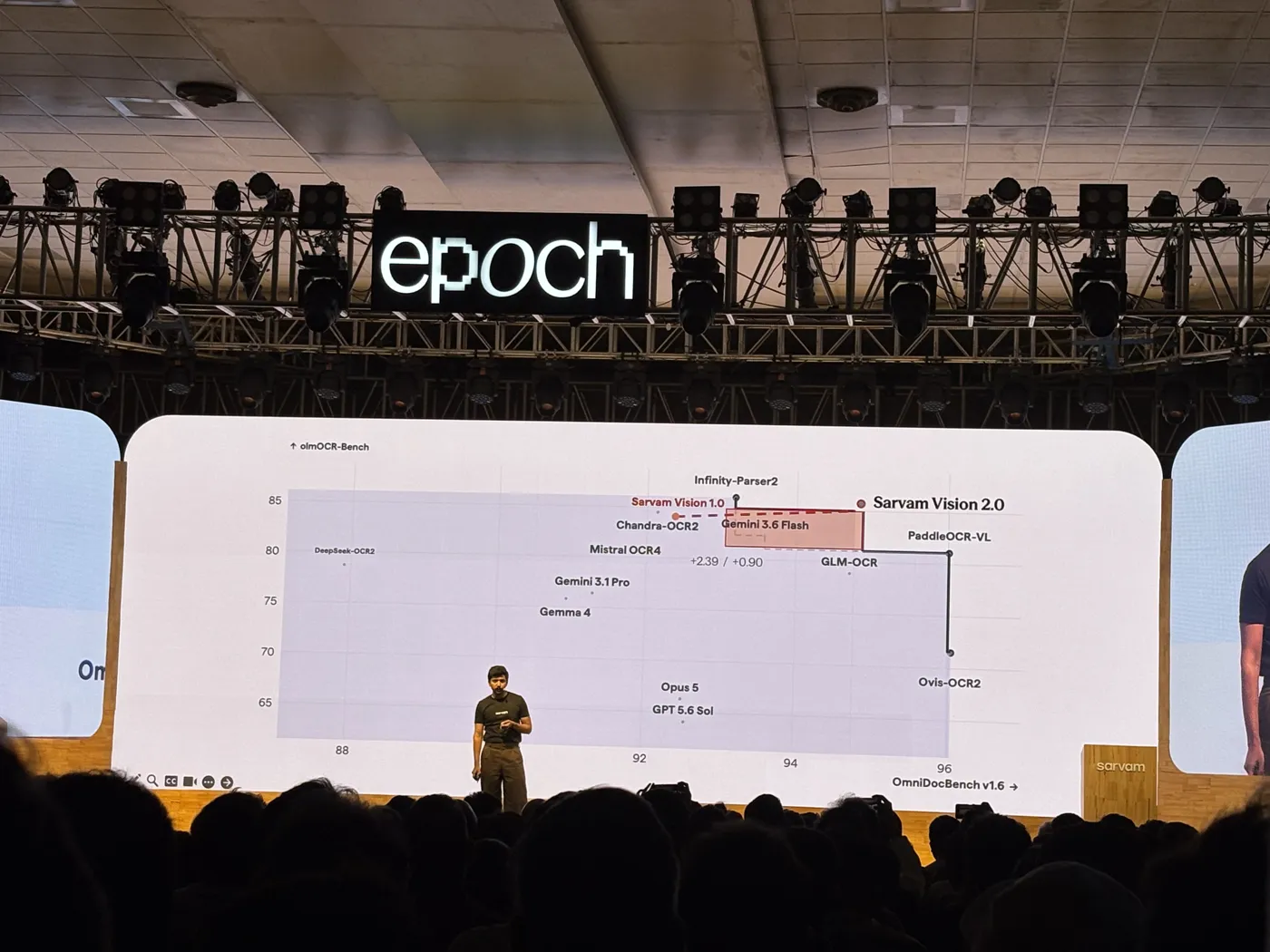 Vision 2.0 against other OCR models on two benchmarks
Version 2.0 adds four things: native key-value extraction, Indic handwriting recognition, complex table parsing and better general Indic and English OCR. The speaker said that, to the team’s best knowledge, it is the first model to do native key-value extraction, and he named DeepSeek-OCR and PaddleOCR among the models it was compared with. Tables used to come out as markdown. Now they can come out as key-value pairs in JSON, and the same goes for a document such as a rental agreement, where the model returns the named fields. Indic coverage spans all 22 languages, with Tamil and Hindi given as examples. It works on printed text and on forms filled in by hand, and it extracts the filled values, not just the text.
Krishna’s explanation of this chart is worth keeping. A Pareto frontier is where you cannot improve on one axis without hurting the other. Old-style cloud OCR services, from AWS, Google and Azure, sit at the bottom left. Vision models moved the frontier a lot. The best systems on each benchmark are tuned to one kind of document: either documents in the wild, or documents with heavy structure. olmOCR-Bench tests the first, which means dense, degraded pages. OmniDocBench tests the second, which means structure under pressure: complex tables and reading order. At launch in February, Vision 1.0 had been state of the art on olmOCR-Bench. But the speaker was candid that it was not on the Pareto frontier. It sat below it, because the team had optimised for a single benchmark.
Non-trivial. Document intelligence is a two-objective problem. Models that win one benchmark tend to give up the other, so Sarvam’s claim is a new region of the plot that nobody else occupies. One small extraction error breaks every downstream agent workflow, which is why both axes matter.
The chart places each model on two document benchmarks. OmniDocBench v1.6 runs along the bottom and olmOCR-Bench runs up the side. Sarvam Vision 2.0 sits at the top right, ahead of the other systems on the slide, including Gemini 3.6 Flash, GLM-OCR, PaddleOCR-VL, Mistral OCR 4 and Chandra-OCR2. Opus 5 and GPT 5.6 Sol sit much lower. A red box marks the step from Vision 1.0 to 2.0 and is labelled +2.39 / +0.90. I read that as the gain on the two benchmarks.
The live examples
 Key-value extraction from a complex table into structured JSON
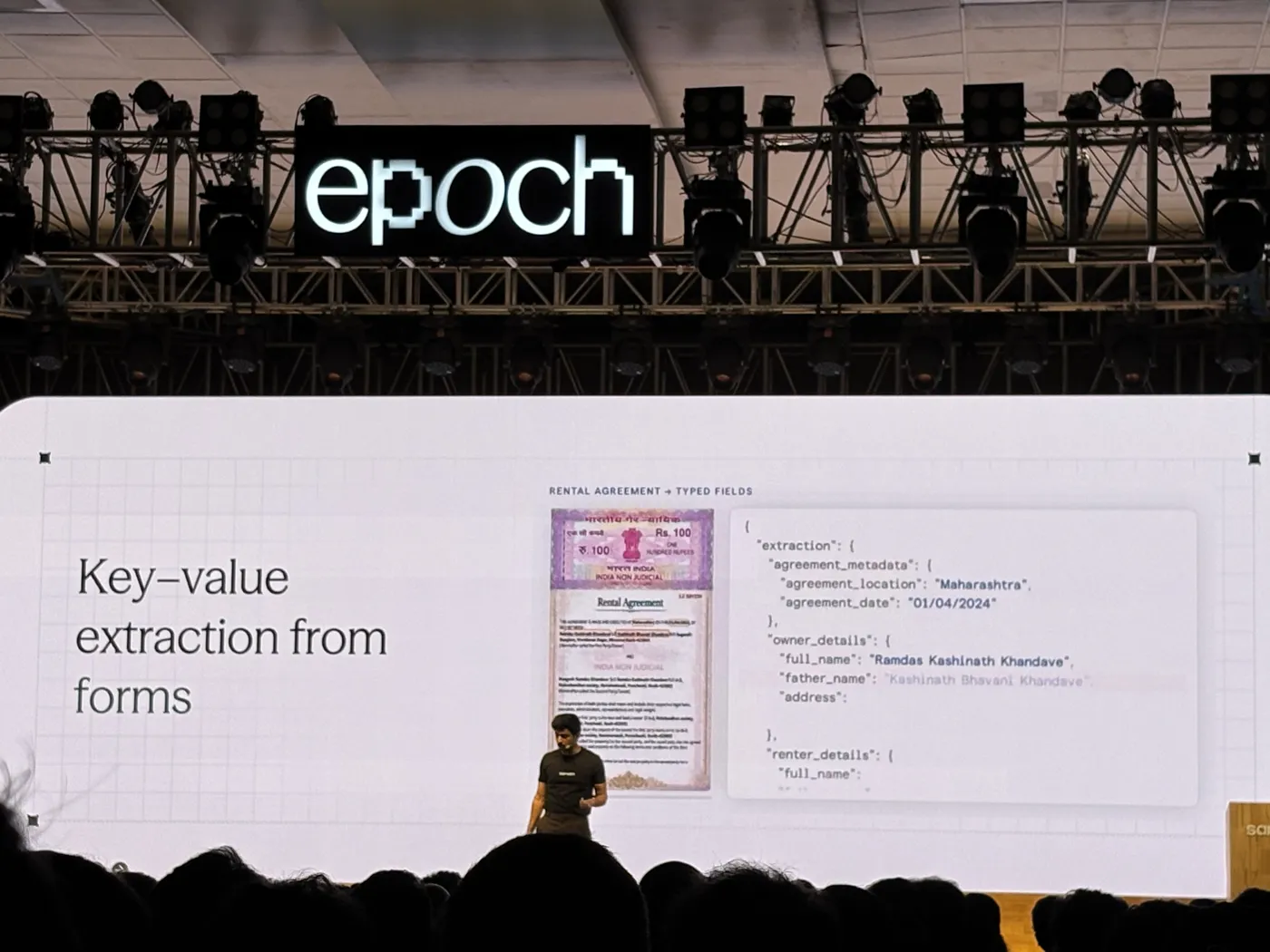 Key-value extraction from a rental agreement into typed fields
The first demo took a dense expense table, with regions, budget and actual columns and subtotals, and turned it into clean JSON. Each region got its own budget and actual value, plus the variance. The second took a rental agreement on stamp paper and filled typed fields: the agreement location, the date, and the owner's and renter's details.
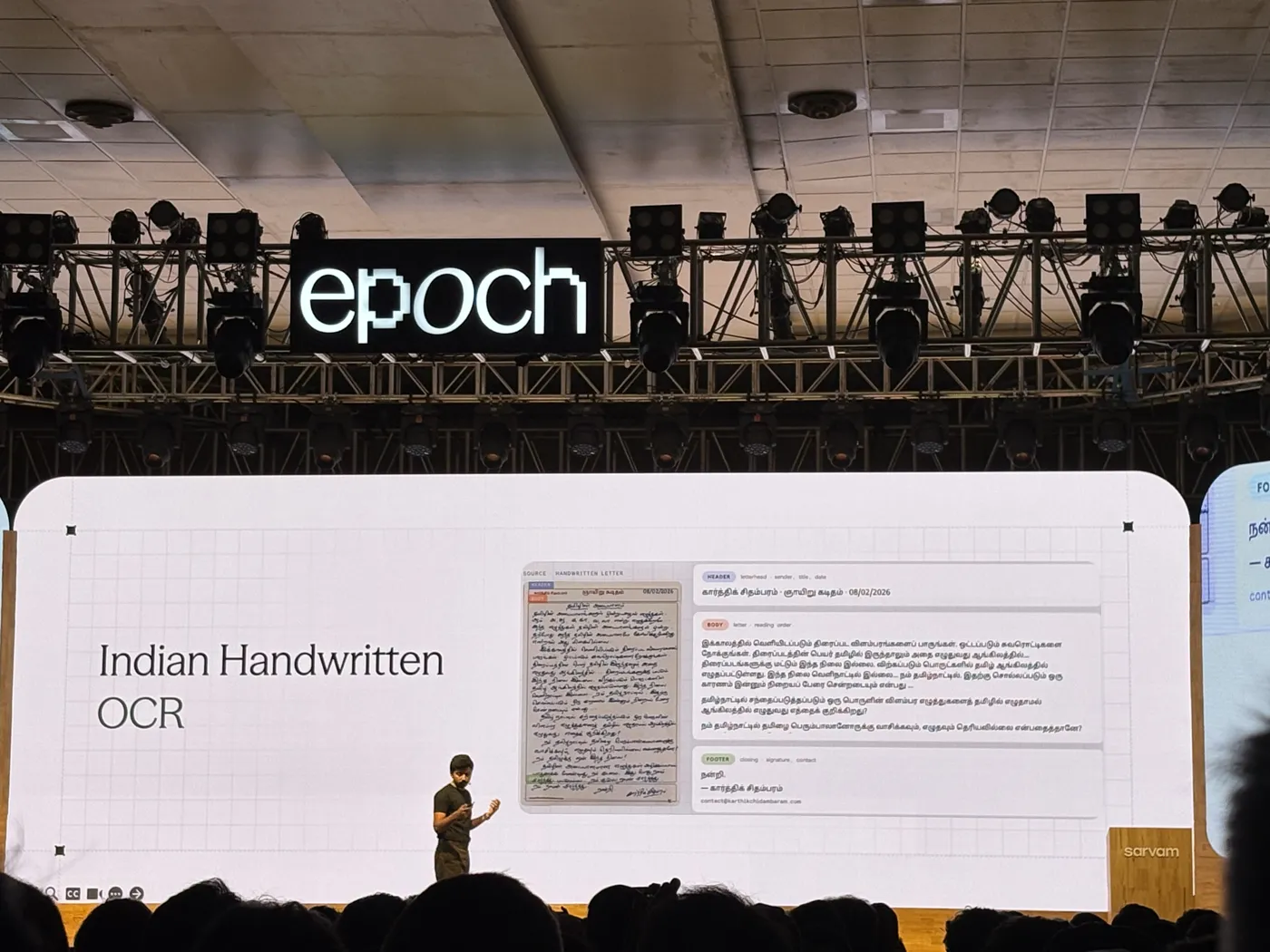 Indian handwritten OCR: a Tamil handwritten letter read into header, body and footer
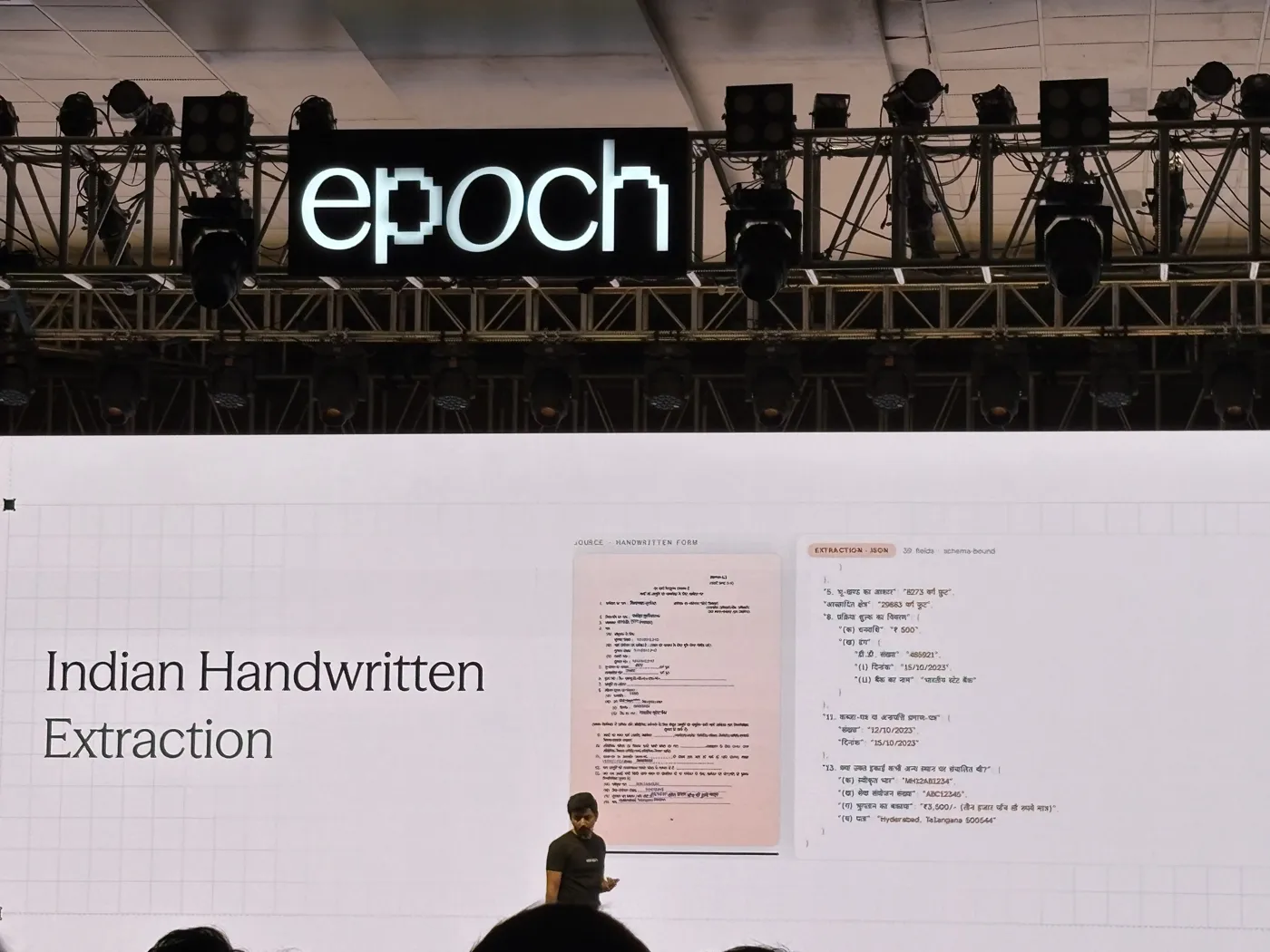 Indian handwritten extraction: a filled form turned into JSON
Handwriting was the part I enjoyed most. A Tamil handwritten letter was read in full and split into a header, a body and a footer. A handwritten form was turned into structured fields.
Vision Edge
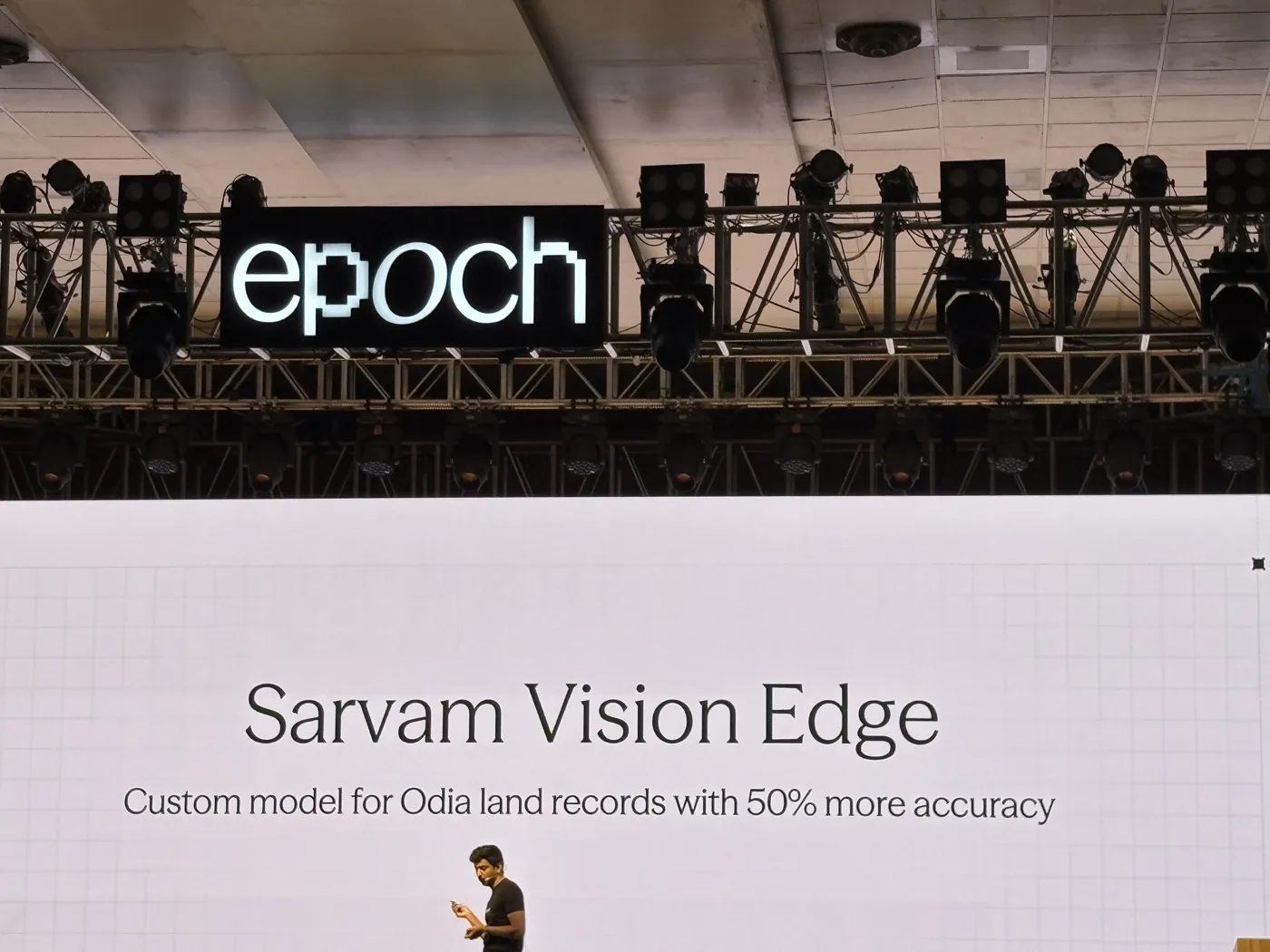 Sarvam Vision Edge: a custom model for Odia land records, 50% more accurate
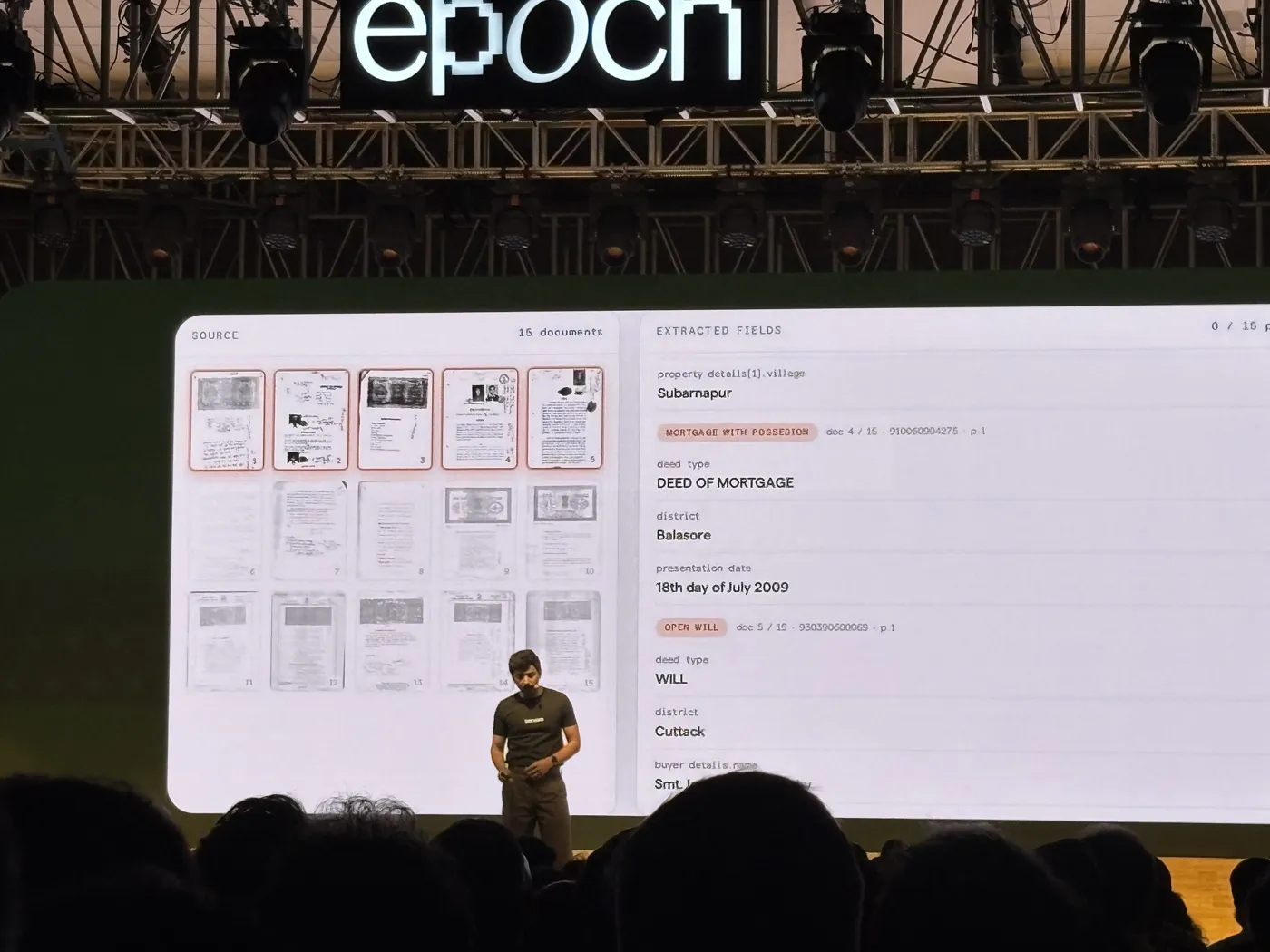 Fifteen land documents processed, with deed type, district and dates extracted
Vision Edge is the version you can run on your own computers. The case study was an ongoing project with the Government of Odisha to digitise its land records. The pages are handwritten and haphazardly maintained, and the model extracts the key-value fields for each document, with the whole land-record database as the goal. The slide says a custom model reached 50% higher accuracy than the best general-purpose model tested on the same task.
The demo slide shows a batch of fifteen scanned documents on the left and the extracted fields on the right. Each document gets a type, such as deed of mortgage, general power of attorney or will. The fields include the district (Balasore, Cuttack, Khurda), the village and the presentation date. The speaker described these as some of the most complicated documents out there. That is the real input, not a clean PDF.
Vision 2.0 will be available through the Sarvam API and on the Sarvam platform.
The lesson. A general model is a good start. A model tuned on one workflow's ugly data beat it by half again.
SpeechSaaras V4 and Bulbul V4
Saaras V4 and Bulbul V4
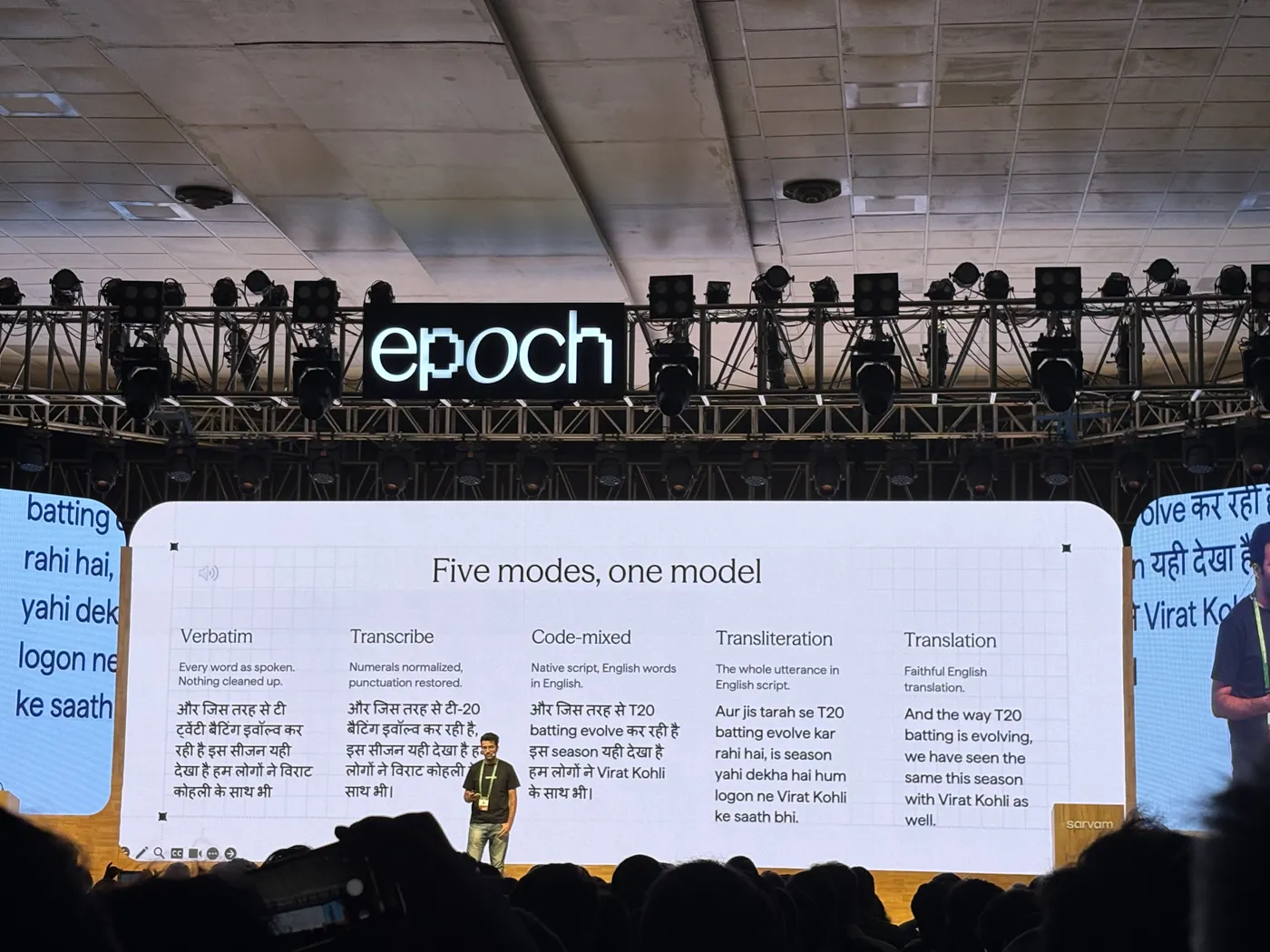
The speech section had one slide I will remember: the best English ASR is now an Indian one.
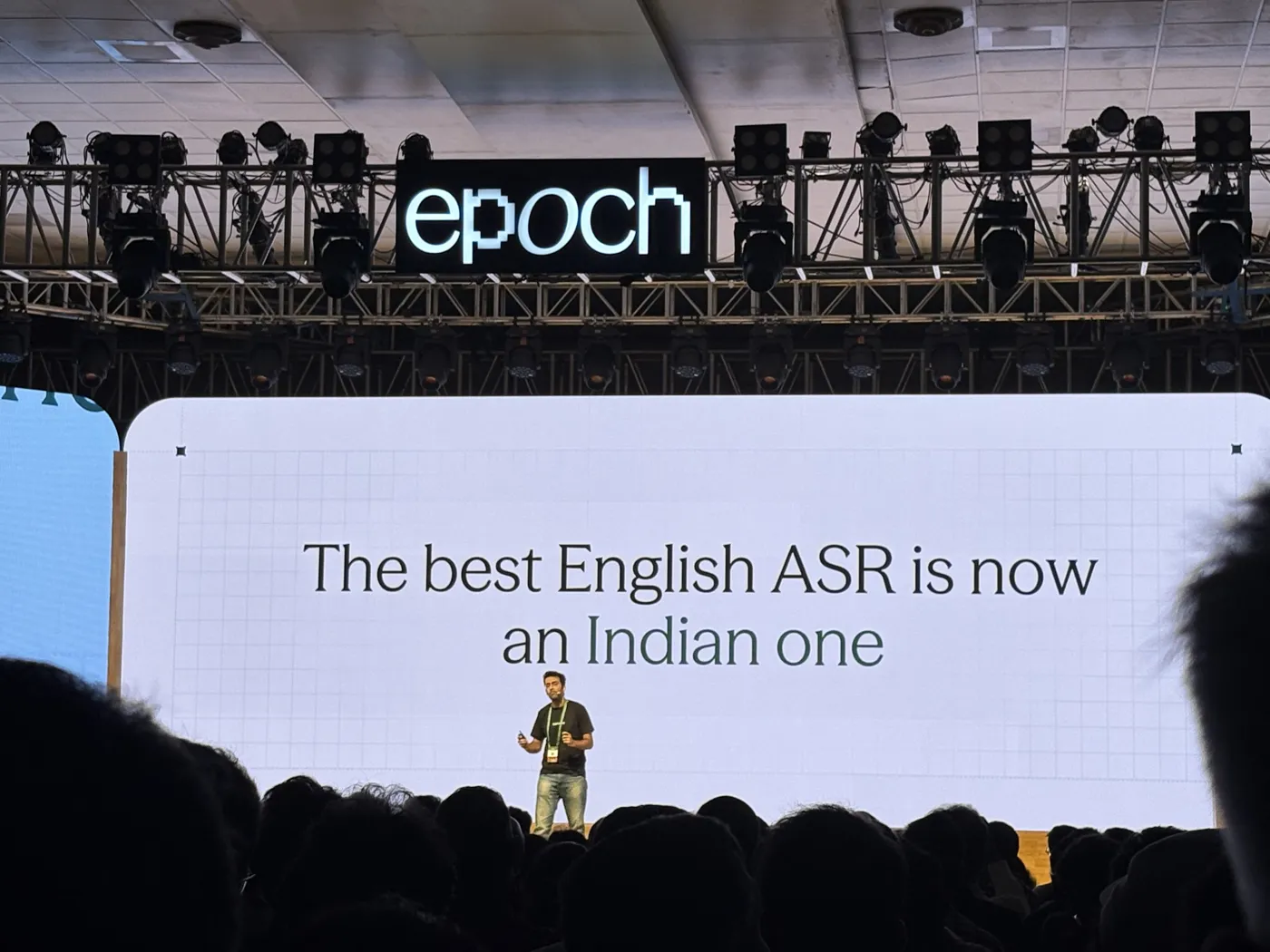
Saaras V4: speech to text
Aaditya M., who presented it, said speech recognition has been the soul of Sarvam. From day one the focus was every Indian language, however low-resource. Saaras V4 transcribes the 22 constitutional languages, including ones where training data is very limited, and he claimed that no competing model has reached that coverage. On the commonly used languages the gap to the competition is wider still. One language had been left out of the story: English. He said this is the first time Sarvam’s ASR is state of the art on global English too, the Sarvam moment of building India for the world. On seven standard English benchmarks, six of them foreign and global English, Sarvam says it has the best average across the sets, not necessarily on each one. These are Sarvam’s own claims. He also said Saaras V4 handles the noisiest test set much better, with no names or numbers given on stage.
The pitch is control: it is your audio, so you choose the style of transcript, romanised, code-mixed or translated, from one model and not five. The talk did not say how the mode is selected. The slide that explains the product best is “five modes, one model”. It shows one sentence about T20 batting and Virat Kohli, spoken in Hindi mixed with English, in five forms:
- Verbatim. Every word as spoken. Nothing is cleaned up.
- Transcribe. Numerals are normalised and punctuation is restored. “Twenty twenty” becomes T20.
- Code-mixed. Native script, with the English words kept in English.
- Transliteration. The whole utterance in the Roman script.
- Translation. A faithful English translation.
Single-speaker ASR is largely solved for Indic languages and English, he said. The next frontier is multi-speaker speech, where he said the competition struggles: overlapping speech, heavy noise, and fast back-and-forth with short back-channel words. The team rethought the architecture instead of bolting a fix onto the old one. A conventional pipeline has a diarisation step that decides who spoke when, cuts the audio into pieces and transcribes each piece. The Saaras V4 multi-speaker model combines the two in one model. It has a speaker-biased encoder, writes the transcript speaker by speaker and is designed to keep the sanctity of overlaps and back-channels. He gave no more detail on how the bias is injected. The demo was an Indian news clip, with a man and a woman anchor talking over each other. The model pulled the overlap apart and gave each line to the right speaker. He said no model today can transcribe two people speaking at the same time, called the result a generational leap, and also called the demo anecdotal.
Non-trivial. The pipeline approach loses the overlap, because it cuts the audio into single-speaker pieces before transcribing. Combining diarisation and recognition in one model, with a speaker-biased encoder, is how Sarvam says it keeps two people talking at once, which is what real calls and TV debates look like. That is the speaker’s description. He gave no more detail.
The biggest problem was that no multi-speaker Indic benchmark existed, so Sarvam made one and released it, calling it the first multi-speaker, conversational, heavy-overlap dataset. It is on Hugging Face, covering all 22 languages, more than 1,200 speakers and 108 hours of conversational audio, and he invited others to benchmark their own models on it. He explained two metrics. DER, the diarisation error rate, is the original metric and shows how good the diarisation is on its own. cpWER, the concatenated-permutation word error rate, scores diarisation and recognition together and shows how well they work in conjunction. Lower is better for both. On the 22-language benchmark he said Sarvam beats the competition on both. On the standard English AMI set he described the result as amazing performance. Both Saaras V4 models are live in the API and the playground.
Bulbul V4: text to speech
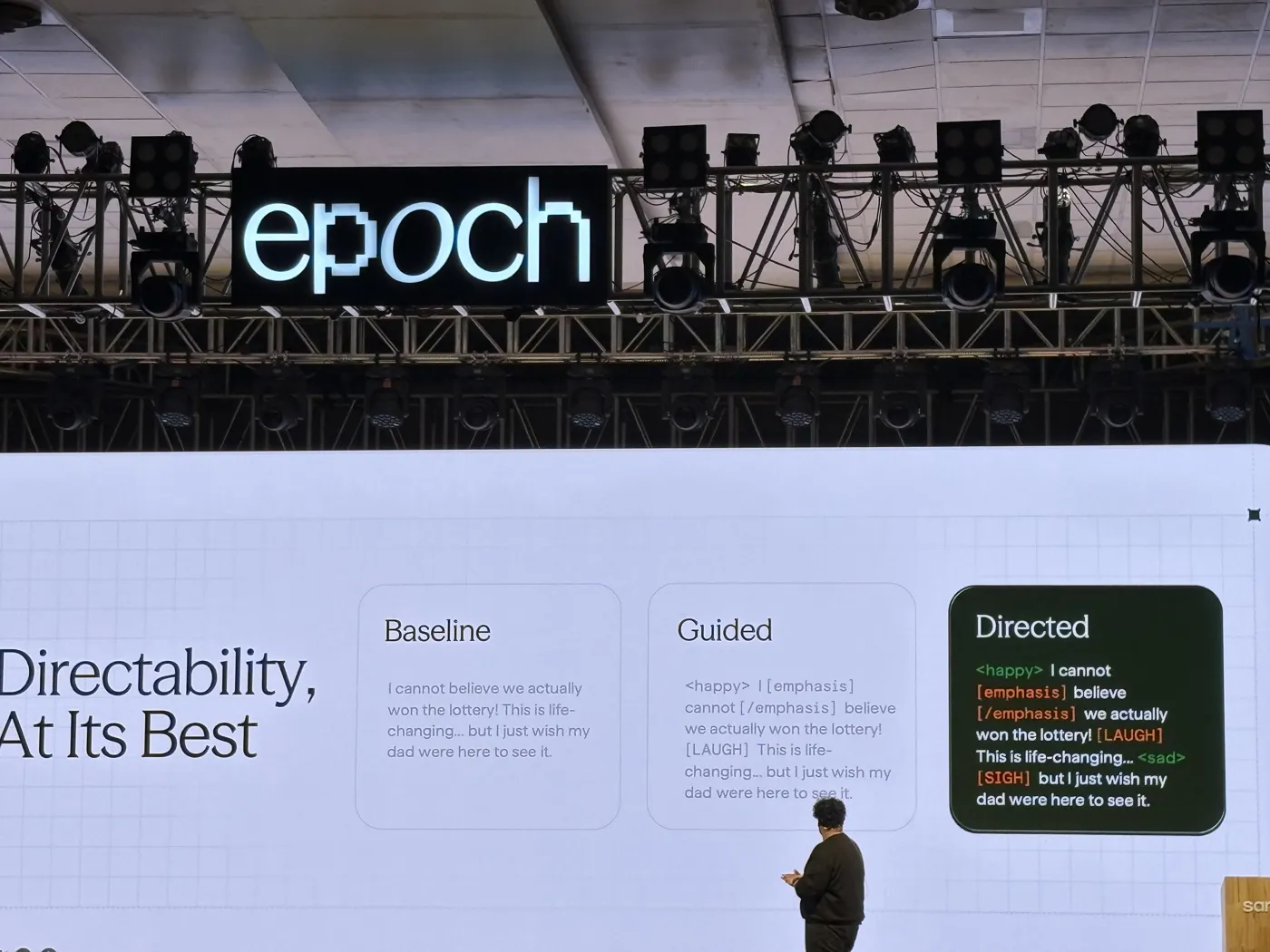
Praveen S V, who presented it, said Bulbul has powered India’s speech for a few generations, and called V4 one of India’s most expressive text-to-speech models. It took many iterations on the architecture, the right data mixtures and the right training curriculum, he said, with the aim of being expressive in many Indian languages and not in just one or two. He gave no numbers, so the recipe stays at the level of a claim. The feature that stood out is directability. The slide uses one line: “I cannot believe we actually won the lottery! This is life-changing… but I just wish my dad were here to see it.” It shows three levels of control. The talk named them as the classic way, adding emotion tags, and re-steering mid-generation, and the slide labels them baseline, guided and directed.
- Baseline. Plain text. The model decides how to say it.
- Guided. You add a few tags: an overall mood, an emphasis on one word, and a laugh.
- Directed. You mark up the whole line. It starts happy, stresses “believe”, laughs after “lottery”, turns sad for the last clause, and sighs before it.
The special tokens
The slide shows exactly what the markup looks like. The control is in the text itself, as special tokens, so the model reads them as instructions and not as words to say.
| Token | Kind | On the slide |
|---|---|---|
<happy>, <sad> | Mood tag | Sets the mood from that point. The directed line opens with happy and switches to sad before its last clause. |
[emphasis] … [/emphasis] | Paired span | Wraps the word to stress. In the directed line it wraps “believe”. |
[LAUGH] | Event token | A laugh, placed after “lottery!”. |
[SIGH] | Event token | A sigh, placed right after the switch to sad, before “but I just wish my dad were here”. |
Non-trivial. The tokens form a small vocabulary inside the text: a mood that holds until the next one, a span that marks a single word, and events that happen at a point. That is what lets the mood change inside one sentence. Tags like these are not new in the text-to-speech community. I looked at how they compare in the Q/A with Alex.
The talk on Bulbul V4 added the point about time. After the tagged version, the presenter said, it still did not sound right, because humans are a bag of mixed emotions. The last clause should be a little sad. So you can re-steer the model mid-generation and change the expression on the fly. Emotion, emphasis and paralinguistic cues such as laughter are all controlled inside the text, while the audio is generated. His summary was “direction at your fingertips”.
Non-trivial. Expressiveness is not one global style. A real line carries mixed emotion, so the control has to work inside a sentence, from excited to sad on one clause. That is a different feature from picking a voice or a mood for the whole clip.
Expression alone is not enough, he said, so there is also a new range of voices for ed-tech, voice agents, content creation and cricket commentary. The demos covered three styles: fast Hindi cricket commentary about the last ball of an over, with a six into the stands; a physics tutor who tells students to draw a free body diagram, find the net force and then write the equation, instead of applying a formula blindly; and a playful, quotable character voice.
Then he framed cloning as more than a feature. Sarvam wants to use frontier technology to empower, preserve and represent India’s diversity, he said, and India has a long tradition of oral history and a culture rooted in speech. The example was a cloned voice of a historic figure, delivering new scripted words about a great digital express of AI leaving the station with India’s languages stranded on the platform, and arguing that India cannot secure its future by speaking exclusively in borrowed tongues. The words were new text, not a real speech.
Sarvam is starting a voice programme with many parts of the ecosystem. A brand can onboard and clone its brand voice and use it across applications. A creator can reach larger audiences through Sarvam’s applications. A voice artist can lend a voice to enterprises and developers. The talk gave no benchmark, latency, language count or price for Bulbul V4, and did not say how cloning works, how much reference audio it needs or how consent for a cloned voice is handled.
Non-trivial. Cloning was argued as cultural preservation, not as a cost saver. If the voices of India are not in the model, they are not in the AI era. The same logic makes a voice a licensable asset with three sides: brands, creators and the artists who supply voices.
TrainingCustom model training, and RL at scale
Custom model training, and RL at scale
Not every announcement was a model. One was Custom Model Training: an SDK to train a model on your data on Sarvam’s infrastructure, with the weights delivered to you, according to Sarvam’s summary.
The talk was introduced with a framing. The token factory is the infrastructure for using models that already exist. The infrastructure the world is still missing, the introducer said, is the infrastructure for training your own custom models.
Romit, who presented it, started from a point everyone in the room would agree with: training large language models is tough. From procuring GPUs to a first well-optimised run takes weeks or months of engineering. You need expertise in storage, in networking and in orchestration. Optimised training frameworks have hundreds of flags, and the best combination changes from model to model. So Sarvam is packaging all of it into a single Python SDK. You run it from your laptop, submit to Sarvam’s infrastructure, put a dataset in and get a checkpoint out. It starts with reinforcement learning using LoRA, and no other training modes or dates were announced. One customer has already used it to hill-climb on their own RL environment. They brought the data and trained on Sarvam’s infrastructure. No customer name, task or score was given, so that anecdote is the only evidence.
Sarvam's summary lists the terms. The training data stays isolated and is never used to train Sarvam's own models. When training is done, the weights are delivered to the organisation and owned by it. The goal is smaller, task-specific models that cut latency and inference cost, instead of sending every request to one big general model.
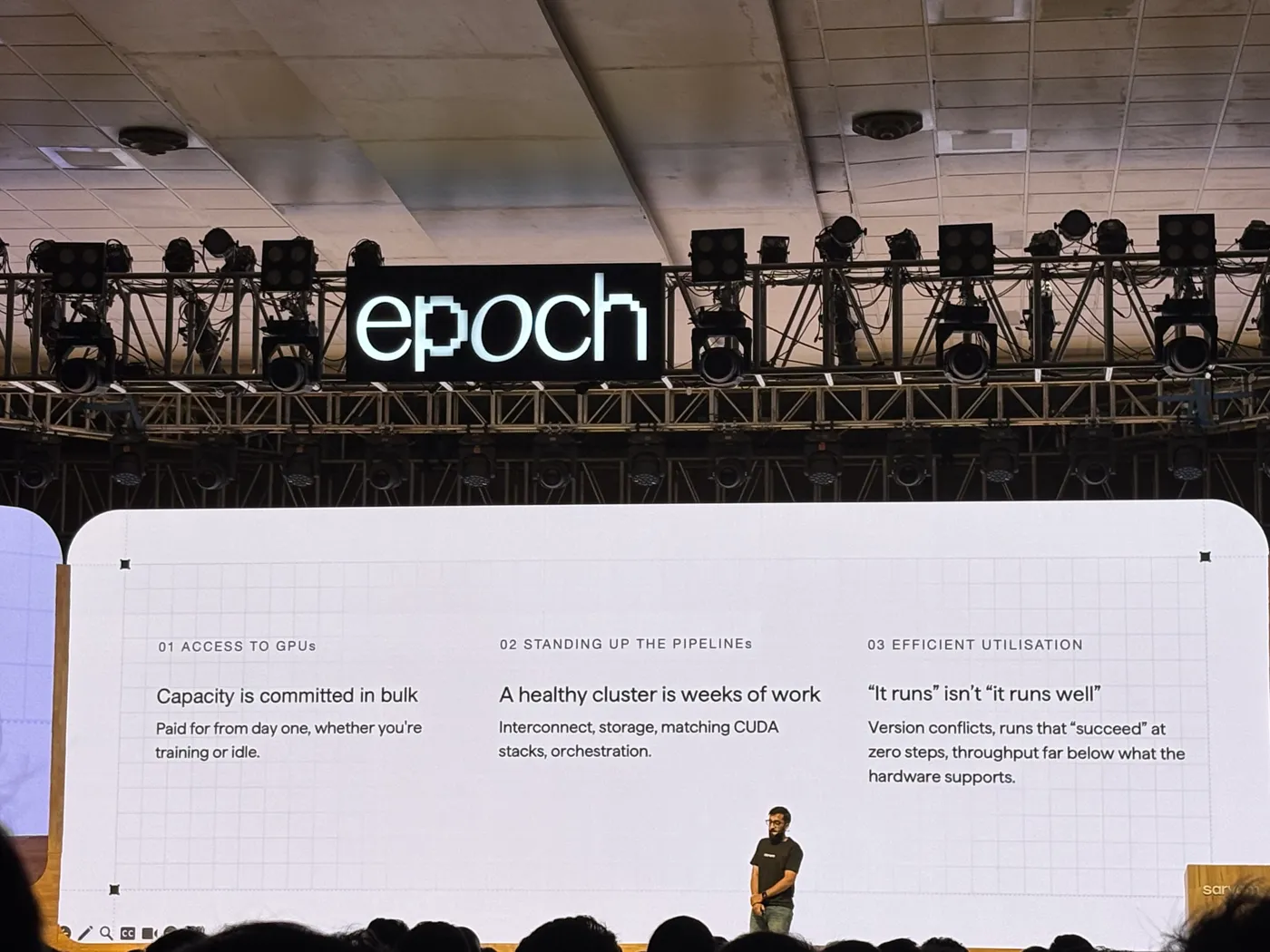
The slide on why this is a service lists three problems, and they are the ones I recognise from cluster work.
- Access to GPUs. Capacity is committed in bulk, and you pay from day one whether you are training or idle.
- Standing up the pipelines. A healthy cluster is weeks of work: interconnect, storage, matching CUDA stacks and orchestration.
- Efficient utilisation. “It runs” is not “it runs well”. There are version conflicts, runs that “succeed” at zero steps, and throughput far below what the hardware supports.
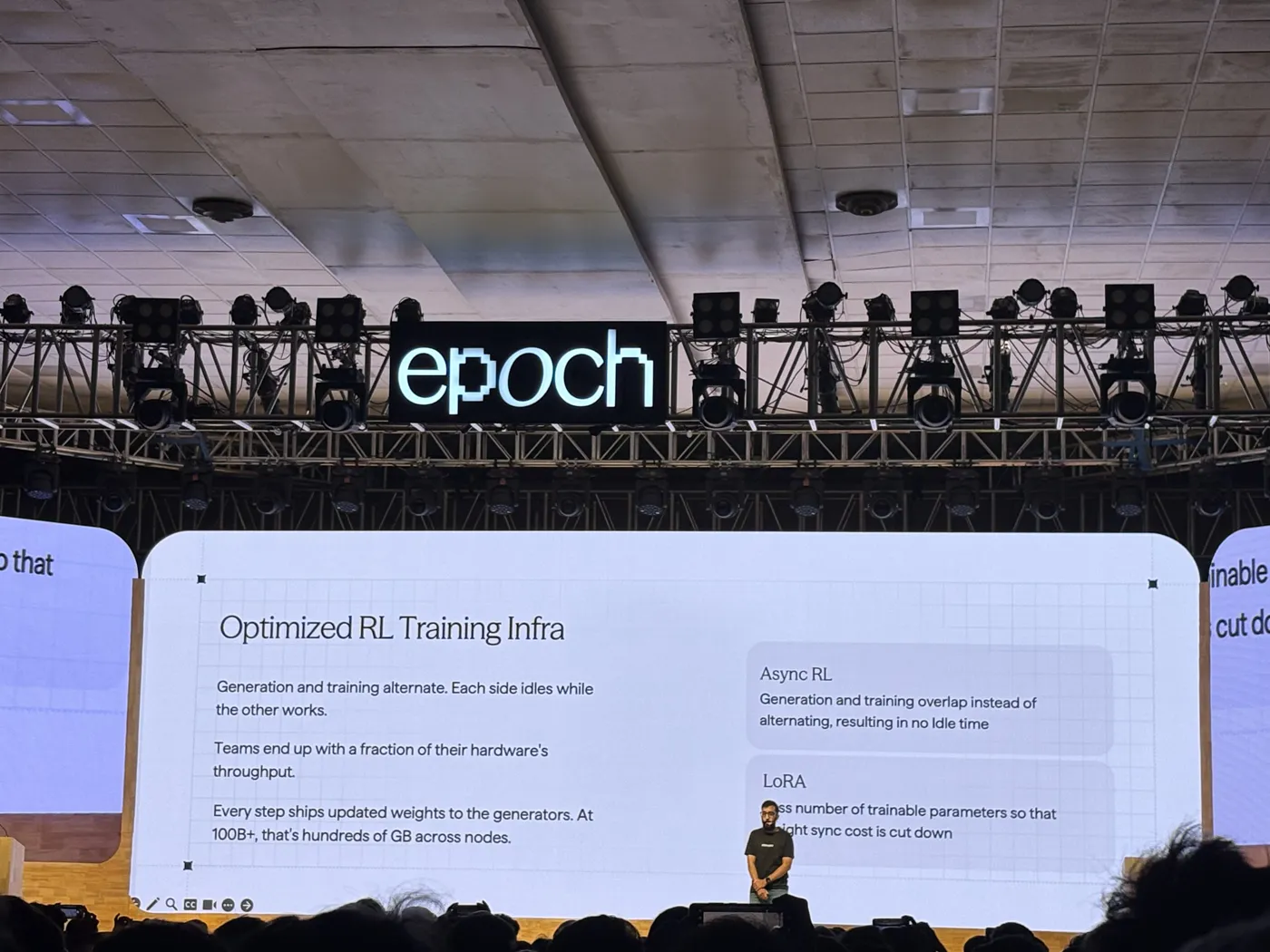 Optimised RL training infra: async RL and LoRA
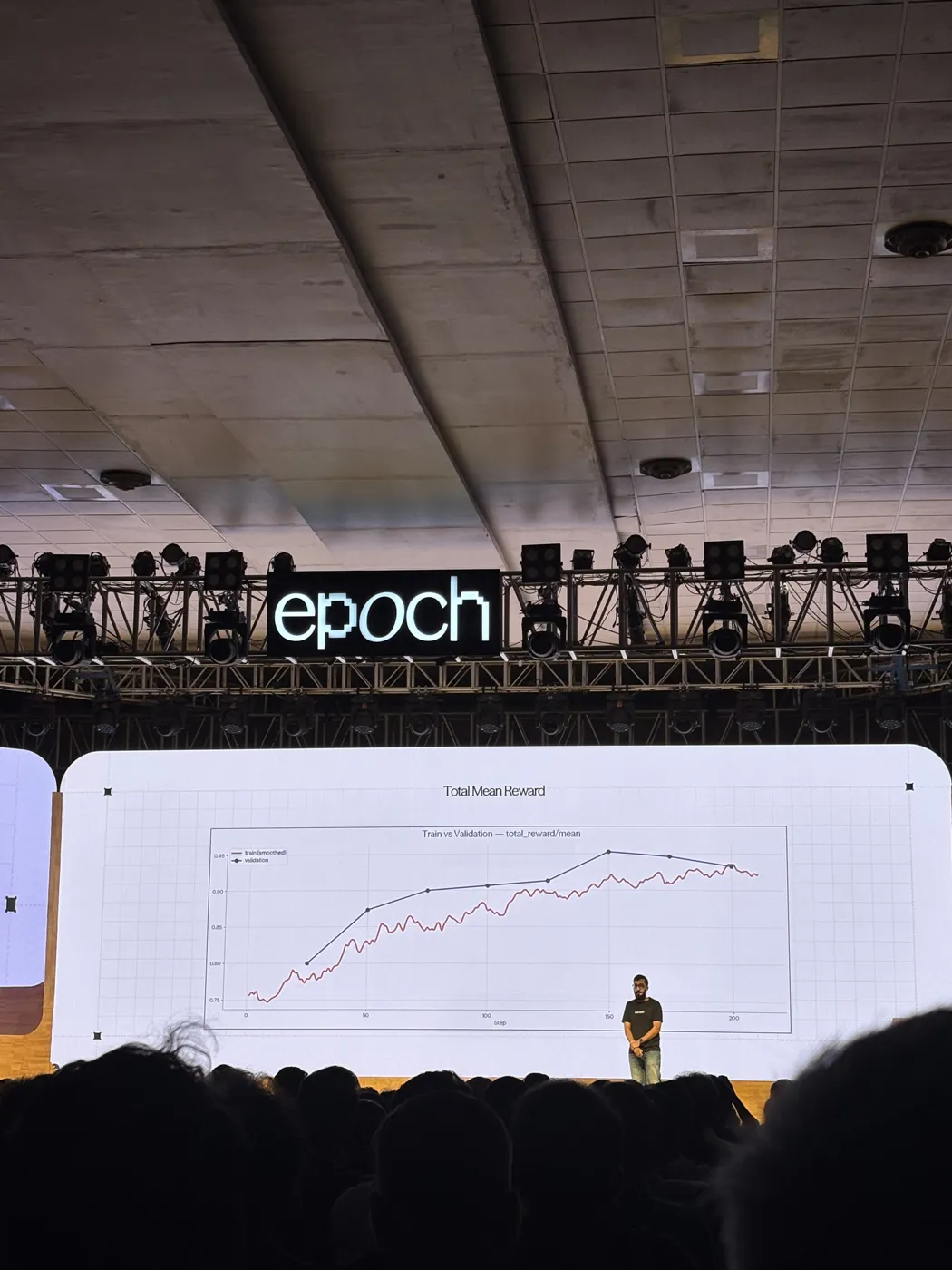 Total mean reward, train against validation, over about 200 steps
The next slide went into RL training, which is where the systems work shows. In a simple loop, generation and training take turns, and each side idles while the other works. While one worker runs, the other sits idle and its GPUs go unused. There is a second cost. The training worker has to sync weights to the generation worker, which can blow up into gigabytes or even terabytes and put pressure on the network between nodes.
The slide gives two fixes. Async RL overlaps generation and training instead of alternating them, so neither side waits for the other and training throughput is maximised. LoRA trains far fewer parameters, so the weights are small enough to send easily between two nodes. Note that the case for LoRA here is the network, not GPU memory. This is the same pipeline thinking as the RL environments talk at the PyTorch meetup.
Non-trivial. In GRPO-style RL the generation worker and the training worker take turns, so each sits idle while the other works. Overlapping them (async RL) fixes the idle time. The second cost is less obvious: every step must sync weights from trainer to generators, which can reach gigabytes or terabytes. LoRA shrinks the trainable parameters to something small enough to send between nodes, so one choice fixes the network problem too.
The slide shows a training run: total mean reward for the training set (smoothed, red) and the validation set (black). The speaker did not discuss it, so I do not know whose run it was. Reading the axes, the reward climbs from about 0.75 to above 0.9 in roughly 200 steps. Validation sits above training and flattens near the end. My reading is that a flat validation curve is what you want to see before you stop.
InferenceSarvam Inference: open models served from India
Sarvam Inference: open models served from India
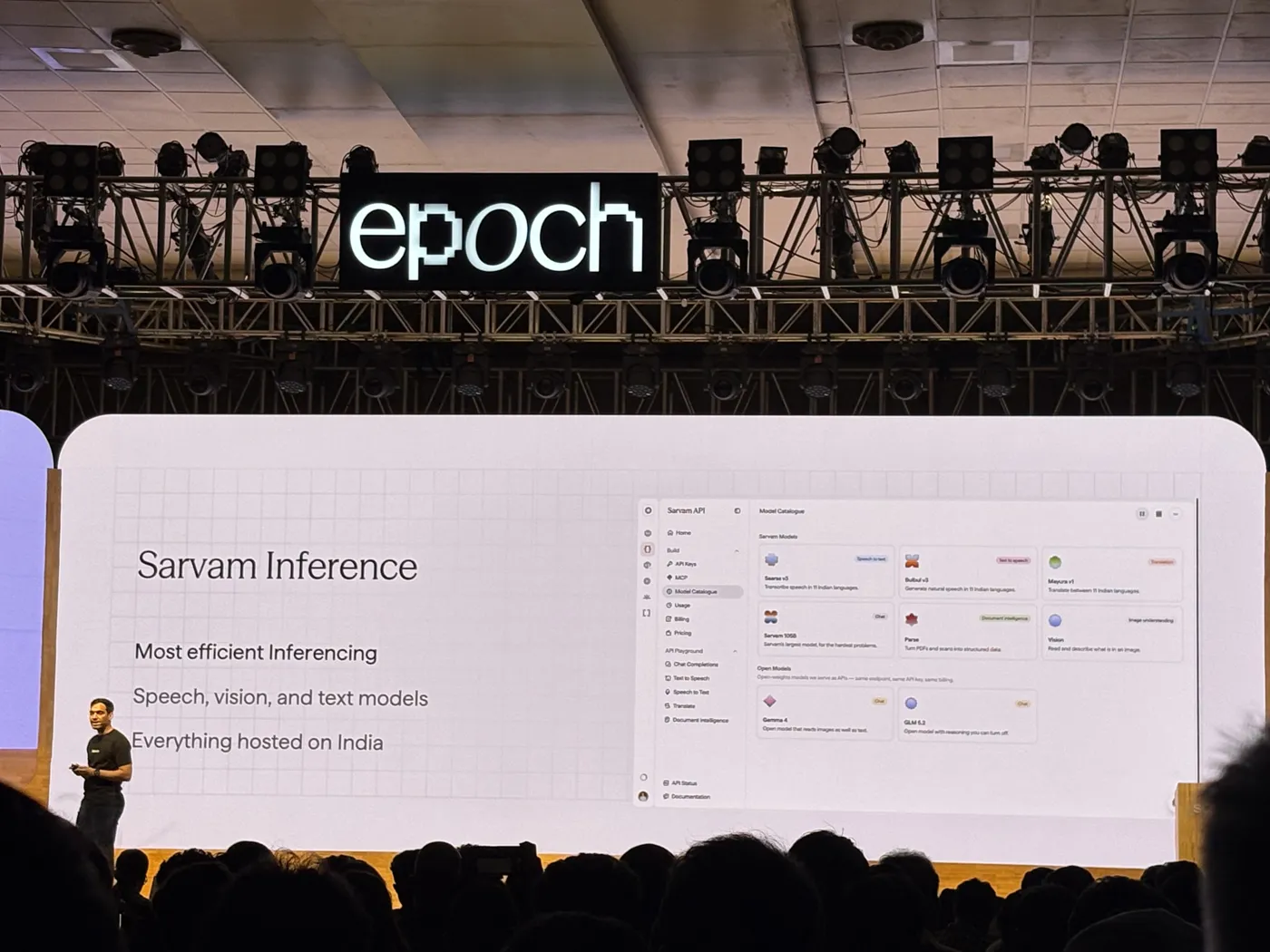
Sarvam Inference is the serving layer. It runs Sarvam's own models and frontier open-weight models from data centres in India. Sarvam’s summary says developers get the best open models and enterprises get data residency and compliance with Indian rules by default.
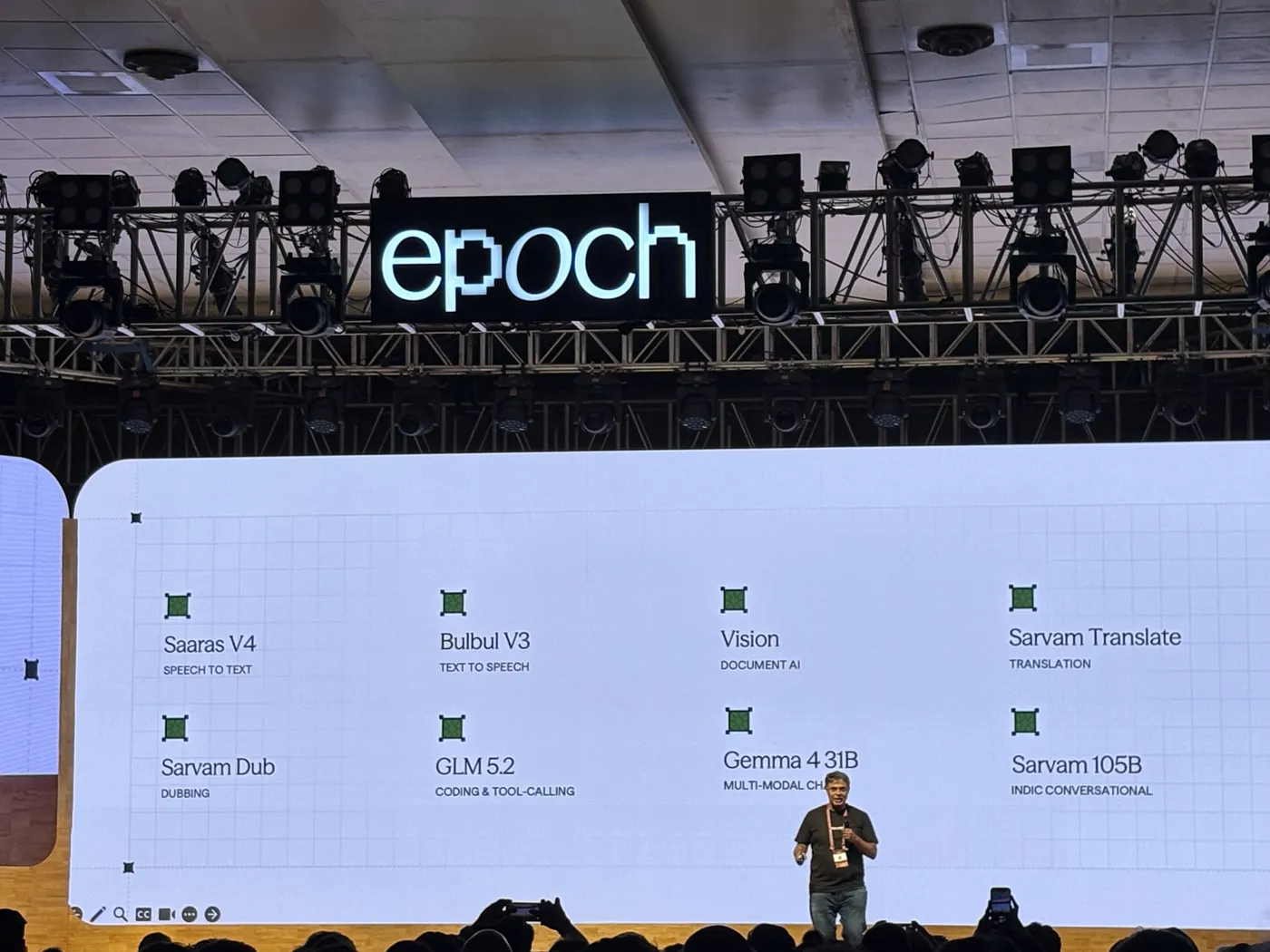
Vivek Raghavan introduced it. His point was simple. Today, if you want to use one of the top open models, you have to use it somewhere that is not hosted in India. If you want to control the intelligence, it has to run on Indian infrastructure. His starting point was blunt: all of Sarvam’s own models will be served too, and the three he picked to focus on were GLM 5.2, Gemma 4 and Sarvam 105B. He called GLM 5.2 a 768B mixture-of-experts model, one of the most capable open models, and said it would be served at a globally competitive price and 80 tokens per second. He did not say whether that is per stream or in total. He said Gemma 4 31B would run with a time to first token under 0.6 seconds, a target that sits close to the 0.63 s on the chart below. For conversational use, he said Sarvam will host the best models for instruction following, tool calling and voice calls, at about 9x lower cost than any other kind of model used for these tasks today. He did not name the comparison, so it is his claim. And there is 30% off for anyone who commits volume in August.
He closed on strategy. If a country cannot serve tokens itself, he said, that is the first step to becoming sovereign, and a real token factory from India is core to Sarvam’s strategy.
Non-trivial. Sovereignty here means serving the tokens, not owning the weights. GLM and Gemma are open and anyone can download them. If the tokens are served abroad, the country still does not control the intelligence.
The line-up slide shows eight models, each with its job. Saaras V4 for speech to text. Bulbul V3 for text to speech. Vision for document AI. Sarvam Translate for translation. Sarvam Dub for dubbing. GLM 5.2 for coding and tool calling. Gemma 4 31B for multi-modal chat. And Sarvam 105B for Indic conversation.
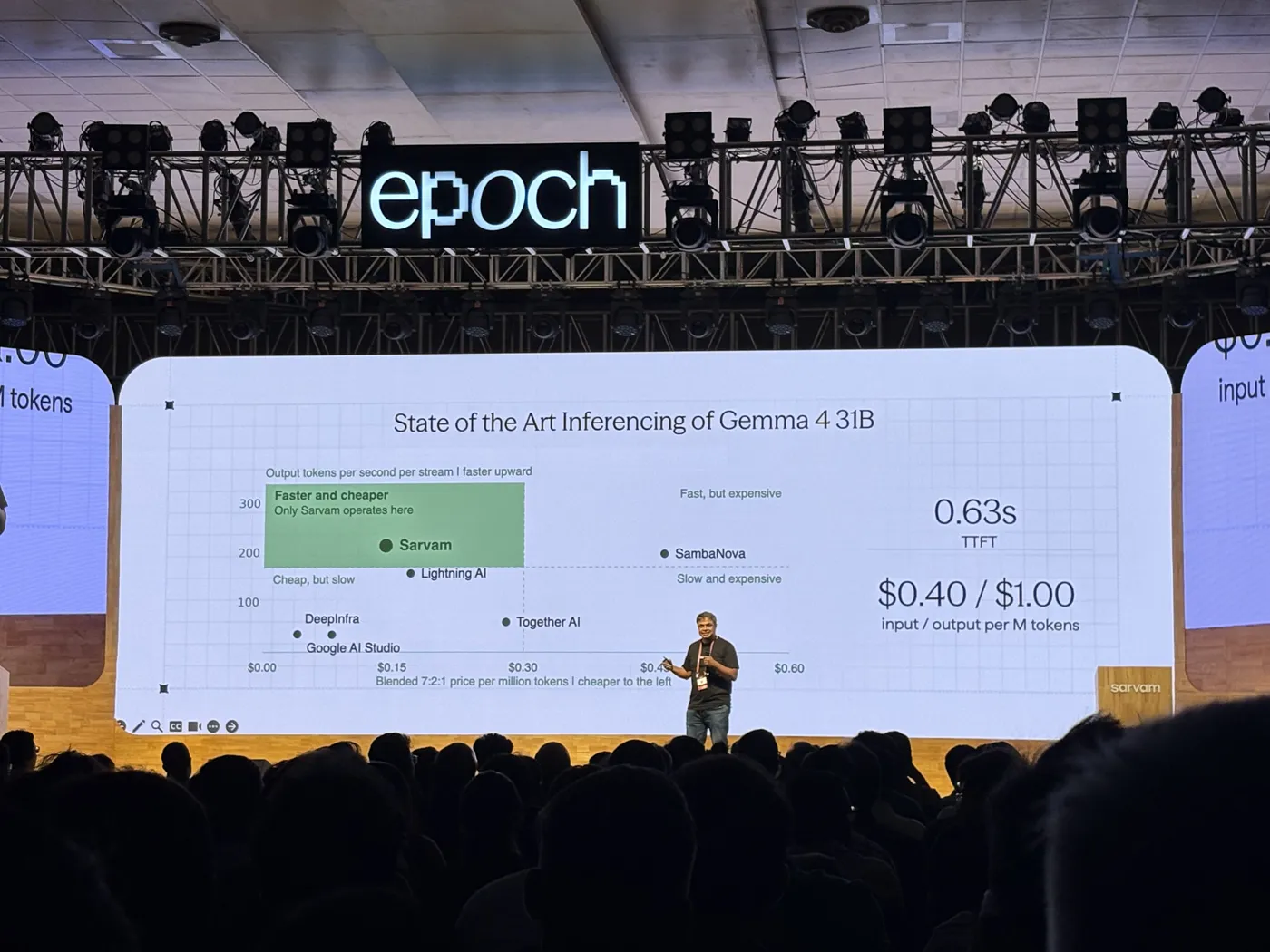
This chart is the clearest picture of the pitch. The vertical axis is output tokens per second for one stream, so faster is higher. The horizontal axis is the blended price per million tokens, using a 7:2:1 mix of input, cached and output tokens, so cheaper is further left. The green box is “faster and cheaper”. The slide says only Sarvam operates there. Providers such as Lightning AI, SambaNova, Together AI, DeepInfra and Google AI Studio sit outside it. On the right of the slide: 0.63 s time to first token and $0.40 input and $1.00 output per million tokens.
The summary post says the same story holds for other open models, using the P50 of real traffic on OpenRouter. It says GLM 5.2 is first on both speed and time to first token. It also claims Sarvam can take in a new open model and tune its serving within three days of launch. The serving details, with NVIDIA, are in the next section. All of this runs on the first fleet of Blackwell GPUs in India, and the fleet is growing.
How the speed is made
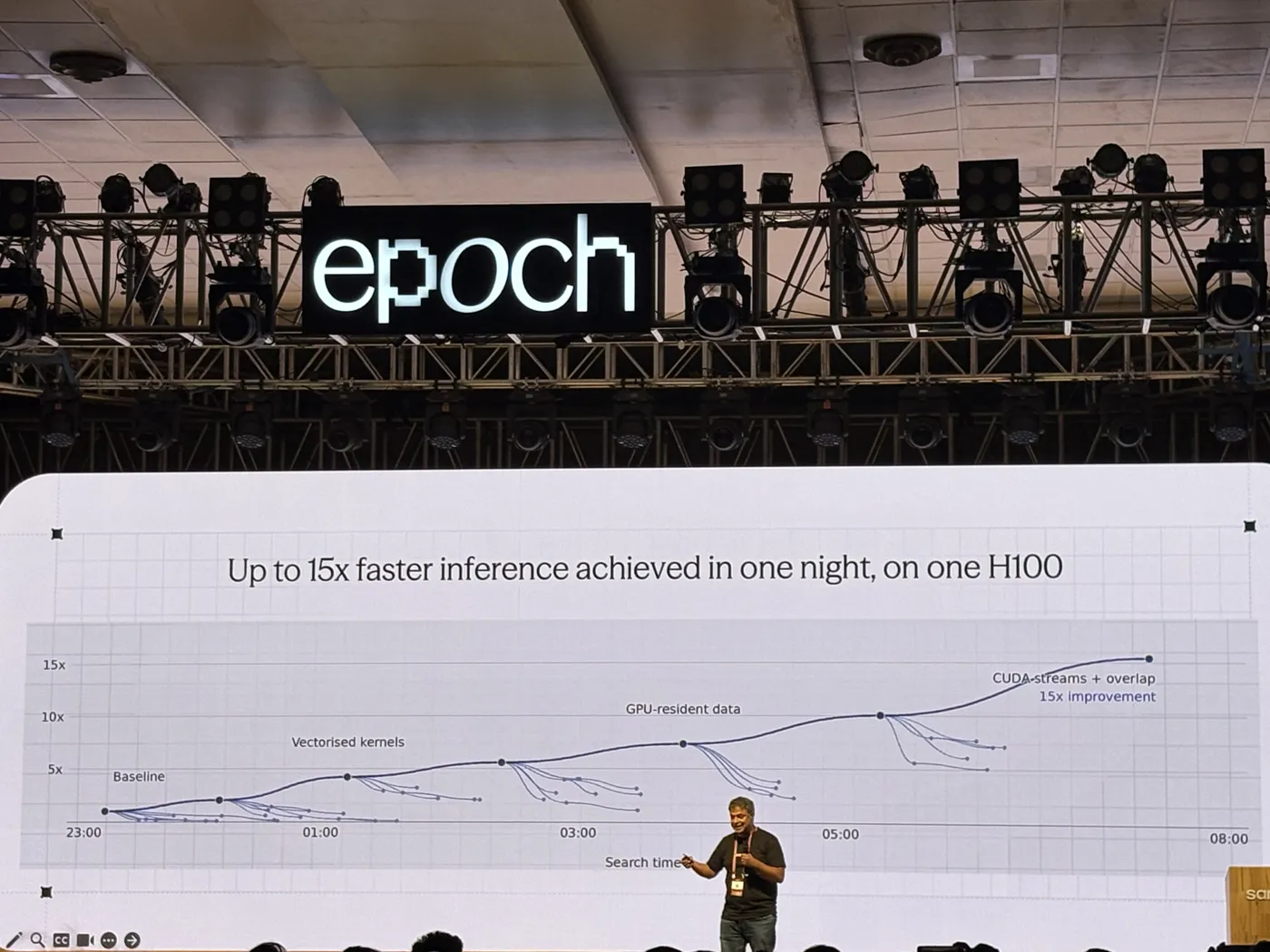
The summary names the work: kernels, disaggregated prefill and decode, KV cache across workload types, and trained speculator models. Then Vivek described something I did not expect, which was the inference team using an agent to do the optimising. Many people start from a model on Hugging Face, he said, but there is a lot of work between that and a model serving at scale, so the team built an agentic model-optimisation loop. He credited Ashwin and team, and his spoken example was a smaller model optimised overnight.
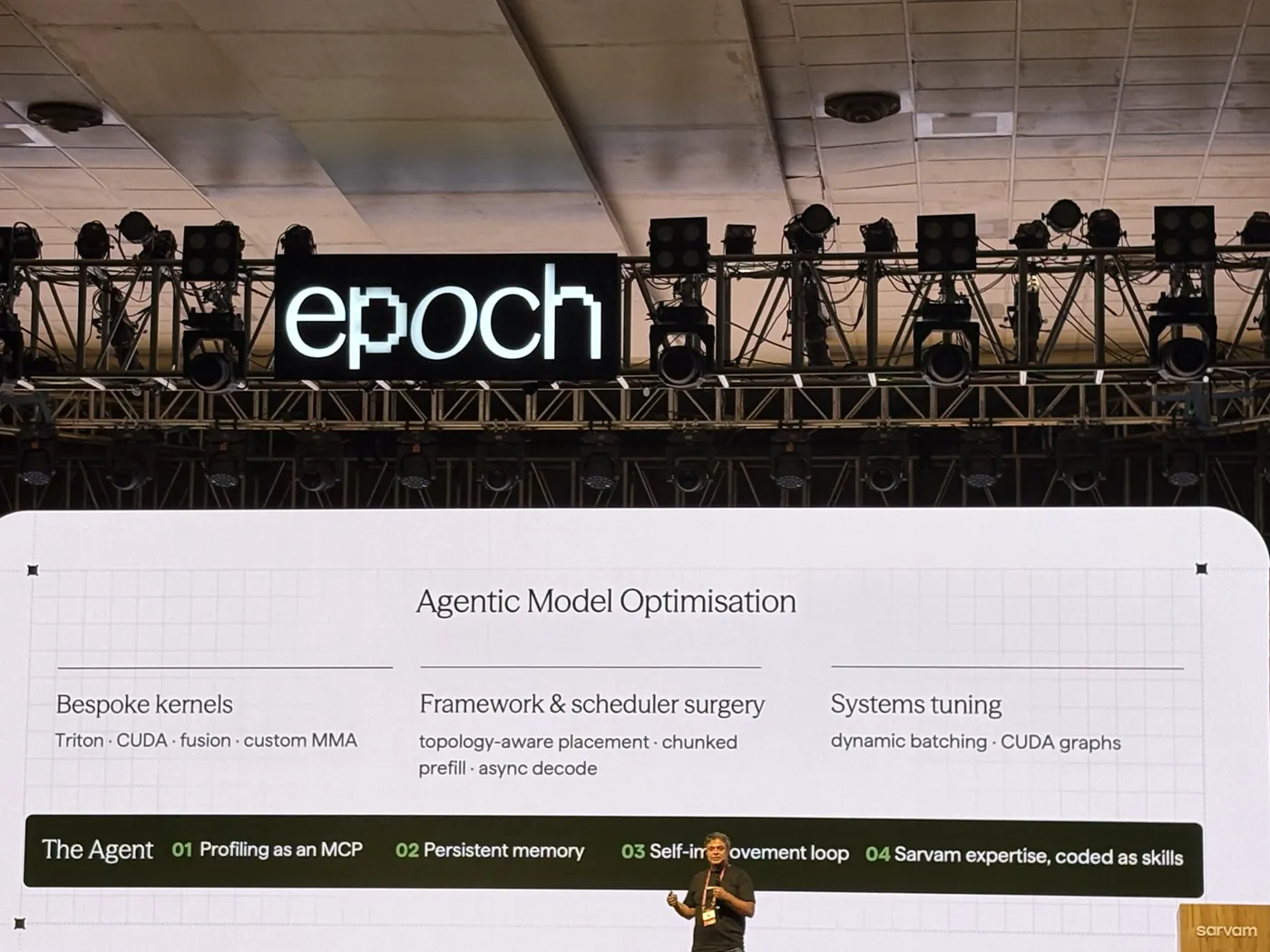 Agentic model optimisation: three layers of work and an agent with four parts
 Up to 15x faster inference in one night on one H100
The first slide splits the work into three layers. Bespoke kernels: Triton, CUDA, fusion and custom MMA. Framework and scheduler surgery: topology-aware placement, chunked prefill and async decode. Systems tuning: dynamic batching and CUDA graphs. Under that sits the agent, with four parts. Profiling as an MCP tool. Persistent memory. A self-improvement loop. And Sarvam's own expertise, written down as skills.
The chart is the result. On the slide, over one night on one H100, from about 23:00 to 08:00, the agent searched for faster versions of a model's inference. Each branch in the picture is an attempt. The main line keeps the winners: a baseline, then vectorised kernels, then GPU-resident data, then CUDA streams with overlap. The end of the line is up to 15x faster. It says “up to”, so I would not read it as a promise for every model. But it is a concrete case of what the profiling talk at the meetup argued: if you can measure it, you can optimise it, and now an agent can do the loop.
Using it
 Sarvam Inference: speech, vision and text models, everything hosted in India
 Extract, digitise, translate: playgrounds to explore and everything as an API
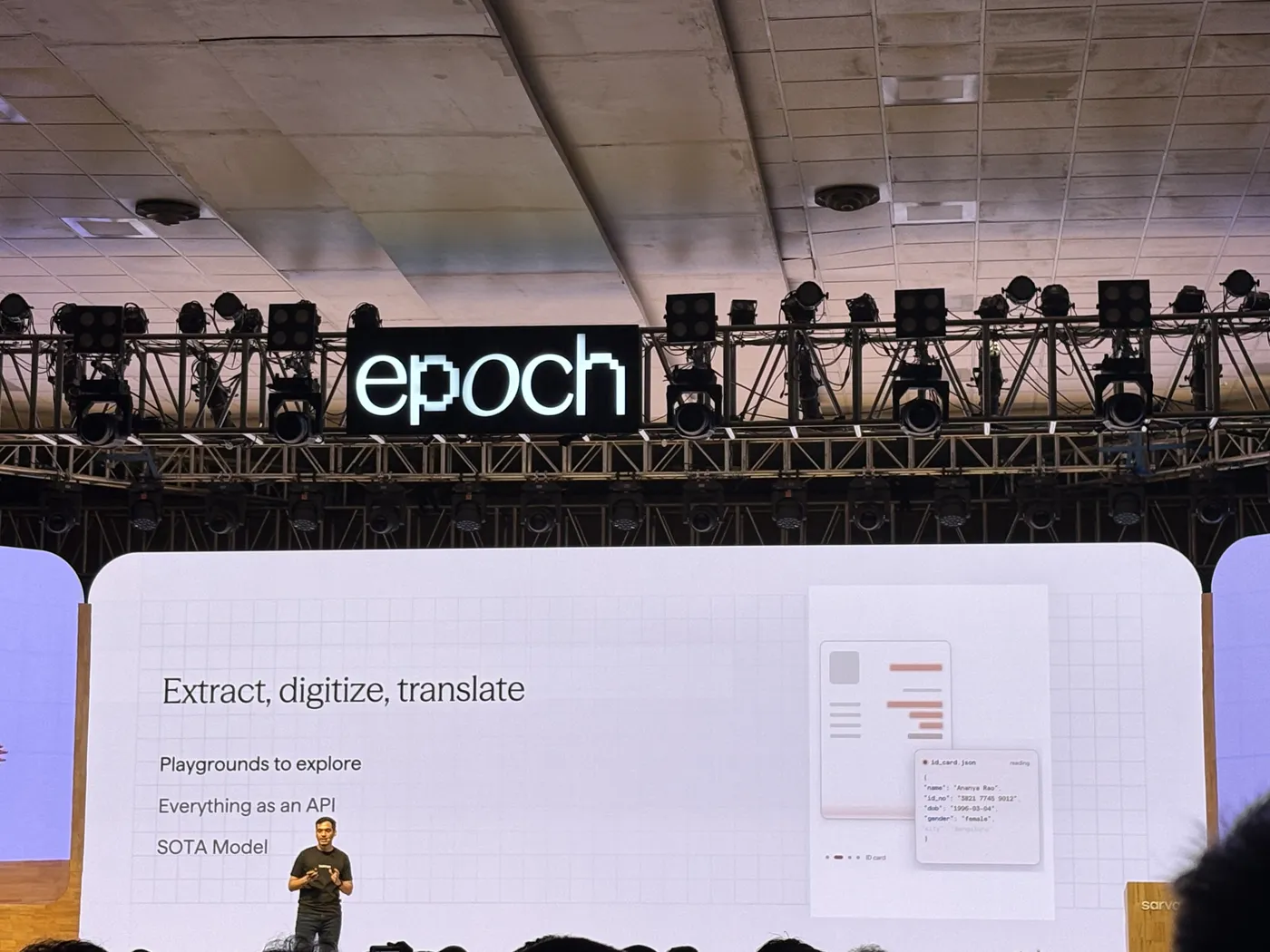
On the product side, there are playgrounds to explore each model, and everything is also an API. The console slide shows the model catalogue, split into Sarvam models and open models. The document example turns an ID card into a small JSON record.
NVIDIANVIDIA × Sarvam: serving mixture-of-experts on Blackwell
Utkarsh (NVIDIA) and Ashwin (Sarvam)
NVIDIA × Sarvam: serving mixture-of-experts on Blackwell
Utkarsh (NVIDIA) and Ashwin (Sarvam)
Utkarsh from NVIDIA and Ashwin from Sarvam covered how to co-design, optimise and serve large mixture-of-experts (MoE) models on NVIDIA Blackwell. Utkarsh did hardware, kernels and numerics. Ashwin did serving. It was a short talk without Q&A.
Why systems matter more now
MoE models are growing on a quarterly or even monthly cadence. Kimi had just released a model of about 2.8 trillion parameters. Training compute is not growing at that pace, but inference demand is, for three reasons: bigger models, reasoning modes that take many intermediate steps before the first visible token, and context windows that went from a couple of thousand tokens to a million. Throwing compute at long context is not efficient, because the return per token falls. Utkarsh's opening point: a good model alone does not make a deployment succeed. The systems part does.
The vocabulary, and the two phases
- Time to first token (TTFT) is what you see as the first token appears. The industry budget is about 1 to 2 seconds.
- Inter-token latency is the time between consecutive tokens during decode.
- FLOPs is how much compute you use and how efficiently. The core operation is matrix multiplication.
- HBM is the high-bandwidth memory on the GPU package. Attention comes in several kinds, such as MHA, MLA and GQA, each with trade-offs.
- Prefill processes the whole input at once, such as an entire repository. The work is matrix times matrix, so it is compute-bound, and it sets TTFT.
- Decode is the autoregressive loop. Each step reads the KV cache and does matrix times vector, so it waits on memory instead of compute, and it sets inter-token latency. The KV cache from prefill lives in memory, possibly across several tiers.
Why MoE inference is harder
An MoE swaps the dense feed-forward layer for a set of experts. A trainable router at each layer decides which experts to activate for each token. That makes an MoE far cheaper in compute than a dense model of the same size, but it creates a communication problem. A model like DeepSeek-R1 has 256 experts. You spread experts across GPUs, so each GPU holds only a few. At scale, every batch triggers a dispatch to send tokens to the GPUs that hold their experts, and a combine to bring the results back. At high load this all-to-all traffic becomes the bottleneck. So deploying Kimi, GLM or Nemotron-Ultra-sized models of 500B and up means budgeting for network bandwidth, not only compute and memory.
He framed four axes to ablate when you plan a deployment: scale-up (one GPU becomes many, at rack scale), scale-out (joining servers), low precision, and the runtime layer, which is Dynamo on top of vLLM, SGLang or TensorRT-LLM.
Non-trivial. Hardware alone does not finish the job. The speaker said the NVL72 rack and the Grace link solve the bandwidth problem in hardware, but without software that uses them you cannot scale the experts in production. That is why the talk pairs every hardware feature with a kernel or communication change.
Hardware: a rack as one GPU
An eight-GPU H200 server cannot hold a frontier MoE's experts, mostly because of memory. The GB200 NVL72, and the GB300, change the unit. It is a single rack with 72 GPUs, four per tray, joined by an NVLink all-to-all switch so that all GPUs share one plane of communication. The aggregate bandwidth is about 130 TB/s.
The second hardware idea is to treat the Grace CPU, an ARM chip, as extra memory for the GPU. Each Grace CPU has 480 GB of LPDDR, 960 GB across two Grace domains. By his count a single GPU has about 184 GB of HBM, which is not enough to hold all the experts. The link between Grace and the GPU is a chip-to-chip interconnect at 900 GB/s bidirectional. He quoted PCIe between host and device as 64, about 120 and up to 256 GB/s, depending on the generation. So you can park expert weights in CPU memory and move hot experts to the GPU often.
Communication: one-sided all-to-all
In a conventional dispatch, sender and receiver both take part and data goes through multiple buffers. In the one-sided version, the sender writes directly into the receiver's GPU memory using puts to dispatch and gets to combine, on shared symmetric memory. The receiver is not involved, and the intermediate FIFO copies disappear. He called the scheme precision-agnostic, meaning the transport does not care about the datatype. In the setup he described, tokens are cast to 4 bits before dispatch, so 4-bit tensors cross NVLink. He did not name the 4-bit format for this step. All of this happens behind the scenes while a coding or agent request is running, so the saving applies to every request.
Kernel level
- CUDA graphs help on any GPU, not just GB-series. Launching a kernel costs CPU time, and on small workloads that cost shows.
- PDL (programmatic dependent launch) lets one kernel start its setup while the previous one is still finishing. His example of work that overlaps instead of running serially was routing and computation.
- Fusion: the QKV concatenation is removed by feeding the Q, K and V tensors straight into the attention kernel.
Wide expert parallelism, and why balance decides everything
Expert parallelism (EP) within one node ends up bound by memory bandwidth, so it helps to spread experts across nodes. He said that past EP 8 the grouped matrix multiply grows, though his own graph below shows GEMM time falling as EP rises, so treat that remark as loosely worded. What is clear is that which experts are hot depends on the data. Routing decides at run time which GPUs are active for a given query, so the load moves. Two measures keep this under control.
- A custom all-gather prepare kernel replaces the standard all-gather, so communication volume stays flat as EP grows instead of rising with it.
- Hot experts depend on the data, but the pattern settles over time, so it can be predicted. Background C++ threads move the next hot experts from Grace memory to the GPU ahead of need, so inference never stops for rebalancing.
The numbers on the slide: as EP rises from 4 to 72, the MoE GEMM time falls from 275 microseconds to 75. That sounds tiny, but against a TTFT budget of 1 to 2 seconds, every microsecond is counted. The second graph shows the catch. In the imbalanced case the all-to-all spikes above 400 microseconds. His rule: you have to enforce a balanced load to use wide EP.
Non-trivial. Wide EP is only a win when the load is balanced. With an imbalanced load, he said, there is no point in doing wide EP. The hot-expert prediction and background swapping are how the system tries to stay balanced. By my arithmetic, going from EP 4 to 72 is 18 times more GPUs for a 3.7 times faster GEMM, while one imbalanced all-to-all can cost more than the whole 275 microsecond GEMM at EP 4.
Numerics: block-scaled low precision
Going from 16 or 32 bits down to 8 loses accuracy, so the formats use micro-scaling. Block-scaled formats came out of an industry consortium. A tensor in these formats carries three things: the encoded values, a scaling factor and metadata. In the 8-bit block format (MXFP8), 32 values share one scale, and that scale is limited to powers of two (an E8M0 value). He said block scaling started with the Hopper generation and that Hopper natively supports MXFP8. That is how he put it. Micro-scaling hardware support is usually credited to Blackwell, so check this before relying on it. The talk asked why this needs hardware support at all, when software could do it. The reason: for each block you compute a scale, do a dot product, accumulate and post-process, and that many operations add up. Done in software they cost too much, which is why the feature went into the hardware.
NVFP4 goes to 4 bits with two levels of scaling. The elements are 4-bit E2M1. He also named E3M0 as a second variant used in some cases, which does not match how NVFP4 is usually defined. Each block gets its own scale in E4M3, which is a finer set of values than powers of two, so the encoding is more accurate. But a finer per-block scale narrows the range of values the format can cover. So there is a second level: one FP32 scale for the entire tensor, which restores the range. The constraint that governs every low-bit technique is the same: keep the accuracy intact. NVIDIA open-sources these quantised checkpoints, for its own models and for others.
Non-trivial. Two-level scaling is the trick that makes 4 bits usable. The per-block E4M3 scale buys accuracy, the per-tensor FP32 scale buys back the range that the first one gave up. Neither would work alone.
Sarvam's side: serving at scale
Ashwin said this work came out of the token-factory announcement that morning. A large model like Kimi or GLM is no longer a single-model workload. It is a system of CPUs, RDMA, storage and more, at the scale of thousands of devices. Kimi K3 is the one he used as the example. He listed four challenges.
- Sharding. Kimi K3 does not fit on one B200 node even at 4 bits. And even when a model fits, one node is not efficient at both phases, because prefill is compute-heavy and decode is memory-bandwidth-heavy. So how do you split the work across them? Once the model is split sensibly, the next problem is the cache.
- The cache. The KV cache is insanely large. With context lengths of a million tokens for GLM and later models, a node holds only a few users. To avoid recomputing a user's cache when their next turn arrives, you need the cache in several offload tiers, shared across nodes over east-west RDMA networking.
- Reality. Everything above was tuned on static load tests. In production, users hit the system in unpredictable ways, from co-work agents, coding agents and APIs, at random arrival rates. Arrival rate and input and output lengths change where the optimal operating point is.
- Disaggregation. At this model size and context length it has become a necessity. To get the most input tokens per second from a node, and so cut the cost per input token, you must keep all the compute busy without hurting the latency targets of requests already in flight.
Non-trivial. The best configuration is not a constant. It moves with the arrival rate and the input and output lengths. A system tuned on a static load test is tuned for a workload that production will never send.
PlatformIndus, Work Agents and Sarvam Code
Indus, Work Agents and Sarvam Code
The host framed the session first: Sarvam had focused on research and on bespoke work for enterprises, and now it was coming out with products that are generally available. Then Mani took over. Indus first launched four months ago as a way for customers to experience Sarvam, and he called today's version “10x supercharged”. It is six tools in one platform: voice agents, work agents, content agents, document agents, coding agents and the API inference stack. He called it the largest agent tech super app: you sign up once, with one payment gateway and one credit system. More than a million developers are already registered on Sarvam's developer platform.
Voice agents
The voice agents product is called Samvaad. The room played a guessing game first. How many minutes have Sarvam's agents spoken with real customers in 12 months? The answer was 325 million, about 618 years of conversation. Voice, Mani said, is how Indians talk to businesses, not email and not chat. Each of those minutes taught the team what a voice agent needs in India: callers who start in Kannada and switch to Marathi, interruptions, background noise, latency and voice activity detection. Until now only enterprises had this system. As of launch day it is open to everyone, on the same models, the same technology and the same price.
Three claims followed, each with a demo.
- Build in under 60 minutes. Today a product manager writes a scoping document and hands it to a developer, who has to pick the models, orchestration, runtime and harness. That is why a voice agent typically takes about three weeks outside Sarvam. Here you describe the agent in plain language and answer a few questions, such as when the customer should be called and which languages to enable. The demo agent was for abandoned carts. It plans the conversation design, the greeting, the tools, the languages and the dialects, and builds the agent. Mani said the real pain in building voice agents is testing, because teams make manual calls and check them by hand. A new simulate-and-run feature simulates about 1,000 realistic users against the agent, so it improves a great deal before its first real customer calls.
- A phone number in 30 seconds. The usual route is a telecom provider, KYC, minimum commitments, contracts and then SIP trunking. One team in the story spent six weeks and then found its trunk worked in only one direction. Mani said Sarvam is the only platform that rents Indian numbers, in the 080 and 91 series, inside the product. The demo uploaded a PAN, an Aadhaar and a GST number and had a working number in 30 seconds.
- Workflows. One agent handles a call. A fleet of agents delivers an outcome. A customer relationship plays out over day 0, day 1 and day 7, with a different agent at each stage of intent. In a workflow the agents share memory, prompts and one personalised customer profile. In the demo a cart is abandoned and a WhatsApp reminder goes unanswered. An agent calls, learns why the customer is not buying and when they want a callback, and books the callback with no human involved. The screen showed the extracted intent, the reason for not buying and the requested time. Two days later a different agent, with a different prompt and nudge, calls back with that context. This time the customer buys. The platform has more than thirty features across building, deploying, monitoring and evaluating.
Agents that improve themselves
You define the goal in a plain sentence, for example that every time a customer qualifies as a lead, it counts as a success. After a week of calls, the system reviews the conversations every day and night with no human in the loop. The demo showed it going through 4,812 of them. It found that customers hit budget limits and that the agent was weak at noticing when a customer wanted a callback. It then ran prompt experiments with four variants, one of them a control, across several days and samples. The winner reached a 32% conversion rate and a human approves it before it goes live. Mani called this automated evals across thousands of conversations, not a person sampling ten. At a large fintech in production, conversion rose almost 3.5 times between day 0 and day 28.
Non-trivial. This is automated evaluation over thousands of conversations instead of a person reading ten. The loop is: define success, collect outcomes, find what breaks, test variants, keep the winner, and keep a human approval at the end. Testing is also the product's first answer: 1,000 simulated users before launch, and 4,812 real conversations mined after it. Both are one eval loop, not two features.
Then Mani ran a blind test. He played a call with two speakers and asked the room which one was the AI. In the call the customer is told there is no sneaker discount on the site, but as a regular customer they get a special coupon: 2,499 rupees becomes 1,999. The customer confirms the address, picks cash on delivery and asks to move the delivery by a day.
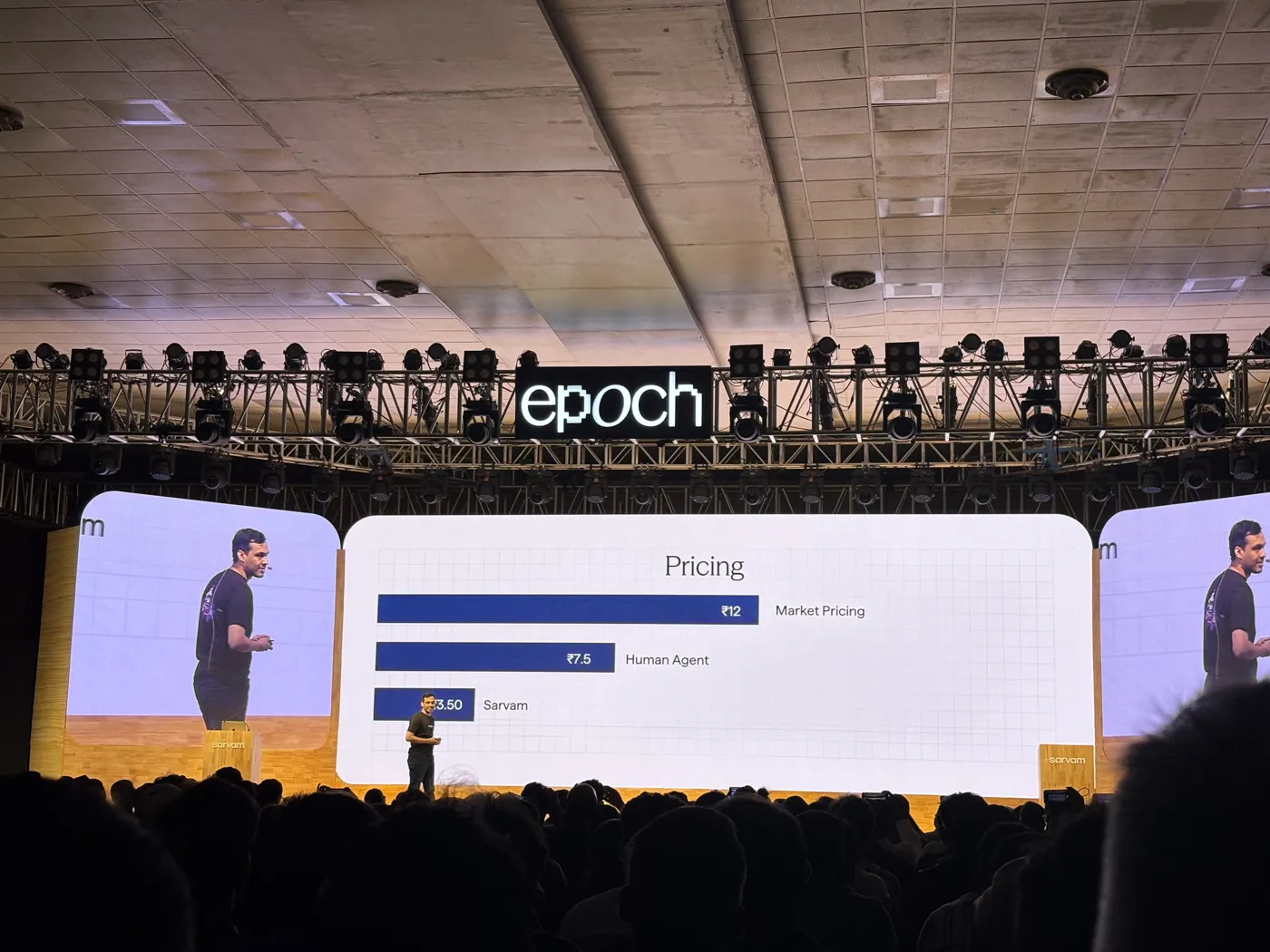
Then the price. Samvaad costs ₹3.50 per minute, which Mani called the lowest in the industry. That price bundles AI-based authoring, simulation, phone numbers, evals and analytics. The slide compares it with the market price of ₹12 and a human agent at ₹7.5. On stage the range was wider: most players charge ₹8 to ₹12, and an average employee costs ₹4 to ₹6, so the slide and the speech do not quite match.
A Sarvam leader who joined Mani on stage made three points. First, he said Sarvam does not talk about being the biggest voice AI platform, but it serves the largest one, and the 325 million minutes is as much a go-to-market achievement as a model one, because it took work with enterprises to make it work at scale. Second, voice AI used to need Sarvam to go in and build with each enterprise. Now a small business, or a product team inside a large company, can go live in about a minute with a PAN card and an Aadhaar card. Third, an expensive frontier model can be used to evolve the system while cheap real-time models talk to users, and the agents keep being tuned to one enterprise's context.
Work agents
The framing: scaling work used to mean adding hands. Now organisations will be teams of humans and agents. Sarvam's marketing team has about twelve people, three of whom eat food and nine of whom consume tokens. About 25 to 30% of Sarvam's workforce is agents, working on code, data analytics and product decisions. A colleague added that Sarvam probably has thirty-odd agents, with every team using them.
The work agent is a full agentic system for long-running tasks. It writes and runs Python inside a secure sandbox, breaks the work into six or seven steps and asks the human when it is unsure. You can steer it at any step. It comes with the usual business connectors, and one click brings a data source in as context. Skills let you describe your own way of working: Mani asked how a company can condense its 10x engineer into something an agent can follow.
The demo gave an agent roughly ten Excel files and about 3 lakh rows, with a trial balance, sales and purchase registers and bank statements, all messy. The ask was an investor presentation for a meeting later that month. The human answered the agent's questions mid-run and set the focus: strategic partnership, one short standard slide, a clear professional tone, HTML output. The live run was still going when time ran short, so Mani showed the finished result from a prepared slide. He said the real run takes 10 to 12 minutes, as a single-shot task. The result was an interactive deck with the top ten customers, monthly sales and product lines. A finance person would normally need six to seven days.
About six to nine months ago, Mani said, OpenClaw and Hermes showed what an agent can do once it has a machine. Sarvam took those ideas and fixed what broke: insecure machines, and machines that clogged when requests went up. Three design choices sit under the harness.
- A custom sandbox. A custom gateway sits between the sandbox and the outside world, so everything executed in the sandbox stays secure and the agent never sees your API credentials or secrets.
- Multiplayer by default. Those frameworks work for one person. In an enterprise an agent can be promoted to a shared workspace, with role-based access and guardrails at the MCP layer, the agent layer and the chat layer.
- Everything in India. The inference, the model, the harness, the product and your data stay in the country.
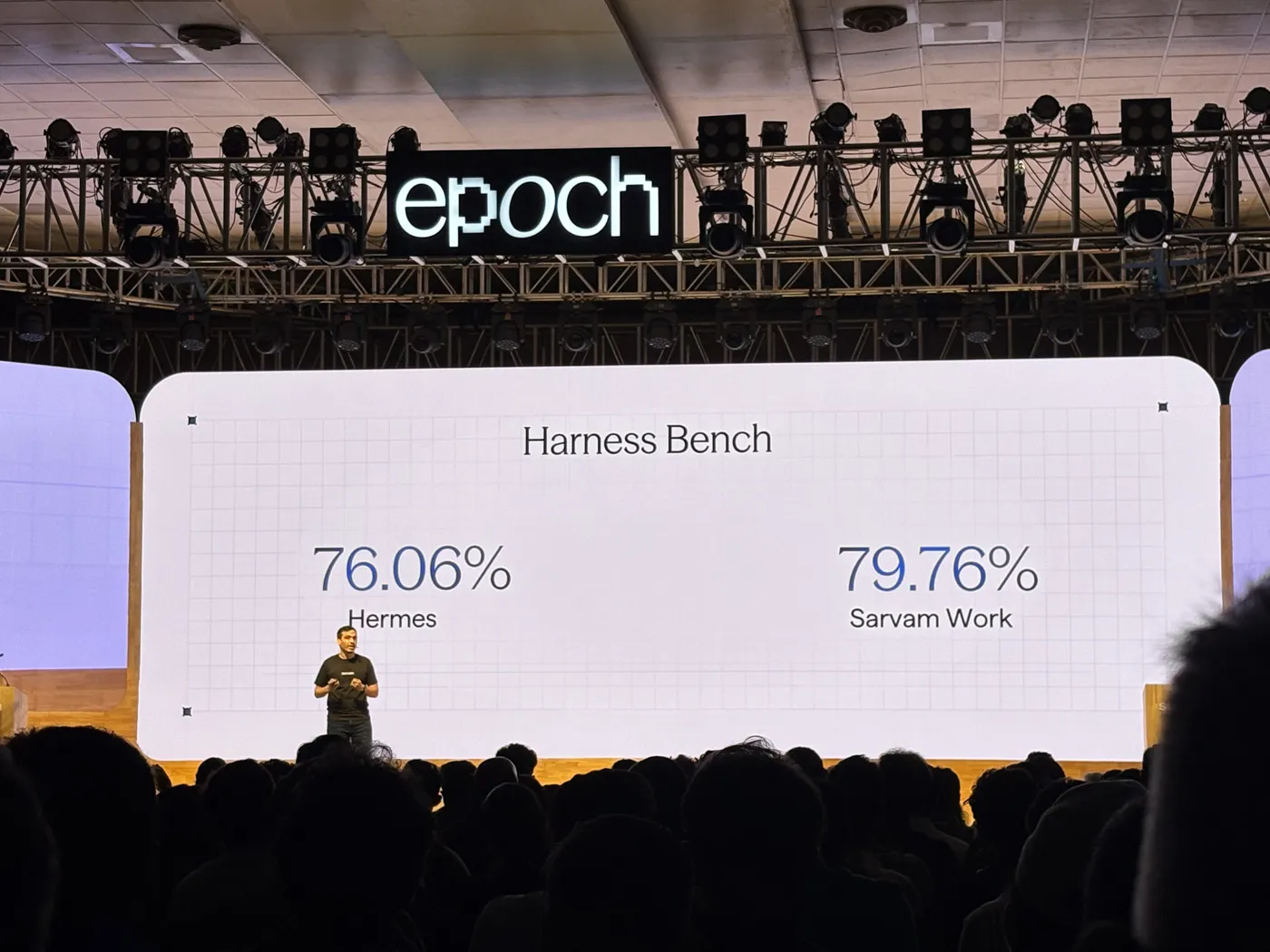
The benchmark comes after those choices and scores tool use, long-running tasks, latency and more, not security. Mani called Hermes widely regarded as one of the biggest harnesses and put it at 76, with Sarvam Work beating it by three percentage points at 79. The slide shows 76.06 and 79.76, a gap of about 3.7 points.
A second speaker pointed to the market. Most people today use Claude, Claude Cowork or Gemini Enterprise, and now there is an Indian product. For an enterprise the point is to avoid a sprawl of agent systems and security worries, and to get one product you can buy, connect your own systems to, and control with role-based access. Sarvam uses it internally, and the pitch includes Indian government bodies.
Non-trivial. The sales pitch for the agent platform is security and operations, not raw intelligence. Credentials never enter the sandbox, and one agent can be shared with a team. That is what turns a personal agent into something a company can buy.
The knowledge layer
Every enterprise has legacy context: folders of markdown, HTML, code bases. Sarvam built a layer, called Tejas, that brings ontologically rich enterprise context to Sarvam Work. The agent treats mixed folders as a file system. It reads, drills down, looks at one thing and discloses more only as it needs it. This is not the vectorised retrieval of the RAG world. It then grounds each answer by showing where in the knowledge base it found it. The speaker's image, from a senior Sarvam leader who joined at this point: the LLM is your CPU, the operating system is the harness, and the knowledge base is a pen drive you plug in.
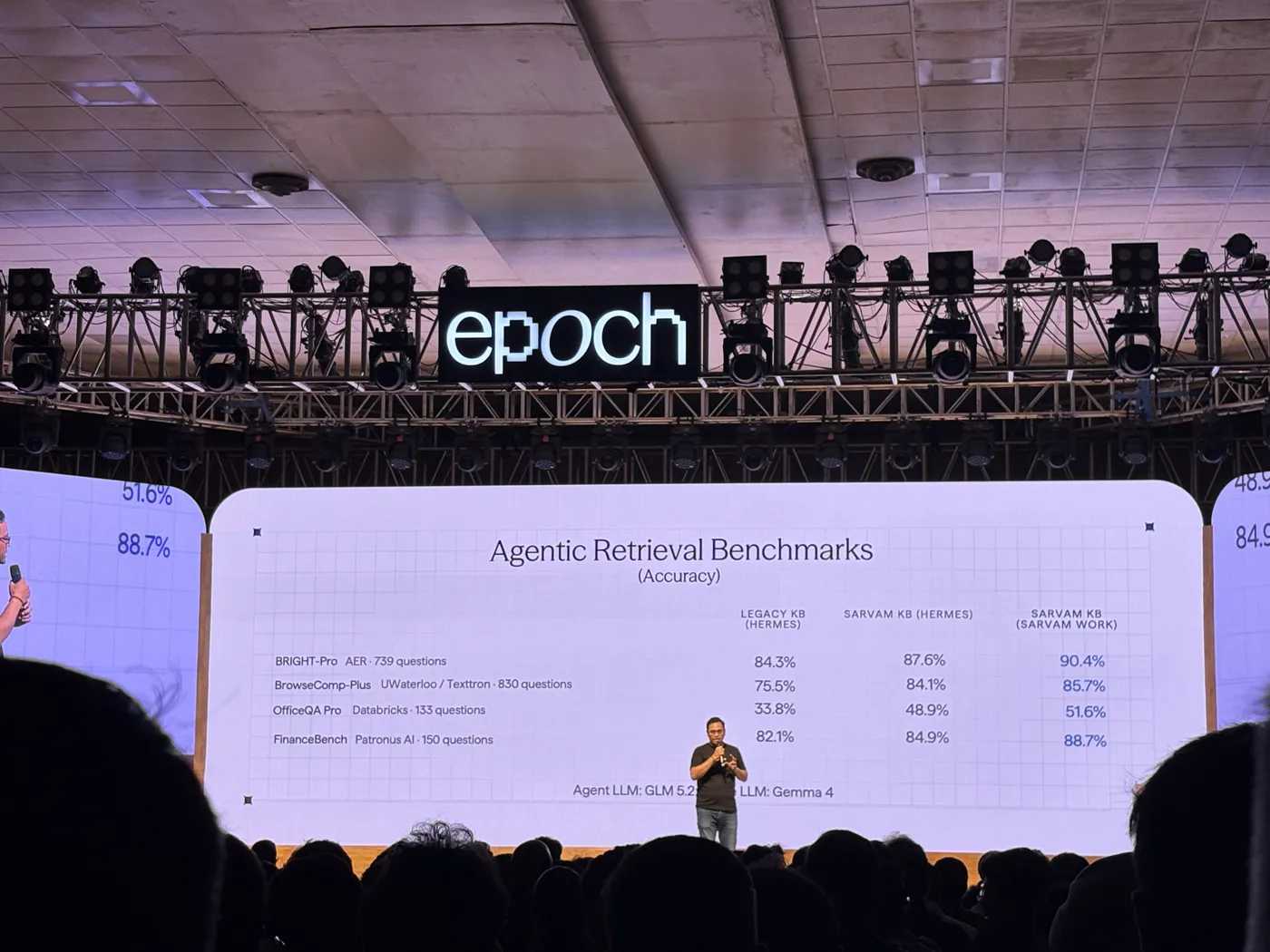
The slide compares three setups on four international benchmarks: a legacy vectorised knowledge base with Hermes, the new knowledge base with Hermes, and the new knowledge base with Sarvam Work, where both parts were tuned together. The numbers are from the slide.
| Test | Legacy KB (Hermes) | Sarvam KB (Hermes) | Sarvam KB (Sarvam Work) |
|---|---|---|---|
| BRIGHT-Pro, 739 questions | 84.3% | 87.6% | 90.4% |
| BrowseComp-Plus, 830 questions | 75.5% | 84.1% | 85.7% |
| OfficeQA Pro, 133 questions | 33.8% | 48.9% | 51.6% |
| FinanceBench, 150 questions | 82.1% | 84.9% | 88.7% |
On every test the better knowledge base lifts the same agent, and the better agent lifts it again. The biggest jump is on OfficeQA Pro, from 33.8% to 51.6%.
Non-trivial. The speaker's explanation for the gain is the mechanism itself: instead of receiving top-k chunks, the agent reads, drills down and discloses more as it needs it. The largest jump on the slide is on OfficeQA Pro.
Custom agents, and agents in Slack
Mani's argument: the 10x employee has intuition, know-how and context, and a chat box cannot give you that. Agents should work toward goals, not wait for prompts. The demo built an agent to root-cause bugs, for a developer who loses 30% of the day to them. The platform asked which connectors to use, which tech stack and which repository. The developer answered Signoz and Sentry and named the repository, then added context on the kinds of bugs and how to read Sentry. The platform added GitHub, Sentry, Signoz and web search, and wrote a diagnostic skill and the instructions on its own. You can open the skill files, review the connectors and give authorisation. The whole path from idea to live agent took under ten minutes.
The second point is where it lives. You do not want employees to work from the office while agents work from home, so agents should come to Slack. The live console failed at this point, so the demo was a pre-recorded video. You click Add to Slack, enter your secrets, then add a name. Ishan, the product manager, asked the agent, called Verdict, to check a turn from a recent session and work out a bug. It pulled traces from Sentry and read the code in GitHub, and a backend developer then joined the thread. A colleague noted that an agent in Slack sits next to other users and takes in what they say in the channel as its context. Work agents are live for everyone, free, and Mani asked people to connect their data, build artifacts and send feedback.
Content and documents
India produces and consumes more content than anywhere in the world, Mani said, and Indic voices and content should get best-in-class tools. The content studio has more than fifty voices, text to speech, voice cloning in different languages and dubbing with lip-sync and emotion preserved. He held back the details on dubbing until the launch and showed a sneak peek. The last item of the demo reel was the keynote itself, dubbed live on YouTube into Gujarati and other languages. In the document playground, English to Indic and Indic to English translation is said to beat state-of-the-art benchmarks, and every configuration there becomes an API. For repeat work, such as a big fintech reading handwritten bank forms and notes, the agent and document-agent APIs automate it at scale. The sixth product is Sarvam Inference, so Gemma and GLM sit on the same platform as Sarvam's own models.
Sarvam Code
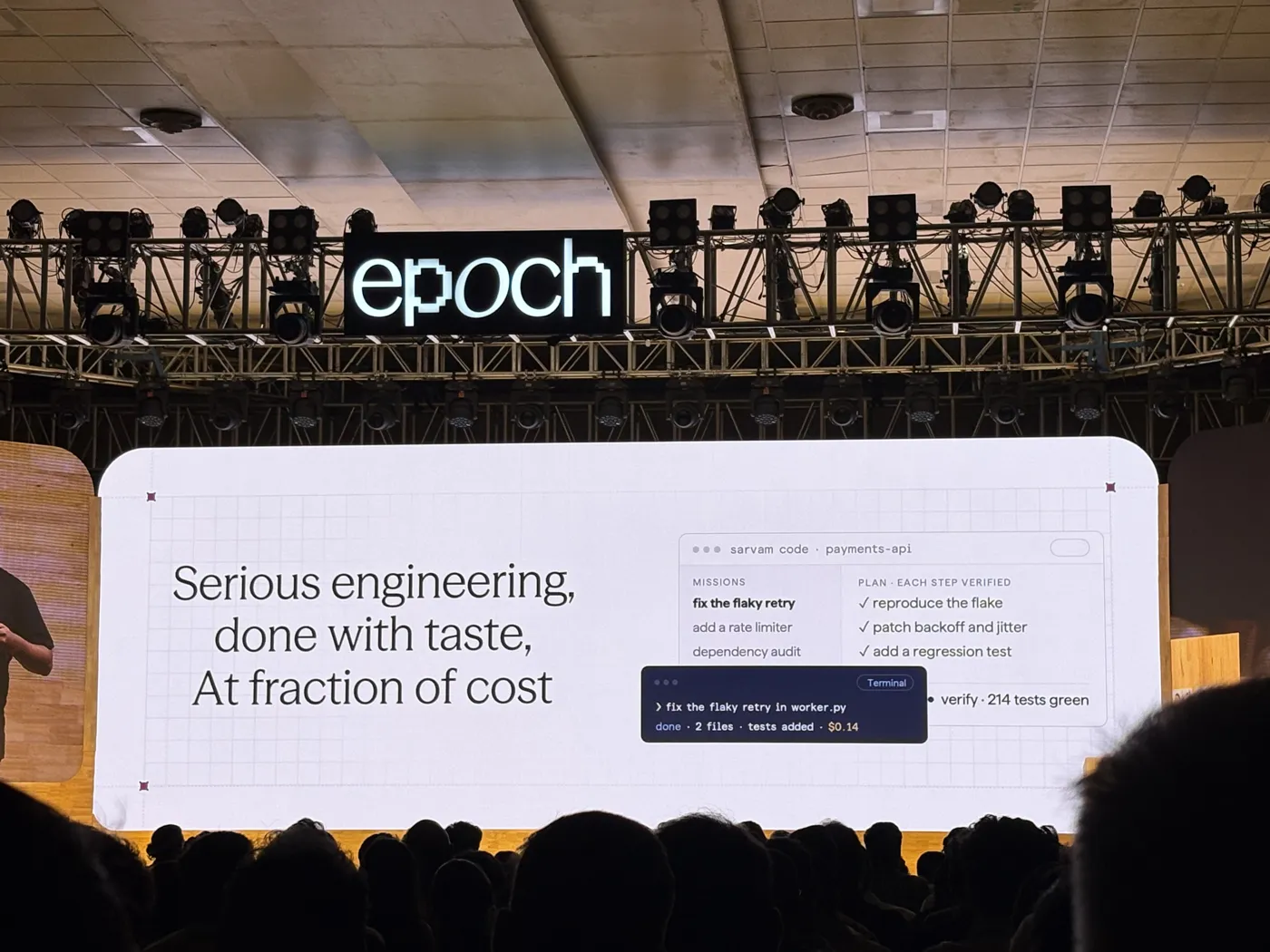 Serious engineering, done with taste, at a fraction of the cost
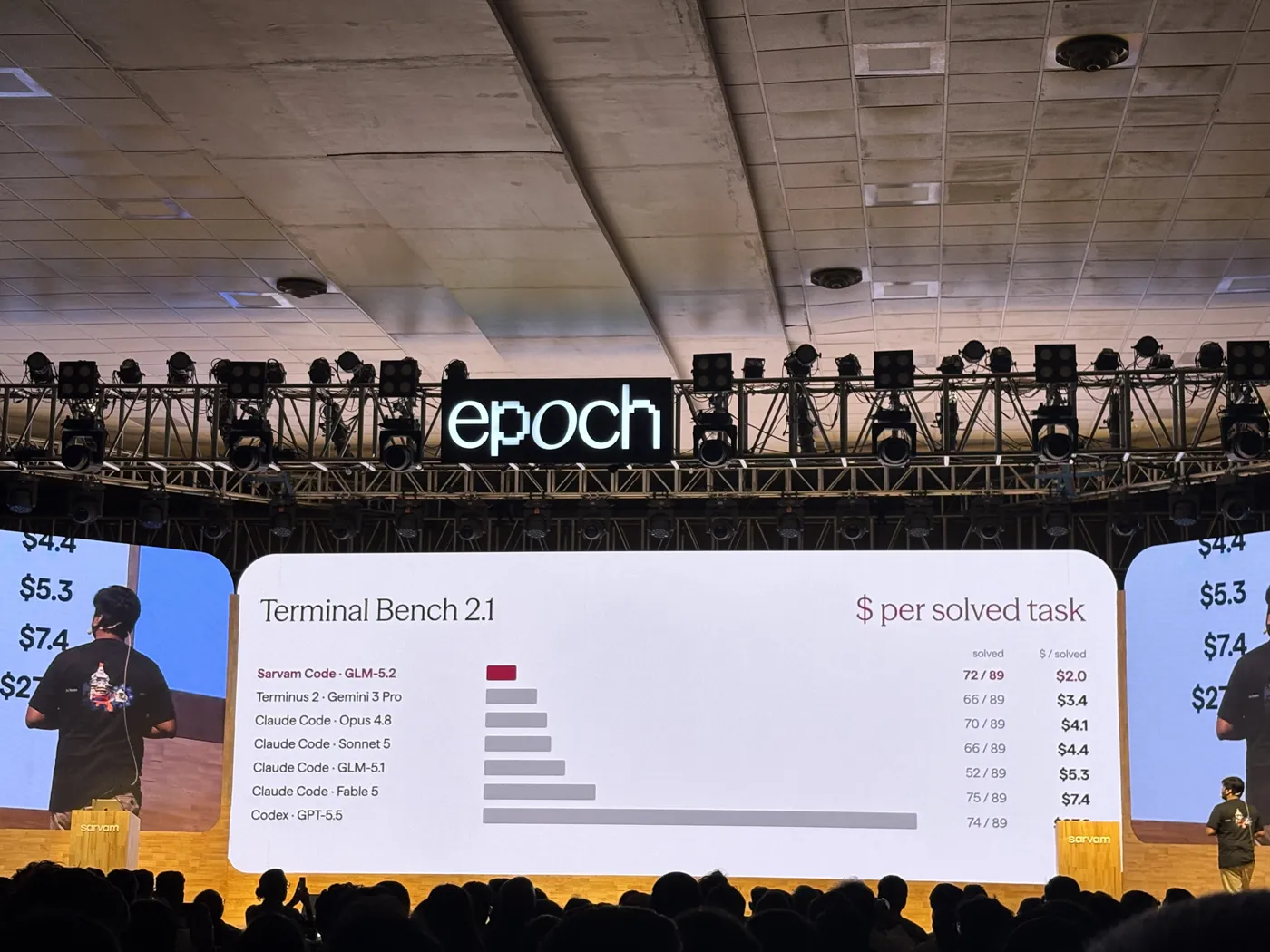 Terminal Bench 2.1: dollars per solved task
Vedant introduced the early beta, which will roll out to more developers over the coming days. The pitch started with developers: coding velocity is not turning into product velocity, code bases fill with slop, and nobody knows what is going to production. Coding agents are getting costly, and teams want open models inside coding harnesses. Open models look very good on Terminal Bench, SWE-bench Pro and SWE-bench Verified. In daily use, though, they felt far from a frontier closed model inside its own harness. The thesis: a good harness can lift an open model to frontier-level performance, and do serious engineering at a fraction of the cost. The chart he showed measures that as dollars per solved task.
The first problem was long-horizon work. The “goal mode” in Codex works only with the largest and most costly model, which he named as GPT 5.6. With open models such as GLM and Kimi it fails in a particular way: the model sets itself a goal, does the work to that goal, and then says it is done.
Non-trivial. Open models are not RL-trained enough to break a problem down and say reliably when the work is done. The same model both sets and judges the finish line. Sarvam split goal mode into a planner, a worker and a verifier, so the check is a separate agent from the one that did the work.
To test the split, the team ran Exploit Bench on GLM 5.2 inside its own coding harness, with and without goal mode. Vedant said there was a tremendous uplift from implementing goal mode correctly, though no figure was given. He said this is why there should be more competition in coding harnesses: the market is far from over.
On Terminal Bench, with about 89 tasks, Sarvam Code solves almost the same number as frontier models inside their own closed harnesses, at a tiny fraction of the cost. The team started much lower, found the problems, and used its own agents to improve its own scores on the benchmark. The chart ranks by dollars per solved task. Sarvam Code with GLM-5.2 solved 72 of 89 tasks at $2.0 each, while the other rows cost from $3.4 up to $7.4 per solved task. Two of them solved a few more tasks, 74 and 75 of 89. So the claim is the lowest price for a solved task, not the highest score. The hero slide shows the idea in a terminal: a plan for fixing a flaky retry in four verified steps, and a bill of $0.14 at the end.
Coding agents help one developer. For teams, Sarvam is building opinionated skills and tools for verticalised tasks, called modes. There are three so far, with more planned.
- Android apps. The example was filing for motor insurance, which means handwritten forms, many image uploads and slow government sites. One Sarvam engineer asked whether the Vision and Voice APIs could power an app for it. The mode then carries the work through to an app that is ready to ship, so citizens get a 21st-century experience at scale.
- Data science and ML. Banks told Sarvam they had spent hundreds to thousands of crores on data infrastructure without enough return, and the hypothesis is that nobody asks good enough questions of heterogeneous tables. Data Agent Bench comes from UC Berkeley and Hasura, and Vedant called it the most complex benchmark the team could find. GLM in a normal harness scores roughly 60. With skills and tools built around the harness the team climbed to 82, which he said is close to Fable 5 level, at a fraction of the cost. A harder demo followed: the Kaggle tournament with the biggest prize, about $100,000, from Home Credit, to train an underwriting model. It has 15 lakh rows, 500 features across seven tables, and 30,000 entrants, many of whom entered hundreds of times over six months. The agent was top of the leaderboard in three hours. It starts with exploratory analysis, forms hypotheses about important features, then trains models, and stops only at a compute budget, a time budget or an accuracy goal. It also analyses the models with the metrics data scientists use and explains them to the end user. The team now tries it on every new Kaggle tournament. Humans stay in the loop on edge cases and on whether an ensemble will be stable in production.
- Cyber (still being built). The task style is the one reported by the newest frontier models: simple flaws that look harmless are chained into a full takeover. Sarvam only recently started on Exploit Bench and plans to keep hill-climbing, and the 41 tasks completed, with a full takeover in 26 of them, are a starting point. In the demo a senior engineer asked for a quick security check of a Grafana system. The agent looked up known open-source vulnerabilities, attacked from outside as a black-box pen test, and chained steps to show a SQL injection leading to command execution. At the end it also patched the system. Vedant said this puts the field in the post-Mythos era, so patching has to be quick. Sarvam said it is disclosing the vulnerabilities it found in widely used Indian software to the vendors, who are working on fixes, and plans to keep building black-box testing and vulnerability assessment for critical information infrastructure in India.
Non-trivial. Sarvam says it improves its own benchmark scores with its own agents: Terminal Bench started much lower, Data Agent Bench went from about 60 to 82, and the Kaggle agent runs on every new tournament. The harness is treated as something you improve with the same tools you ship. The unit on the chart is dollars per solved task.
Also launched
- Kaze is a smart-glasses system with Sarvam's speech, vision and language models, using cloud and edge models for places with poor networks.
AnvayaAnvaya in a Box: deep research on one machine
Laksh and Aaditya, Sarvam Chanakya
Anvaya in a Box: deep research on one machine
Laksh and Aaditya, Sarvam Chanakya
Laksh and Aaditya are engineers from the Chanakya vertical at Sarvam, which builds AI for government entities in defence, national security and intelligence. They opened with the constraint that shapes everything: these are high-stakes problems, so accuracy and security come first. Every model, harness and application they deploy has to run on-premises. If your data is on the internet, you are automatically allowing some sort of leak.
On-prem has two hard consequences. First, the stack must run on whatever GPUs and compute the client offers, so the application has to use the GPU at close to maximum capacity. Second, national-security decisions are taken from the outputs, so the outputs have to be accurate.
They made the point with a prop. A small box he had brought on stage was a Spark, a single-GPU machine. The demo ran live on it while they talked, and the entire stack ran on that one box: the model, the harness, the application and the data.
What Anvaya is
Anvaya is a platform that builds a unified data layer over any kind of messy data and lets an analyst do multi-hop deep research on it. The demo case: after a recent corporate collapse, SEBI asked whether AI could help prevent something like it in the future. To test it, the team gave Anvaya only open-source data from before the event, as video, audio, PDFs and images, about one company, and asked whether it would spot trouble. The output was a report of the kind an analyst would write: financial fragility, suspicious patterns, and the relationships between entities.
How it works
- Buckets and an ontology. Anvaya groups the corpus into buckets that are neither too sparse nor too dense. It then uses an efficient sampling algorithm, so it does not read everything. With a million items, it visits each bucket, samples some data and builds the ontology from the samples.
- A knowledge graph with citations. For each entity, such as the company, the graph gathers everything from across the documents, writes a summary, shows where the data came from, and maps the entity's relationships. The source is what lets an analyst cite it, and it makes an investigation much simpler.
- An agent that questions the graph. The agent starts by asking what it needs to know in order to answer the report question. It then hires a second agent, which they called paranoid, to ask even more questions after seeing the data. These branch out in several directions, for example into the ownership web. While it answers, the graph highlights the nodes it is using, and the run ends in a report. If the analyst is unhappy with an answer, they can ask the system to go deeper on that question, and the graph shows which nodes the answer came from.
Non-trivial. Giving the model a bounded field removes part of the thinking. That is how, the speaker said, a smaller model can match the output of a bigger one. Here a 30-billion-parameter model, far smaller than frontier models, did the entity extraction, the graph and the reports, all on that one machine. The demo is his evidence, so read it as the speaker's claim.
Non-trivial. The team ran a backtest by design. Because Anvaya saw only data from before the event, it could not know the outcome. That is the right way to ask whether AI could have flagged a problem.
The two properties they stressed were that the platform is model-agnostic and data-agnostic: it works with any model and with any type of data. They also see it going beyond government, into finance and health, because the team already works with very complex data. It runs on-prem.
KiviKivi: your computer, by voice
Abhigyan Raman, Sarvam
Kivi: your computer, by voice
Abhigyan Raman, Sarvam
Abhigyan Raman presented Kivi, a dictation and voice-editing app for your computer. It began as a passion project a couple of months earlier, by four people working mostly part-time, and he credited Sarvam for giving the team a creative space. He recalled that, more than three years earlier, Pratyush told him Sarvam would be a cocoon of energy where you can play with ideas, experiment and build. The Kivi booth is the first one just inside the gate, with a link and some merchandise.
The launch video was generated entirely by AI. Its opening argument was that most dictation tools are built to solve one problem, typing, and Kivi aims to do more.
Why typing has not changed
He opened with a history lesson. He dated the typewriter keyboard and the telephone both to the 1860s, though the telephone patent is usually dated 1876. The telephone went from point to point, to rotary, to cellular and now to satellite, and you can chat from space. Typing barely changed. Why? A keyboard gives you three things: it is predictable, it is reliable, and it is free. No other interface matched all three, because none could solve reliability. His claim is that you can now get reliability and predictability almost free, with Kivi powered by Sarvam's state-of-the-art ASR model and intelligence on top.
Non-trivial. A keyboard is predictable, reliable and free, and that is the bar any replacement has to clear. Kivi's free tier and free pro period are aimed at the “free” leg of that bar. The bet is that a state-of-the-art speech model fixes the reliability leg.
What Kivi does today
- Dictation with context. Custom words for your own terms, which you can share with friends. Speed dials are spoken shortcuts that expand into longer text, so the output does not have to match what you said. You pick a style per app.
- Editing by voice. Select any text on screen and speak a command. In the demo, “make it sound apologetic” rewrote a short note about running a little late.
- Understanding context. The product video's second point was context: Kivi picked up that the product's name and the bird called a kiwi are different things. In another clip it was asked to translate a passage into the simplest possible English.
- Filling forms by voice. A member of the team used Kivi to fill in a form. He gave a name and a number for the emergency contact, and told it to answer yes to every acknowledgement.
The vision, not yet built
The team showed a concept video of controlling a whole machine by voice. In one scene, a single spoken request opens a recent message from a contact, gives a TL;DR, translates it into English as bullet points and replies that the group will join from Lonavala on Saturday morning. In another, one request emails a message to a colleague and books a 30-minute calendar invite after 4 p.m. in the first free slot. The assistant answered that it was blocking 5:30 to 6 for the next day, 31 July. The team said plainly that this is something it is building toward and is not there yet. He closed the section with a claim that how we deal with machines, and how machines deal with us, is going to change fundamentally, and soon.
Non-trivial. The speaker kept a sharp line between what ships (dictation, editing by voice, a Mac app) and a concept (voice control across apps, “not there yet”). Editing is also a different idea from dictation: dictation puts words in, while a command on a selection changes text that is already on the screen.
Availability
Kivi is downloadable for Mac today. Windows is coming soon, and Android and developer access follow. A developer version is being launched, limited for now to Kivi's own app, and the team will open it up through an API and MCP. There is a free tier and a pro tier, and pro is free for everyone until 15 August. He asked the audience to help make Kivi a movement for the next generation of human and computer interaction, and said the two traits he wanted were smart and daring.
PartnersAWS, IBM and Sarvam Circle
Satinder Pal Singh (AWS) and the Sarvam team
AWS, IBM and Sarvam Circle
Satinder Pal Singh (AWS) and the Sarvam team
The partner session had three parts: AWS, an IBM MOU, and the launch of Sarvam Circle. Its technical content is in the AWS talk. Satinder Pal Singh, introduced as a director of solutions architecture for AWS South India, presented it.
What was announced
Sarvam's models will be available on AWS Marketplace, in several form factors: Saaras and Bulbul for speech, and Sarvam 105B. Sarvam Code and the Indus work agents will be on the marketplace too, and the models are available on SageMaker. The pitch to developers was no procurement hassle. AWS brings the reach, Sarvam brings the soul.
AWS on AI infrastructure
His talk had four layers: infrastructure (GPUs and AI accelerators), models and agents (many models, plus a framework to build and deploy agents), an interface layer (voice, text and multimodal), and the applications that businesses use. He said AWS expects billions of agents, and then spent the talk on the bottom layer.
- Why AI infrastructure is different. Power, cooling, memory and GPU power consumption are an order of magnitude different from conventional infrastructure.
- The network. Training is bulk-synchronous parallel, so micro-benchmarks stop being enough. AWS decided to reinvent conventional networking and built EFA, a purpose-built network, and SRD, a protocol. They avoid the inefficiency of per-packet routing and of expecting an acknowledgement for every packet, and they use the whole network for bulk-synchronous workloads.
- Scale. The UltraCluster design gives tens of petabits of capacity at under 10 microseconds of latency.
- Failures. Conventional recovery takes 10 minutes or more. He described a system that brings failure detection to under a second.
- Sarvam's setup. The collaboration uses the latest NVIDIA instances, SageMaker HyperPod and high-performance FSx for Lustre storage.
- Custom silicon. AWS builds its own accelerator, Trainium, now in three generations. He claimed that Trainium 2 gives 30 to 40% better price-performance than the first generation. Trainium 3, the first 3 nm chip, gives twice the compute at 40% lower cost and four times better efficiency. Trainium 4, announced last year, is said to bring 6x the performance of Trainium 3, 4x the memory bandwidth and 2x the memory capacity. These are the speaker's claims, not independent numbers.
- Choice. No single model rules every use case, so AWS offers choice and no lock-in. Sarvam's models and agents arrive through Marketplace and SageMaker JumpStart.
Non-trivial. AWS framed the network as the place it reinvented. Training is bulk-synchronous, so the whole fabric has to work in lockstep, and a protocol with no per-packet acknowledgement and failure detection in under a second matter as much as the chips. These are the speaker's claims.
IBM
The host linked IBM to mission-critical systems for banks, governments and population-scale systems, and an IBM executive exchanged an MOU with Sarvam's leaders on stage. His points: sovereignty has many dimensions and should not slow innovation. IBM's offering is Sovereign Core, covering security, governance, management, hardware optimisation and air-gapped operation, for citizen services, banking transactions and life-and-death uses. Sarvam's models and agent harnesses layer on top of it. IBM is also built on open source, and a big part of sovereignty, he said, is technological sovereignty. Earlier this year IBM opened a GovTech AI innovation centre in its Lucknow lab, which will be a hub for co-creating with Sarvam.
Sarvam Circle
Shruti Agrawal, from the go-to-market team, announced Sarvam Circle: a strategic alliance of partners across consulting, OEMs, ISVs, technology services and investors, to reach every institution in the country. Sarvam's forward-deployed teams have worked with large banks, financial services firms, public-sector institutions and industrial companies, and the ambition is to take that to 100x the scale.
| Group | Partners named |
|---|---|
| Cloud | AWS |
| Consulting | Boston Consulting Group and one more firm |
| System integrators | EY, KPMG and HCL Technologies. HCL is also now an investor in Sarvam, and works on a full-stack data centre and AI park in Odisha |
| Private equity | A leading Indian fund, to run AI transformation across its portfolio companies |
| Public sector | A firm embedded in central government and the public sector |
| ISVs | MoEngage, which will embed Sarvam's platforms into its own customer-engagement products, and ThoughtWorks, a systems integrator in banking and financial services |
Sarvam promised its partners a joint go-to-market motion, co-created IP that combines their industry expertise with Sarvam's technology, and joint delivery of some of the largest AI transformations in the country.
One more talk on the Epoch programme
- How to Keep Sprinting Through a Marathon, Pullela Gopichand. A talk about discipline for builders, with no technical content: put in the hours, feel the problem, keep the kid in you alive, and do not let your desire or your attention leak.
The demo hall
In a separate hall, Sarvam had the demos, and it was open the whole day. It was nicely organised, and busy. Each team was there demoing its own technology at its own booth, so you could walk up and talk to the people who built it.
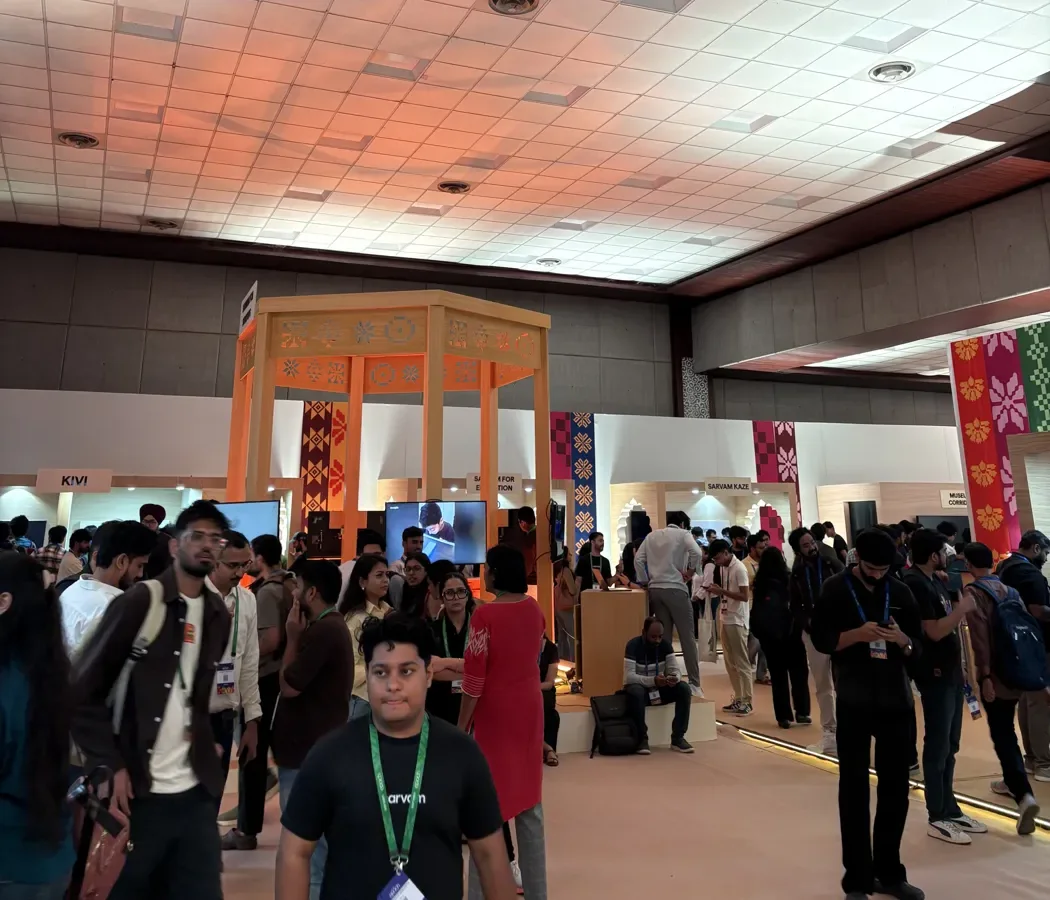
The goodies
There were goodies to take home, and they were made with the same care as everything else. At one booth a team was printing bags and shirts by hand on a screen-printing press. One person lined up the print, and another used a heat gun to set it. A small clip of it is below. It is another example of the details the team sweated over.
The technical session
The technical session (15:20 on the agenda) was a panel on continual learning: how models keep improving after they ship. Sarvam's programme describes it as a panel on continual learning, evals and enterprise improvement loops. It ran about 38 minutes, with the last few minutes for audience questions.
The slide names four panelists: Vivek Raghavan, co-founder of Sarvam; Manish Gupta, Senior Director at Google DeepMind; Devendra Singh Chaplot, Sarvam; and Aaditya Sood, Surge Venture Partner at Peak XV. A fifth person from Sarvam moderated. This page is a question-by-question record, in the order the questions were asked.
The moderator set the frame at the start. Continual learning is a hotly discussed topic at every layer of abstraction: how can models keep improving as they get deployed more and more? To talk about models as systems that continuously improve, you first have to define the system and its components. So the first question was about the line between the model and the harness.
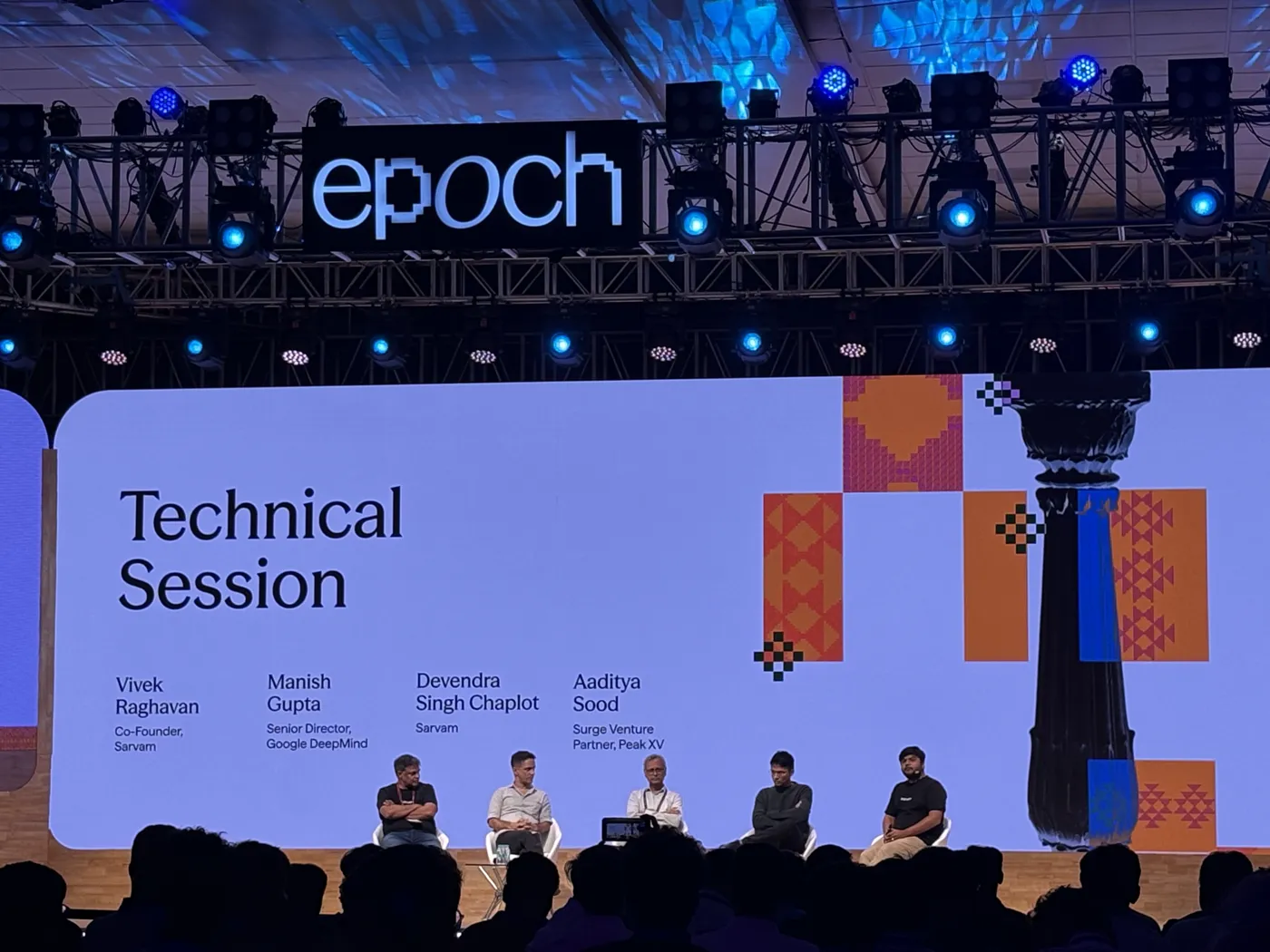
Q1. People hold very different views on the model and the harness: will the harness layer eventually fold into the model, or will it always be there to extend what the model can do? How do you define the components of a system that keeps improving, and how do you think about the harness layer? (Put first to Aaditya Sood, given his 20 years of building orchestration layers and watching Kubernetes and cloud infrastructure play out, then to the others.)
Aaditya Sood: Harnesses will never go away. What the industry has learned is that we want to build layered systems with a separation of concerns. He recalled a famous line that the white-haired people in the room will remember from X-Windows: separate the mechanism from the policy. In his view the model holds the non-deterministic logic engine, the intelligence engine. But a lot of business-level matters, such as risk appetite, authority, approvals and what counts as a good outcome, will always live in a layer above the model, because they are so specific to the application. Model capability can keep going up, but by and large there will always be a control loop, a harness.
Manish Gupta: He agreed with the first part: there will always be a need for both the model and the harness. But he did not think you should treat them as a clean separation of concerns, because the relationship between them is very close. One of his pre-doc researchers, now doing a PhD at Berkeley, visited and gave a talk called “training fast and slow”. That researcher is thinking of a startup whose whole thesis is how to co-evolve the model and the harness, and how to train them jointly. He added that his own team already uses harnesses to improve model quality. This is the idea of recursive self-improvement. We are not fully there yet, he said, but many parts of the loop are already closed. Agents are used to improve the quality of the model, and then that higher-quality model is used to improve things further, and so on. For both capability and efficiency, his team is already seeing huge gains from agents that now do a lot of the efficiency work automatically, where people used to do it by hand.
Non-trivial. The panel disagreed on the framing more than on the conclusion. Sood wants a clean split, with policy above and the model below, so that each layer can change at its own rate. Gupta wants the two trained together. Both can be right for different layers: the business-policy layer stays separate, while the layer that talks directly to the model is the one that has to move with it. Sood returns to exactly this point later, with the clutch analogy.
Q2. Devendra, you have taken models through scaling. How do you think about the value a harness adds at different scales, and at different parts of training? How do we include the harness in the training loop?
Devendra Singh Chaplot: He agreed with Manish that the harness and the model need to co-evolve. Models should be trained with the harness in mind, and harnesses are designed for specific models. He gave a second reason why harnesses matter now and will matter in future: they let users customise the model for their own application. One-size-fits-all models will not work well for everyone's needs, he said, and that is why harnesses are important. On scale, he said that as model size grows, harnesses can become lighter, because the models can do a lot of the work themselves. But that does not mean harnesses go away completely. They remain very important.
Q3. Vivek, Sarvam has been deploying the 105B model inside various harnesses, and it is improving. How does scale change the value of the harness, and how much does the harness need to do? How far can we push a hundred-billion-class model, how do you deploy it in different places and learn from production traces, and how should we think about that loop?
Vivek Raghavan: When the model is smaller, the harness can play a bigger role in what you are trying to do. That is what Sarvam has seen: you can get significantly better outcomes, at least for the specific things you want to do. He agreed with both Manish and Devendra that models and harnesses will co-evolve. Then he said he was curious, and honest that he had no real feel for the answer. As the model gets more powerful, one instinct is that the harness layer becomes thinner. But will the nature of the tasks we want to do change so much that we still have a significant harness, just a different one from today's? He was not sure which way it would go. What is very clear, he said, is that putting a harness around a model can dramatically improve outcomes.
Manish Gupta: One aspect where harnesses are useful whatever the power of the model is when you break the problem into sub-problems and have agents, all powered by those models, work together. Different agents solve different sub-problems. Sometimes agents also compete on the same sub-problem, and you use leaderboards to see which does best. He tied this to AI for science, which Dr. Somanath had spoken about earlier in the day: you can now have many agents exploring different scientific hypotheses in parallel. The analogy is how humans work. A single person does not do all the work, and we do not do it all in one shot. We do it repeatedly. Even when we code, we do not go from the first token to the last. We work as part of bigger teams, and he expects similar things to apply to AI agents powered by models.
Non-trivial. Vivek Raghavan's uncertainty is itself informative. The easy prediction is that a stronger model means a thinner harness. His point is that stronger models take on harder tasks, so the harness may not shrink. It may change shape instead. Gupta's multi-agent examples (decomposition, competing agents, leaderboards) are harness designs that exist because the model is strong, not because it is weak.
Q4. On continual learning, one end of the spectrum holds a purist view that imitation learning is the wrong direction and we need different algorithms and model architectures. The other end says it is simply an infrastructure problem of how quickly you can take production traces and learn online from them. What bets do you see in the research community, and which excite you most?
Manish Gupta: One reason companies like Google, Anthropic and OpenAI invest so much capital in these models is their bet that you ultimately get to the place where the models improve themselves: recursive self-improvement. The whole premise rests on that. A lot of his team's own work is on languages, adding support for more languages, and a lot of that work is now done by agents. They do not want to curate all the data by hand. When you add a new language or a new dialect, you do not want to do the data curation and the evaluation manually. Agents do much of that work today. It is not completely automated, because human judgement is still involved. RL has worked very well for verifiable problems, but not nearly as well for non-verifiable domains. Language work is largely non-verifiable. There is a judgement in how well, say, my model speaks Haryanvi. So a human still has to judge, and for that reason the work is not fully automated, though many aspects already are.
Non-trivial. The verifiable versus non-verifiable split explains where automation stops. Wherever a program can check the answer, the loop can close itself. Wherever the answer needs taste, as with a dialect like Haryanvi, a person is still inside the loop. This theme comes back in the answers on evals, traces and interpretability.
Q5. Sarvam has worked very deeply on evals, and for non-verifiable tasks humans have to be involved very deeply. One question that keeps coming up is: who evaluates the evals themselves? How should we think of evals as systems?
Vivek Raghavan: Evals are one of those problems where, each time you do the work a new way, you discover another layer of complexity. In the end, evals are everything. If you cannot get good evals, you are not going to go to a good place. As the ambition grows to cover more and more complex tasks, the evals have to become more nuanced. He gave the practical case. When you are looking at something fairly narrow that you want to make better, you can probably build evals that steer the model to do very well on that task. But overall that may not be a good thing. You have to understand how representative the eval is of the real problem you want to solve. You do not want to over-specify the eval and end up in places you will never deal with. At the same time, you do not want it to be so narrow that it misses the real problem. In the end, he said, continuous evals to clean up the data are the game. There is nothing else here. The quality of the data is the entire game.
Q6. When a task is very narrow and you optimise in that direction, the model can go far but perhaps at the cost of other things. This is the jagged intelligence we all experience: great at one task, regressing on another. Devendra, how is this handled at large scale? How do you cover a diversity of environments, and how much of that comes from synthetic environments versus real production traces? How do you weigh the value of one against the other?
Devendra Singh Chaplot: It is not one or the other. You have to use both. Real-world production traces give you the distribution of tasks that users care about, and they tell you what the models are good or bad at. But by design, production traces are backward-looking: they tell you only what people use models for today. If you want to think about the future, where you build into models capabilities that people do not use them for yet, you need something else. He then described the difficulty of adding new capabilities. It is a very tricky balance. Whenever you add new capabilities, models may regress on the old ones. So you have to be very careful in designing the data mixture, and you continue training on the old capabilities so that the model does not regress on them.
Aaditya Sood: One big challenge with real-world traces is that they are the exhaust pipe of things that have already happened, and the policy at the time was already baked in. The second challenge, from a purely philosophical point of view, comes from what a code editor like Cursor does. It takes traces, sees when the user intervened and what new suggestions were made. That presupposes that our user was intelligent. At scale, we do not know whether the user made the right choice when they intervened in the model. That challenge will keep showing up in real-world data. In coding especially, just because your code compiles does not mean it is correct. Just because your unit tests pass does not mean it is correct. Only from a business context, when you deploy at scale and see whether you are meeting business objectives or outcomes, can you say this was the right thing to do. That is again a judgement call. For that reason, other than very narrow algorithmic domains, he expects it to remain an open challenge for at least a while.
Manish Gupta: Synthetic data is very useful for creating increasingly harder problem instances, so the model can hill-climb. If you give a model too hard a problem, it cannot learn from it. There is a Goldilocks zone: the problem should not be too easy, but still solvable. You make the problems increasingly harder. The model improves, and then you make it work on a newer, harder class of problems, and so on. For a model that keeps learning, this is another process where synthetic data is extremely helpful. As an aside, he said, this is how we teach children. Never teach them calculus in grade one.
Non-trivial. A user who accepts or corrects a model's output is treated as a label, but that label is only as good as the user. A patch that compiles and passes tests may still be wrong for the business. So real traces tell you what users asked for, synthetic tasks tell you what they will ask for, and neither tells you if the answer was right. That needs a deployment outcome, which arrives slowly.
Q7. How do we operationalise this continuous improvement, especially when learning from production traces? Models are often deployed inside enterprise infrastructure, which may have its own improvement loops and security boundaries, and the model labs run their own loops at much larger scale. How should we think about the infrastructure that makes this happen? (Asked first to Devendra, given his experience designing Tinker.)
Devendra Singh Chaplot: He pointed back to the morning conversation. Model building needs a few key things. Compute: of course you need a lot of it. People and talent. And then the question is what the people do. People build the infrastructure needed for model training, for iterating and for scaling-law research. People build the training recipe, which includes the data, the model architecture and the optimisation. And people actually train the model. All of these components have to go together. Once you deploy the model, you get production data and feedback. You incorporate that feedback and think about how to keep improving the model. At the same time you think about what the next generation of models can do that they cannot do today, and about innovative ways of unlocking new capabilities.
Manish Gupta: For enterprise customers in particular, you have to be very careful. The default position is that whatever the enterprise does in a cloud setting, all that data belongs to the enterprise customer, so you do not use it to improve your model. With consumers it is different. There is a wealth of data, both explicit signals and implicit signals, and the implicit signals come from many things about how users behave.
Q8. Many enterprises worry that if they invest in post-training a model on their own data now, the next pre-trained model may be much better, and the investment will be wasted. How should enterprises design an improvement loop so that it keeps absorbing the advances happening outside the loop as base models get better?
Aaditya Sood: Most enterprises are actually very concerned about something else. They say, “I don't want my data leaking to my competitors,” and that is usually the higher-order bit. Going back to his earlier point, he described a layer cake: you build layers, each handling a different thing. Right now, he said, one of the challenges is that we have shoehorned too many things into the harness. Every exception and corner case goes in. Whenever something weird happens, we put a rule in the harness, if this, then that, until the model gets better.
He understands why, because you have to make things work right now and cannot wait. But in the long term, that leads to brittle systems when everything is so tightly coupled. His view is that enterprises would separate these things out. As the model jumps in capability, the lowest layer, which Manish earlier said is tightly coupled, is the only one that needs to be changed, rewritten or adapted. He thinks of it as the clutch that couples to the engine. The higher-level policy and business goals do not change that fast. He takes an evolutionary perspective: different layers have different rates of change. The same holds for learning. Doing a model weight update is a very big thing, and an irrevocable one. It is like a human neocortex getting updated. You normally do not do that easily, and it takes a while. So there will be different rates of change, and that is how enterprises can keep up as more and more capability shows up. The abstraction keeps moving.
Non-trivial. The practical advice here is to put the replaceable part at the bottom. The coupling layer is the one that should be easy to rewrite when a better base model arrives. Business policy sits above it and stays put. Thin, swappable glue is what stops an enterprise's earlier investment from being wasted when the base model improves.
Q9. (Follow-up.) It is fascinating that you say changing the model is a big deal, and also that the policies change slowly. If both are slow, what is the thing that changes fast?
Aaditya Sood: He clarified what he meant by calling it a big deal. Say you ran your traces for a week from your customers: should you go and update your model weights for that? His answer is that weight updates should be a slow process. You should not do them that frequently or that casually. One reason is adversarial attacks. He worries about people tricking you into generating bad traces. If you are too quick on the uptake, you might fall into that hole.
Non-trivial. If a model learns from its traces, then whoever can shape those traces can shape the model. Slow, reviewed weight updates are as much a security control as a stability control, which is a different reason from the usual one about forgetting.
Q10. Would you classify the inability to change model weights fast enough from, say, weekly production traces as an infrastructure problem? Or is it not an ideal thing to do in the first place, given that we hear Cursor updates its models every few hours?
Manish Gupta: It is the problem that someone mentioned earlier, catastrophic forgetting. There is a sweet spot you want to reach: you do want these models to learn, but as they learn new capabilities, you do not want them to forget their previous ones. That has fundamentally not been fully solved. A lot of exciting research is happening on how to co-evolve.
Q11. Devendra, would you also chime in on that? (He took it toward how enterprises can run their own improvement loops.)
Devendra Singh Chaplot: It is pretty hard for most enterprises to customise models themselves. That is why it is very important to build the platform and infrastructure that makes it easier. There is a lot of motivation among enterprises, governments, researchers and developers to train their own models, build custom models, fine-tune and specialise them for their application. The challenge is how to actually do it. Without a good platform, you have to get your own GPUs, write your own distributed training code base and manage all the hardware yourself. That takes many different skills that most enterprises do not have. If the tools and resources were there, he said, enterprises would do it. He listed what they care about. First, ownership of the models. Second, as Aaditya said, not having their data leak to their competitors. Third, not having the model training labs become their competitors tomorrow. Fourth, access risk: labs might cut off access or deprecate old models. Fifth, pricing. This is why they are all motivated to train their own models. It is just very hard today, but it will become easier, and more and more enterprises and people will train models.
Manish Gupta: He added a related piece of work. A paper at ICLR 2024 from his team, called CALM, is a way to compose two existing large language models. For his team, the initial motivation was languages. When they added support for Indian languages, there was a concern that better support for them could make the model regress on languages like English. Even a minor regression would not be acceptable. With CALM you take the two models and fuse them into a new one. They were very excited that this is also an approach for enterprises to customise their own model: you can take an existing model and compose it with another. He would like to see this methodology adopted in the real world, and noted that the paper appeared almost two years ago.
Q12. As we near the end: what is the one direction of research or engineering in continual learning, in intelligent systems, models and the systems around them, that you find most exciting and expect to see a lot of progress on in the next six to twelve months?
Devendra Singh Chaplot: He is most excited about algorithms that automatically improve the model as you interact with it. As a user, you should not need to think about how to continually improve the model. You interact with it as you would with any LLM today, and it keeps improving, every week and every day. It learns your preferences and learns from the mistakes it made in the past. He thinks this can be done by innovating on how we use interactions with humans to improve the model itself. There are multiple ways. You can use external memory and RAG, as many people already do. But you can also do it with model updates, especially low-rank adapters, which can let every individual have their own model, with their own weight updates in low rank, just by interacting with it.
Manish Gupta: He started from the analogy with humans, and spoke about capturing and harnessing all of the learning that has happened. He and Aaditya both brought up Newton and Einstein. He closed with the other half: there is an element of subjectivity, and the question is how to make progress on those problems. That, he said, is another exciting direction his teams are working on. (This ties back to the point about non-verifiable domains such as language quality.)
Aaditya Sood: Before saying what he finds most interesting, he made an observation about the structure of scientific revolutions. Part of what Newton and Einstein did was to throw away some of what they had been taught, regress ten or twenty years, and rebuild. Progress has a sawtooth curve. It will be interesting to see models do that: to say, you have taught me these twenty things, but I am going to suppose ten of them are not true, because they are only conventional wisdom. What he finds most interesting, and he said he does not know how it relates to continual learning, is interpretability. How do we know whether a trace or a reasoning chain that a model gives us is what actually happened? As we build more and more systems on top, we are taking a non-deterministic worker, putting it inside a shell, and slowly trusting it to make more and more decisions. Unless we can verify, not just by the outcome but through the reasoning chain, that it did the right thing, he thinks it might lead to bad situations.
Non-trivial. Most continual-learning proposals assume knowledge only accumulates. Sood's sawtooth view says that sometimes the right move is to unlearn: drop received wisdom, step back, rebuild. Nobody on the panel had a method for that, and it sits oddly with the earlier worry about catastrophic forgetting. Forgetting the wrong things is a bug; choosing to drop the right ones would be a skill.
Q13. On a lighter note: both of you spoke about Newton and Einstein. What is actually the difference between a Newton or an Einstein and the rest of our brains?
The moderator posed this as an open, closing thought and no panelist answered it before the floor opened to the audience. The moderator's own view was that the difference is probably something very small, yet the outcomes are so outsized, and that there is deep thinking to be done about how this relates to the kind of progress we can look forward to.
Q14. (Audience, to Vivek.) You worked on Aadhaar, so it is safe to say you tapped a successful formula for a piece of technology to reach billions of Indians. I am building Sushasan.in, an end-to-end AI infrastructure for solving civic grievances for billions of Indians. For developers like me, who are not targeting a market to monetise but trying to selflessly serve everyone in India, what is your advice for making a piece of technology land with every Indian?
Vivek Raghavan: This is not directly related to the topic of the panel, he said, but we live in a fascinating time. You can now do things at the pace of your imagination, rather than at the pace of anything else. So he encouraged everybody: if you want to do things, it is so much easier to do now. We live in wonderful times, so leverage that and try to improve the things that need to be improved.
Q15. (Audience, open to anyone.) Six months ago we were discussing that the SaaS world was going to collapse. We predicted that agents would help us shop, yet we still love to shop on the famous e-commerce sites and to book trips on travel sites. What are your predictions: will SaaS stay as it was six months ago, will there be massive changes, or was the collapse a myth that is now being broken?
Aaditya Sood: The news of the death of SaaS is greatly exaggerated. He learned the painful way that you do not want to write code if you can help it. Unless writing the code is a core competency and a differentiator, he said, remember that code has gravity, code has entropy and code has errors. So what he sees is that SaaS will be there, because there are things you want other people to do. They add no value to you. Why write a bug database? It is not your business if you are a bank. What will happen is that margins will compress until the surface area grows. There were many marginal businesses that survived only on switching costs or inertia, because people kept using them. But in his view SaaS is not going anywhere. You do not want to write tons and tons of code, maintain it forever and keep changing it.
Non-trivial. “Code has gravity, entropy and errors” is an argument against building what is not your core, and it applies to agents too. An agent that writes you a custom tool also hands you its upkeep. The thing SaaS vendors sell is that someone else carries that upkeep.
The moderator thanked the panelists and the audience and closed the session.
Across every question the hard part was not the learning mechanism but judgement: who decides what counts as good, in evals, in traces, in language quality, in when to update weights and in whether a reasoning chain can be trusted.
Conversations between the sessions
Between the sessions I got to talk to a few of the people who had spoken. These are my notes of those conversations, grouped by person, with each question opening to its answer. Where I add background of my own, it sits under a line that says so, so you can tell it apart from what was said to me.
Devendra Singh Chaplot
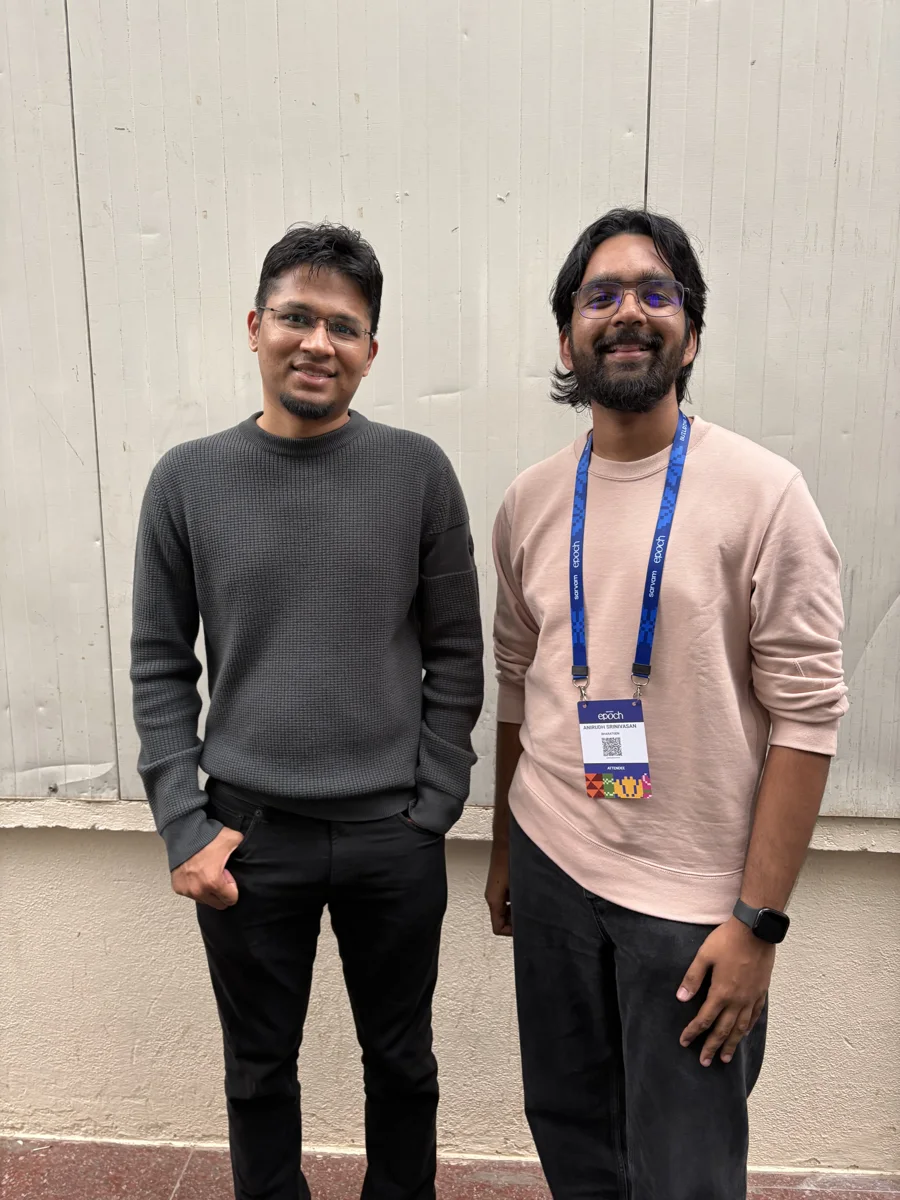
Of everyone I met, this was the conversation I most wanted. Devendra was on the continual-learning panel, and he has led multimodal model teams at some of the frontier labs. He was part of the founding team at Mistral AI, where he worked on Mistral 7B and led the multimodal research team behind Pixtral 12B and Pixtral Large. He then joined the founding team at Thinking Machines Lab, where he worked on Tinker, the training API he mentioned on the panel, and later moved to xAI. Before that he was a research scientist at Facebook AI Research. His own page is devendrachaplot.github.io.
I told him about my role at BharatGen, where I lead the vision-language models team. We talked about a lot: how to experiment quickly, how to find a training recipe, why custom infrastructure matters, and what to do with a career. Thank you, Devendra, for giving me 15 minutes of one-on-one time! Here are my questions, in the order I remember asking them.
How do you trust small-scale experiments when some capabilities only emerge at scale?
Scaling laws. Run the experiment at several small sizes, draw the curve, and see what happens as you move along it.
I asked it this way: we cannot run every experiment at full scale, so we run them small. What if a result does not carry over to the larger scale? Some capabilities only emerge at a certain size, so how are these decisions taken?
Devendra: His answer was about scaling laws. You do not take one small run on trust. You run the experiment at a few small sizes, draw the curve, and then see what happens as you move along it.
In more detail (my elaboration, not from the conversation). The decision is not “does the new recipe win at small scale?” It is “what does the gap between the two recipes do as the model grows?”
- Train both recipes at several sizes, and plot loss against compute on log axes. A clean power law lets you extrapolate. If the gap holds or widens, the recipe is worth scaling. If the curves converge or cross, it is a small-scale artefact.
- The method works at the frontier. The GPT-4 report says the final loss was predicted from runs that used a thousandth of the compute. Chinchilla and the earlier scaling-law study are how the field learned to split a budget between parameters and tokens.
- Emergence is the hard case. Wei et al. showed benchmark scores that jump at a certain size. Schaeffer et al. argue many of those jumps come from the metric, because accuracy is all-or-nothing, and that the same models improve smoothly when you measure likelihood. This is why the Llama 3 paper predicts benchmark accuracy in two steps: compute to the loss on the correct answer, then that loss to accuracy.
- So the practical rule is to track a smooth proxy, keep a ladder of sizes, and validate each prediction with one larger run before committing the full budget.
Sources: GPT-4 report · Chinchilla · Scaling laws for neural language models · Emergent abilities (Wei et al.) · Are emergent abilities a mirage? (Schaeffer et al.) · Llama 3
There are too many knobs. How do you change only the things that matter, and is that not too many experiments anyway?
The same answer. Draw the curve. A knob that matters moves it, and one that does not will not.
Devendra: It is the same answer. Draw the curve and look at what happens. A knob that matters moves the curve, and one that does not will not.
In more detail (my elaboration, not from the conversation). The curve is also how you prune the search. Sweep a knob once at small scale to see whether it shifts the curve or only adds noise, and drop the ones that do nothing. For the settings that are known to transfer, such as learning rate and initialisation under μP, tune on a small proxy and reuse the result at the large size. Save the expensive runs for the questions that the curve cannot answer, like data mixture and architecture.
How do scaling laws work for a VLM, when it starts from a pretrained LLM and we cannot find an LLM at every size?
Use the sizes that exist, make the size you need, build your own LLM ladder, or skip the initialisation and train natively.
This one I took away to understand properly. The usual recipe is to start from a pretrained LLM, connect a vision encoder, and then train end to end. The question is what you do when the size you want does not exist.
Background (from the literature, not from the conversation).
- Use the sizes that exist. Model families ship at several sizes, so the law is often fitted along those discrete points. The encoder is a separate, much smaller axis. Pixtral 12B, for example, pairs a 400M-parameter vision encoder trained from scratch with a 12B decoder.
- Make the size you need. Pruning plus distillation from a bigger parent gives several smaller models from one run. The Minitron work does this with far less training data than training each size from scratch.
- Train your own LLM ladder first. A team with its own LLM stack can pretrain the sizes it needs, then add vision to each. That is the benefit of owning the base model.
- Skip the initialisation. Train a native multimodal model from scratch with early fusion, as in Chameleon. A study of 457 such models found no inherent advantage for late fusion, with early fusion doing better at smaller sizes and being cheaper to train. Adding a mixture of experts helped too. This costs more compute than reusing an LLM, but every size is on the table.
- What the fitted curve is about. When the LLM is initialised, the language ability is already paid for. The curve is then mostly about the multimodal data, the stage (align the connector, train everything, fine-tune) and the encoder, and less about parameter count. This part is my own reasoning, so treat it as a hypothesis.
Sources: Pixtral 12B · Minitron: pruning and distillation · Chameleon · Scaling laws for native multimodal models
Should I do a PhD, and what should I focus on?
For research roles, yes. But it is not the degree that matters. It is the ability to sit on a problem and solve it.
Devendra: For research roles, yes. But it is not the degree that matters. It is the ability to sit on a problem and solve it, and that is what you learn. The PhD is where most people get that practice.
My reading. The question becomes less “PhD or not?” and more “am I getting long, hard problems to stay with until they give?”
Manish Gupta
Manish was on the panel too, and it was his idea from the panel, fusing models, that I wanted to push on.
Could model fusion work for continual learning, with many agents or robots pooling their experience into one brain?
A good question, and it could possibly be used for that.
I asked it like this: say many agents are interacting with the real world, as in physical intelligence. Could all the skills and experience of the different agents or robots be consolidated into one big brain through a similar mechanism?
Manish Gupta: He said it was a good question, and that it could possibly be used for that.
Background (not from the conversation). The idea he raised on the panel is CALM, from his team. It keeps two models frozen, an anchor and a specialist, and trains only a small set of cross-attention layers between them, using a little data. The old abilities stay intact, which is what you want when the worry is catastrophic forgetting.
Open questions I am left with. If each robot's experience became a small module, composing them would not overwrite the others. But a single brain still needs the cost of running many composed models to stay bounded, and a way to settle conflicts when two agents learned opposite lessons. I did not get an answer on these, and I do not think anyone has one yet.
Sources: CALM: LLM augmented LLMs
Krishna, from the vision team
His talk, on Vision 2.0, is covered in Talk 3.
What has been the hardest case for the vision models so far?
Among the languages, Odia was not easy.
Krishna: Among the languages, Odia (the language of Odisha) was not easy. Custom data had to be added for it.
How do you source multilingual data?
A lot of it is synthetic data generation.
Krishna: A lot of it is synthetic data generation.
Alex, who leads text to speech on the speech team
His talk is covered in Talk 4, including the special tokens that control emotion.
How do you mix languages in the training data?
You do not need equal amounts of everything. Languages transfer to each other, and what you want can be mixed in and will emerge.
Alex: You do not need equal amounts of everything. There is some transfer learning across languages. You also do not need to pretrain with everything up front: whatever you want in the model can be mixed in, and it will emerge. The work is then to find the right ratio, and you need not worry about the earlier stages of training.
Non-trivial. Equal shares per language is the obvious plan, and it is not the one he described. Transfer between languages means a language does not need as much of its own data, and the mixture ratio becomes the thing to tune. Read this next to Devendra’s point on the panel, that adding a capability can make a model regress on old ones, so you keep training on the old data. The two answers are about the same knob, the data mixture, and neither treats it as fixed.
Is using special tokens to carry emotion in text to speech new, or already common in the community?
Already common. Open and commercial models have shipped inline tags for laughs, sighs and moods since 2023. What is worth noting in Bulbul V4 is how the tags are used on one line.
This one is my own clarification, so the answer is from the literature and not from Alex.
Existing practice (from the projects’ own pages).
| System | Tags it documents | What they do |
|---|---|---|
| Bark (Suno, April 2023) | [laughter], [laughs], [sighs], [gasps], [clears throat], [music] | Non-speech sounds from text cues. Capital letters give emphasis, and [MAN] or [WOMAN] nudge the voice. |
| Dia (Nari Labs) | (laughs), (sighs), (coughs), (gasps) and many more | Nonverbal sounds in a dialogue. Its page advises using them sparingly. |
| Orpheus TTS (Canopy Labs) | <laugh>, <sigh>, <chuckle>, <gasp> and others | Emotive sounds on the fine-tuned production models. |
| Eleven v3 (ElevenLabs) | [sad], [angry], [whispers], [sighs], [laughs] | Bracketed cues read as performance direction. They shape emotion, pacing and delivery, and sit before the text they affect. |
What the Bulbul V4 slide shows. It uses the same family of ideas, with a few details worth noting: angle-bracket mood tags (<happy>, <sad>), a paired [emphasis] span around a single word, and event tokens ([LAUGH], [SIGH]), all in one sentence. The point of the demo was changing mood inside the line, from happy to sad on the last clause. The talk did not present the tags as an invention, and it gave no benchmark, so I cannot say how it compares with the systems above. The claim that matters is that it works across many Indian languages, which I could not check against the other systems.
Sources: Bark · Dia · Orpheus TTS · Eleven v3 audio tags
A thread through all of these conversations, and through the talks: the harness adds a lot on top of the model. The robustness of a system comes from heavy investment there.
The non-trivial ideas, in one place
The same highlights as the gem callouts inside each section, gathered here. Each one is a point that I would not have guessed from the headline of the talk. Tap one to go to where it came from.
- The moat is judgement, not an appWhat Sarvam says it owns is the judgement from training models for years. That is why its harness knows where a model needs load-bearing help and where it does not.
- Async RL has a second bill: weight syncOverlapping generation and training removes idle GPUs. But every step still ships weights from trainer to generators. LoRA shrinks that to something a network can carry, so one choice fixes both.
- Diarisation inside the encoderA pipeline cuts the audio into pieces before transcribing, so it loses the overlap. Sarvam combines diarisation and recognition in one model, with an encoder biased toward speakers, to keep it.
- Refusing to act is the real agent testWhether a model stops and asks when a request is ambiguous came from production logs, which is why Sarvam built its own benchmark.
- The agent reads and drills down, instead of receiving top-kAn agent that browses a knowledge base like a file system beats vector retrieval. The largest jump on the slide is OfficeQA Pro, from 34% to 52%.
- Open models cannot tell when they are doneSarvam did not wait for a better model. It split goal mode into planner, worker and verifier, so the check is made by an agent that did not do the work.
- Self-improving agents are evals running in productionDefine success, read thousands of conversations, test variants, keep the winner, and keep a human approval at the end.
- Credentials never enter the sandboxThe agent platform is sold on security and operations: a gateway guards everything run in the sandbox, and one agent can be shared with a team.
- Hardware needs software to scale a mixture of expertsHardware alone does not finish the job. The NVL72 rack and the Grace link solve bandwidth, but you still need software that uses them.
- Wide expert parallelism only wins when balancedGoing from EP 4 to 72 cuts MoE GEMM time from 275 to 75 microseconds. An imbalanced load spikes the all-to-all above 400, which is why hot experts are predicted and pre-loaded.
- Two scales make 4 bits usableA per-block E4M3 scale buys accuracy. A per-tensor FP32 scale buys back the range the first one gave up.
- The best serving config is a moving targetIt shifts with the arrival rate and with input and output lengths. A system tuned on a static load test is tuned for traffic that production never sends.
- A bounded field lets a small model do a big jobAn ontology built from samples gives the model a structure to work inside. The speaker said that is how a smaller model can match a bigger one, and a 30B model did the demo on one machine.
- Why the keyboard survivedIt was predictable, reliable and free. He argued no other interface solved reliability, and that a state-of-the-art speech model now does.
- ISRO built the applications firstIt learned to use space data, bought launches, and built the launcher once the demand and the skills existed. Capacity to use came before capacity to produce.
- AWS says it reinvented the network for trainingAWS argued that bulk-synchronous training needs the whole fabric in lockstep, so it built a protocol with no per-packet acknowledgement and failure detection under a second.
- Answering “who evaluates the evals?”Continuously. Evals clean the data, the cleaned data improves the evals. An eval that is too narrow or too over-specified trains a model for a task nobody has.
- Traces say what users asked, not what was rightThey are backward-looking exhaust. Code that compiles, or tests that pass, is not proof that the business problem was solved.
- Keep policy in the layer that does not moveShoehorning every exception into the harness makes a brittle system. Keep the coupling layer replaceable, and treat a weight update as a rare, reviewed event, because whoever can produce traces can teach the model.
- Fit the curve, then decideThe way to tell whether a result will survive at scale is to run it at several small sizes, fit the line and see whether the gap between recipes holds or closes. The metric matters: accuracy jumps, but likelihood is smooth.
- Equal shares per language is not the planLanguages transfer to each other, and what you want can be mixed in rather than pretrained up front. The ratio is the thing to find, and earlier stages need not be revisited.
- Could composed models become one brain?A way of fusing frozen models, built to avoid forgetting, might be a route to pooling what many robots learn. It was posed as a question and the answer was a maybe.
What I am taking away
The theme, as at the last event: India is not only using models. It is building the factory under them.